Moss (original) (raw)
Last Updated : 7 May, 2026
Mosses are small, non-vascular plants that belong to the division Bryophyta. They are commonly found growing in moist, shady places such as forest floors, rocks, walls, and tree trunks. Because they lack true roots, stems, and leaves, mosses are considered primitive plants and are often called the “amphibians of the plant kingdom”, as they require water for sexual reproduction.
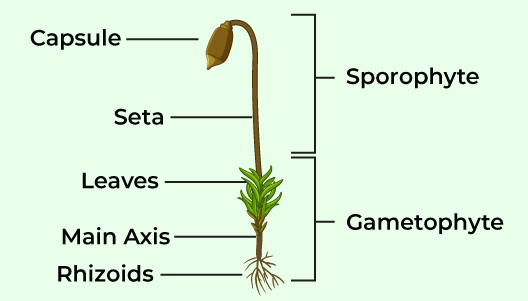
The plant body of mosses is mainly the gametophyte, which is the dominant and photosynthetic stage. It is usually leafy in appearance, with Rhizoids instead of true roots for anchorage, a short stem-like axis, and Leaf-like structures arranged spirally. Mosses do not have vascular tissues (xylem and phloem), so water and minerals move by diffusion.
**Characteristics of Moss
- Mosses are non-vascular plants belonging to the division Bryophyta, which also contains terrestrial plants.
- They are generally herbaceous (non-woody) plants that absorb water and nutrients via their leaves and trap carbon dioxide and sunlight to make food through photosynthesis. Except for Takakiopsida, no known moss develops mycorrhizae.
- They differ from vascular plants in that they lack water-bearing xylem tracheids or vessels.
- The most common step of the life cycle, as in liverworts and hornworts, is the development of haploid gametophytes. In contrast, in all vascular plants (seed plants and pteridophytes), the tendency favours the development of diploid sporophytes.
- Mosses lack blossoms and reproduce by spores rather than seeds.
- The stems of moss gametophytes can be straight or curved, simple or branching. Takakiopsida, Sphagnopsida, Andreaeopsida, and Andreaeobryopsida are early-diverging classes that either lack stomata or have pseudostomata that do not produce pores. Stomata have disappeared from the remaining classes more than 60 times.
- Their leaves are straightforward, frequently consisting of just one layer of cells with no internal air gaps and larger midribs. Although they lack true roots, they are anchored to their substrate by threadlike rhizoids. Through their rhizoids, mosses do not take up water or nutrients from their substrate. Their multicellular rhizoids allow them to be recognised from liverworts (Marchantiophyta or Hepaticae).
- Mosses are distinguished from polysporangiophytes, which are all vascular plants, by the sporangia or capsules that contain their spores, which are carried individually on long, unbranched stems.
- The short-lived spore-bearing sporophytes (i.e., the diploid multicellular generation) are often photosynthesis-capable but rely on the gametophyte for water and most or all of their nutrition.
- Additionally, unlike liverworts, the majority of mosses have spore-bearing capsules that expand and mature prior to their stalks elongating. This contrasts with the majority of mosses.
- Other characteristics are not always present in all mosses and liverworts, but the existence of a clearly distinct stem and straightforward, non-vascular leaves that are not grouped in three ranks all indicate that the plant is a moss.
**Types of Moss
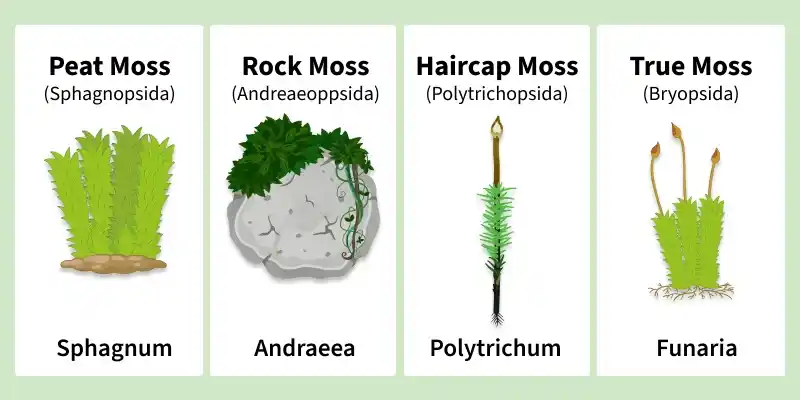
Moss are classified into four main types (classes) based on their structure and reproductive features:
**Peat moss (Sphagnopsida)
- Sphagnopsida, sometimes known as peat moss or sphagnum moss, is the first moss group.
- Numerous mosses that live in moist, bog-like regions and frequently form sizable, spongy clumps are part of this category.
- These mosses are frequently utilised as mulch to improve the soil, but can also make the soil acidic.
- Plants that thrive in acids, such as blueberries and cranberries, are often found growing alongside peat moss.
- One of the various types of plants that can decompose into peat is peat moss.
- One of the many uses for peat is as a fuel substitute for cooking and heating homes. In truth, peat has been gathered and utilised for this purpose for millennia in some regions of Europe.
**Andreaeopsida (Rock moss or Lantern moss)
- The following class, Andreaeopsida, is also known as lantern mosses or rock mosses and grows on rocks.
- Numerous species grow in tufts and are black in colour.
- The labels "rock" and "lantern" are appropriate, given that a portion of the plant might resemble a lantern and that it grows on rocks.
- Members of the Andreaeopsida can be found growing at high latitudes and in chilly environments.
**Polytrichopsida (Haircap Moss)
- The Polytrichopsida is a pioneering family of plants that can thrive in challenging environments, and they make up the third group of mosses we are showcasing.
- When there has been a disturbance, such as a flood or fire, pioneer species are the first to reappear in the region.
- This category has a wide range of species, including the tallest moss in the world, Dawsonia superba, as well as small and large species.
**Bryopsida (True Moss)
- The largest group of mosses, Bryopsida, which comprises 95% of all moss species.
- This group is diverse, yet they all share a toothed spore capsule as a common feature. The capsule merely serves to preserve the spore, which disperses and develops into new mosses.
- When the time comes for the spores to disperse, the "ring of teeth" on these spore capsules helps them do so.
**Life Cycle of Moss
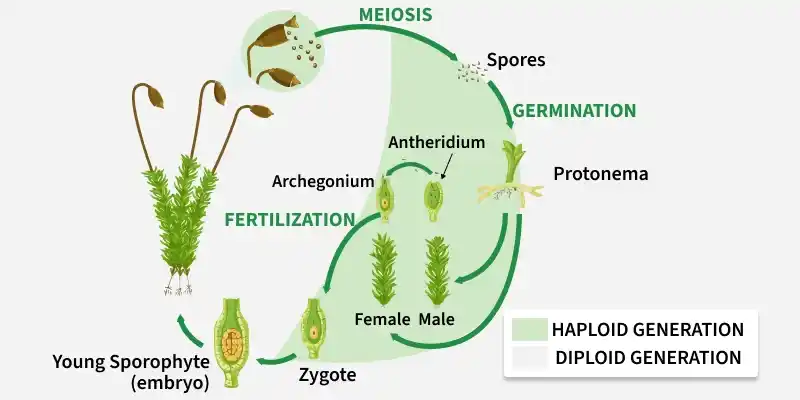
The haploid gametophyte and the diploid sporophyte, which is known as alternation of generations, alternate during the life cycle of mosses. The haploid gametes produced by the male and female gametophytes combine to form a zygote, which then develops into the diploid sporophyte. The haploid spores that the sporophyte generates later develop into the haploid gametophyte.
**Gametophyte
- The gametophyte generates the male and female sex organs at the terminals of structurally distinct stems and leaves.
- The female sex organ is referred to as an archegonium, and it is only one cell thick and bottle-shaped. Perichaetium leaves, modified leaves, shield them.
- The male sex organ, also known as the antheridia, is a small, club-shaped structure with stalks. They are shielded with perigonium, modified leaves.
- Antherozoids, which have a biflagellate shape and are released when the antheridium reaches maturity, move across the water when fertilising with an archegonium's egg.
- The second life phase of mosses, the sporophyte, results from the formation of a diploid zygote.
- The calyptra, which eventually divides to produce the archegonium, serves as a protective structure for the capsule in the sporophyte.
**Sporophyte
- A diploid sporophyte develops from a diploid zygote. A sporophyte is made up of a foot, a seta—a long stalk—and a capsule with an operculum on top.
- The sporophyte divides through mitosis and stays connected to the gametophyte like a parasite, depending on it for food and water.
- Spore-producing cells in the capsule go through meiosis to create haploid spores.
- Peristomes, which resemble teeth, are featured on the capsule that stops spores from slipping off when it is wet.
- The operculum and peristome fall off when the conditions are right, or when the spores are prepared to be spread, and the spores are then dispersed in the surrounding environment.
- Spores that land on moist, damp ground germinate to produce a protonema, which are filamentous structures that resemble threads. The gametophyte, which completes the life cycle, develops from the protophyte as a transitional structure.
Economic Importance of Moss
- Florists utilise them to decorate homes.
- Sphagnum was employed as a bandage during World War I because of its ability to absorb water.
- In the past, it was also employed as a fire extinguisher.
- Peat, a layer of moss that has been collected, is burned as fuel.