Nucleic Acid (original) (raw)
Last Updated : 1 Jun, 2026
Nucleic acids are important biomolecules present in all living organisms that store and transmit genetic information. They play a vital role in growth, reproduction, metabolism, and the functioning of cells. The two main types of nucleic acids are DNA and RNA, which together control hereditary characters and protein synthesis. These molecules were first discovered by Friedrich Miescher in 1869 and are considered the molecular basis of heredity.
Structure of Nucleic Acids
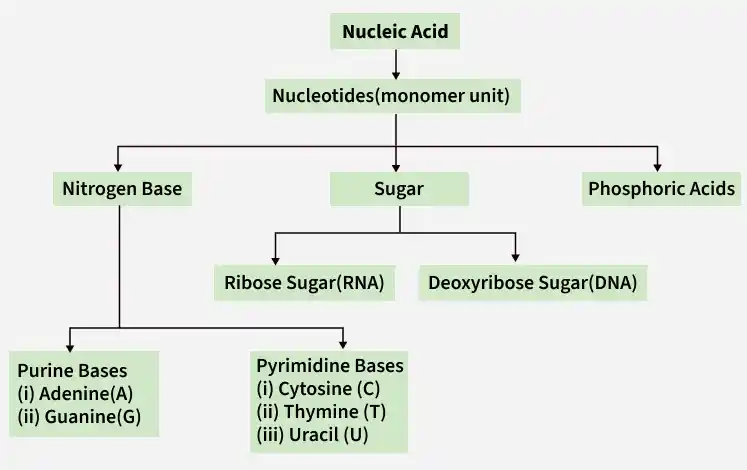
Nucleic acids are large macromolecules composed of repeating units called nucleotides. These nucleotides are connected to one another by phosphodiester bonds, forming long chains that make up DNA and RNA molecules. Each nucleotide consists of three important components:
1. Pentose Sugar
The sugar present in nucleic acids is a five-carbon sugar called pentose sugar. The type of sugar present differs between DNA and RNA. In DNA, the sugar is deoxyribose, while in RNA, the sugar is ribose. Deoxyribose lacks one oxygen atom compared to ribose, which makes DNA more stable than RNA. The sugar molecules form the structural backbone of nucleic acids and are linked together by phosphate groups.

2. Phosphate Group
The phosphate group is derived from phosphoric acid (H₃PO₄) and plays an important role in connecting nucleotides together. The phosphate group of one nucleotide forms a phosphodiester bond with the sugar of the next nucleotide, thereby creating a continuous sugar-phosphate backbone. This backbone provides stability and strength to nucleic acid molecules.

3. Nitrogenous Bases
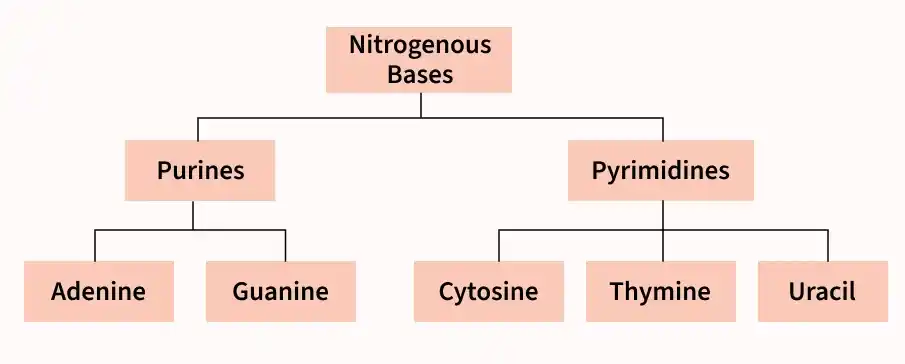
Nitrogenous bases are nitrogen-containing organic compounds that carry genetic information. These bases are classified into two groups known as purines and pyrimidines.
Purines
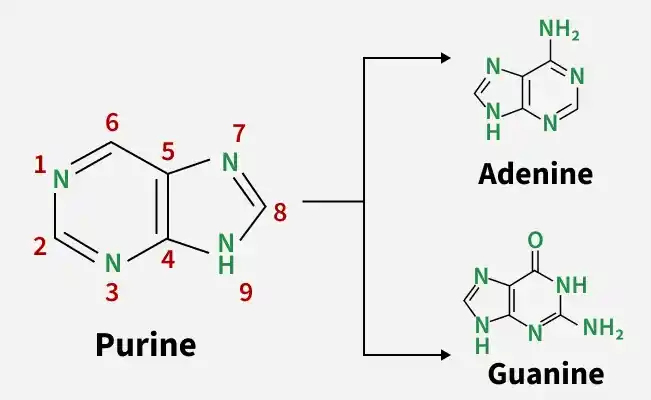
Purines are larger nitrogenous bases that possess a double-ring structure. Adenine and guanine are present in both DNA and RNA. The two purines present in nucleic acids are:
- **Adenine: Adenine is a purine nitrogenous base that pairs with thymine in DNA and with uracil in RNA through hydrogen bonds. Adenine plays an important role in the storage and transfer of genetic information. It is also present in important energy molecules such as ATP (adenosine triphosphate), which provides energy for cellular activities.
- **Guanine: Guanine is another purine base found in both DNA and RNA. It pairs with cytosine through three hydrogen bonds, which provides stability to nucleic acid structures. Guanine is essential for maintaining the structural integrity of DNA and RNA molecules.
Pyrimidines
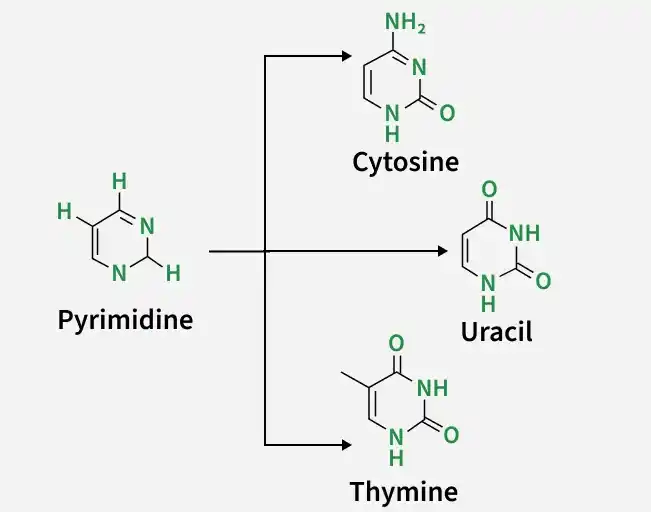
Pyrimidines are smaller nitrogenous bases having a single-ring structure. Thymine is found only in DNA, whereas uracil is found only in RNA. The pyrimidines found in nucleic acids are:
- **Cytosine: Cytosine is a pyrimidine base present in both DNA and RNA. It pairs with guanine through three hydrogen bonds. Cytosine plays an important role in storing and transmitting genetic information.
- **Thymine: Thymine is a pyrimidine base found only in DNA. It pairs with adenine through two hydrogen bonds. Thymine helps maintain the stability and proper structure of the DNA molecule.
- **Uracil: Uracil is a pyrimidine base found only in RNA and replaces thymine found in DNA. Uracil pairs with adenine during protein synthesis.
Types of Nucleic Acids
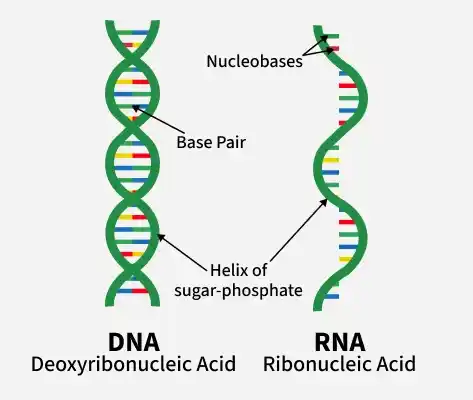
The two major types of nucleic acids found in living organisms are DNA (Deoxyribonucleic Acid) and RNA (Ribonucleic Acid). DNA acts as the genetic material in most organisms and stores hereditary information in the form of genes, while RNA helps in the expression of this genetic information and plays an essential role in protein synthesis.
DNA (Deoxyribonucleic Acid)
- DNA is the hereditary material present in almost all living organisms and contains the complete set of genetic instructions required for growth, development, metabolism, and reproduction.
- DNA is mainly located in the nucleus of eukaryotic cells, although small amounts are also found in mitochondria and chloroplasts. In prokaryotic organisms, DNA is present freely in the cytoplasm because they lack a true nucleus.
- DNA consists of two long polynucleotide strands that coil around each other to form a double-helix structure.
- The two strands run in opposite directions and are held together by hydrogen bonds between complementary nitrogenous bases.
- Adenine pairs with thymine through two hydrogen bonds, while guanine pairs with cytosine through three hydrogen bonds.
- The specific pairing of bases ensures accurate replication and transmission of genetic information.
- The double-helix model of DNA was proposed in 1953 by James Watson and Francis Crick with the help of X-ray diffraction studies performed by Rosalind Franklin. Their discovery revolutionised the field of genetics and molecular biology.
RNA (Ribonucleic Acid)
RNA is another important type of nucleic acid that plays a major role in protein synthesis and gene expression. Unlike DNA, RNA is generally single-stranded and contains ribose sugar instead of deoxyribose. RNA contains the nitrogenous bases adenine, guanine, cytosine, and uracil. RNA is synthesised from DNA during the process of transcription and helps convert genetic information into proteins required for cellular activities.
**Types of RNA
There are three major types of RNA:
- **Messenger RNA (mRNA): Messenger RNA carries genetic information from DNA in the nucleus to ribosomes in the cytoplasm, where proteins are synthesised. It acts as a template for protein synthesis.
- **Transfer RNA (tRNA): Transfer RNA transports amino acids to ribosomes during protein synthesis. It helps arrange amino acids in the correct sequence according to the genetic code.
- **Ribosomal RNA (rRNA): Ribosomal RNA forms the structural and functional component of ribosomes. It helps in the assembly of proteins during translation.
Importance of Nucleic Acids
- Nucleic acids are extremely important because they are responsible for storing, expressing, and transmitting genetic information in all living organisms.
- They control the synthesis of proteins, which are necessary for the structure, growth, repair, and functioning of cells and tissues.
- They regulate cellular metabolism, coordinate biological activities, and ensure the continuity of hereditary traits from one generation to another.
- Nucleic acids are also essential in modern biotechnology, medicine, and genetics. They are widely used in DNA fingerprinting, forensic science, genetic engineering, recombinant DNA technology, cloning, diagnosis of genetic diseases, and the development of vaccines and medicines.
- Knowledge of nucleic acids has greatly improved the understanding of heredity, evolution, and molecular biology.
- Thus, nucleic acids are indispensable biomolecules that serve as the foundation of life by controlling heredity, protein synthesis, cellular functions, and biological organisation in all living organisms.