PCR Full Form (original) (raw)
Last Updated : 27 Jun, 2025
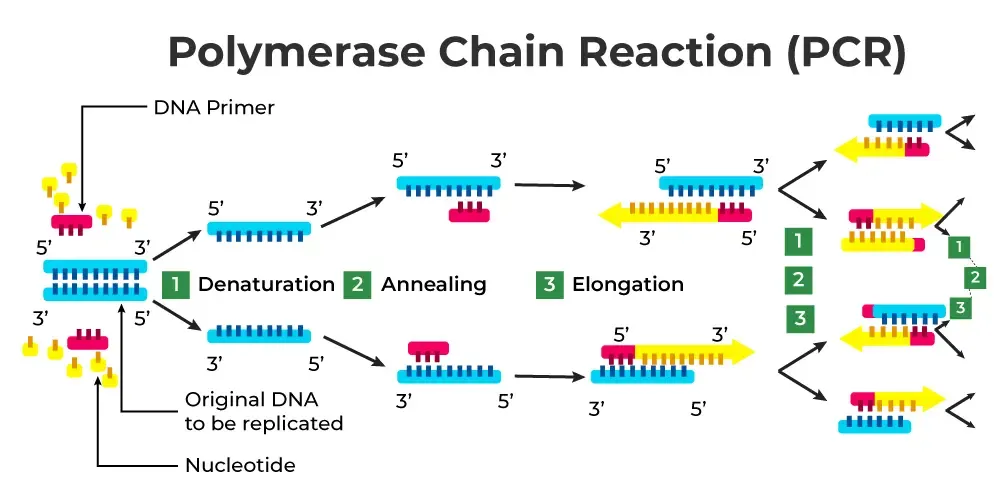
**Full Form of PCR is Polymerase Chain Reaction (PCR) is a powerful laboratory method used to make millions to billions of copies of a specific DNA sequence, allowing for in-depth analysis. This method was pioneered by American biochemist Kary Mullis" in 1983. The technique relies on synthetic DNA primers, short fragments designed to target a particular region of the genome, and a series of amplification cycles to replicate that segment. This rapid replication enables researchers to examine and study the DNA with precision.
History of PCR
The history of Polymerase Chain Reaction (PCR) is a game-changer in molecular biology, transforming the fields of genetics and biotechnology.
- **1970s: Before PCR, amplifying DNA was slow and difficult. While the discovery of restriction enzymes made it easier to cut DNA into smaller pieces, the real challenge was amplifying specific DNA sequences.
- **1983: **Kary Mullis, a biochemist at **Cetus Corporation, came up with the idea for PCR. He realized that by using synthetic DNA primers and the heat-resistant enzyme **Taq polymerase from _Thermus aquaticus, he could quickly replicate specific DNA sequences.
- **1983-1985: Mullis successfully demonstrated PCR in 1983, and by 1985, the first paper on the method was published. While it was initially met with doubt, the potential of PCR quickly became clear.
- **1980s-1990s: PCR became essential for molecular biology, genetics, and medical diagnostics. It allowed researchers to amplify tiny amounts of DNA, revolutionizing fields like DNA sequencing, forensics, and virus detection (like HIV).
- **1993: Kary Mullis won the **Nobel Prize in Chemistry for PCR, sharing it with **Michael Smith, who developed site-directed mutagenesis, another important technique in molecular biology.
- **2000s-Present: PCR continued to evolve with improvements like real-time PCR (qPCR), which allows scientists to monitor DNA amplification in real-time. Modern high-throughput PCR systems have made the technique faster and more widely accessible, playing a key role in fields like genomics, personalized medicine, and biotechnology.
Principle of PCR
The principle of PCR is based on the process of copying DNA using enzymes. In this technique, a specific segment of DNA is replicated by using short DNA sequences called primers. DNA polymerase is the enzyme responsible for building new DNA strands.
It works by adding nucleotides that are complementary to the template DNA. However, DNA polymerase can only extend a DNA strand from an existing 3'-OH group, which is where primers come in. These primers provide a starting point, allowing the polymerase to add nucleotides to the **3' end of the DNA strand, leading to the amplification of the target DNA segment.
**Also Read, Steps of Polymerase Chain Reaction
Advantages of PCR
Here are some of the key benefits of PCR that make it an essential tool in scientific research and diagnostics:
- PCR can amplify even tiny amounts of DNA, making it possible to work with very small samples.
- PCR can quickly produce millions of copies of a DNA segment in just a few hours.
- PCR targets and amplifies a specific DNA sequence, reducing the chances of errors or amplification of unwanted DNA.
- PCR can be used in many fields like medicine, forensics, research, and environmental science.
- Once set up, PCR is relatively inexpensive and requires minimal amounts of materials.
- The process is highly accurate, allowing for precise analysis of DNA.
- PCR can be automated, enabling large-scale testing and analysis with high efficiency.
Disadvantages of PCR
Here are some of the limitations of PCR that researchers need to consider when using the technique:
- PCR amplifies DNA so quickly, even small amounts of contamination can lead to false results.
- PCR requires prior knowledge of the DNA sequence you want to amplify, meaning it can't amplify unknown or unexpected sequences.
- The success of PCR depends heavily on designing effective primers, and poor primer design can lead to failed reactions or inaccurate results.
- Although DNA polymerase is accurate, errors can occur during the amplification process, leading to mutations or misinterpretation of the results.
- PCR works best with high-quality DNA, so degraded or damaged samples may not amplify properly.
- PCR is generally not effective for amplifying very long DNA sequences, as the process becomes less efficient with larger templates.
- While the PCR process itself is cost-effective, the equipment (such as thermal cyclers) and reagents can be costly.
Applications of Polymerase Chain Reaction
Polymerase chain reaction (PCR) has a wide range of applications including:
Forensic Analysis
- In forensic science, PCR is primarily used for DNA profiling.
- Even a small amount of DNA from a crime scene can be valuable for analysis and identification.
- PCR amplifies the DNA to provide sufficient material for further investigation
Genetic Testing and Diagnosis
- PCR is a valuable tool for identifying genetic diseases.
- It amplifies the specific DNA sequence associated with a genetic disorder.
- This helps in early diagnosis and treatment planning.
Infectious Disease Detection
- During COVID-19, PCR was a important technique for detecting the presence of pathogens like viruses and bacteria in clinical samples.
- PCR can also be used for diagnosing other diseases, including HIV and tuberculosis.
Paternity and Relationship Testing
- PCR-based DNA tests are used to determine paternity and other familial relationships with precision.
- The test compares specific genetic markers between individuals to establish the relationship.
Food Safety
- PCR is used for food safety and quality control.
- It efficiently detects pathogens or genetically modified organisms (GMOs) in food products.
Conclusion
Polymerase Chain Reaction (PCR) is a technique in molecular biology that amplifies specific DNA sequences, generating millions or billions of copies from a tiny starting sample. This process is essential for a range of applications in research, diagnostics, and forensics, enabling the analysis of DNA even when only small amounts are available.