Photosynthetic Pigments (original) (raw)
Last Updated : 1 Jun, 2026
Photosynthetic pigments are coloured substances present in plants, algae, and some bacteria that absorb light energy from the sun for photosynthesis. These pigments play a vital role in trapping solar energy and converting it into chemical energy required for food production. They are mainly found in the chloroplasts of plant cells and absorb different wavelengths of visible light.
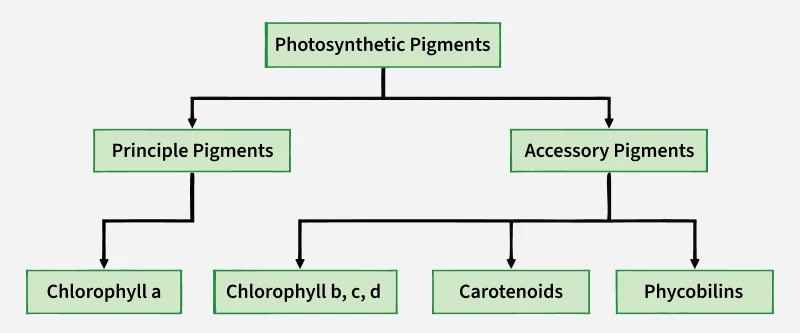
Types of Photosynthetic Pigments
Based on their role in photosynthesis, photosynthetic pigments are broadly classified into two major categories:
1. Principal Pigments
Principal pigments are the main pigments directly involved in the process of photosynthesis. These pigments actively participate in the light reactions and convert light energy into chemical energy.
Chlorophyll a
- Chlorophyll a is the primary and most important photosynthetic pigment present in all green plants, algae, and cyanobacteria.
- It is considered the chief pigment because it directly participates in the photochemical reactions of photosynthesis.
- Chlorophyll a mainly absorbs blue-violet and red wavelengths of light while reflecting green light, which gives plants their characteristic green colour.
- This pigment is present in the reaction centres of both Photosystem I and Photosystem II, where it plays a central role in initiating the light reaction.
- When chlorophyll a absorbs light energy, its electrons become excited and move to higher energy levels. These energised electrons are then transferred through a chain of electron carriers, leading to the formation of ATP and NADPH.
- These energy-rich compounds are later used in the synthesis of carbohydrates during the dark reaction of photosynthesis.
- Chlorophyll a is therefore regarded as the molecule that enables photosynthesis by transferring energised electrons to molecules involved in sugar production. Without chlorophyll a, photosynthesis would not be possible.
2. Accessory Pigments
Accessory pigments are pigments that assist chlorophyll a during photosynthesis. Although they do not directly participate in the photochemical reactions, they absorb light energy and transfer it to chlorophyll a. Accessory pigments include chlorophyll b, chlorophyll c, chlorophyll d, carotenoids, and phycobilins.
Chlorophyll b
- Chlorophyll b is an accessory pigment found mainly in green plants and green algae. It absorbs blue and red-orange wavelengths of light and transfers the absorbed energy to chlorophyll a.
- Chlorophyll b broadens the range of light absorption and increases the efficiency of photosynthesis, especially under low-light conditions.
- It appears yellowish-green in colour and helps plants utilise sunlight more effectively.
Chlorophyll c
- Chlorophyll c is present mainly in certain groups of algae, such as brown algae, diatoms, dinoflagellates, and photosynthetic members of Chromista.
- It is absent in higher green plants. This pigment acts as an accessory pigment by absorbing additional wavelengths of light and transferring the energy to chlorophyll a.
- Chlorophyll c helps marine algae survive efficiently in aquatic environments where light penetration differs from terrestrial habitats.
Chlorophyll d
- Chlorophyll d is a specialised accessory pigment found in red algae and some cyanobacteria. It absorbs far-red light, which is not effectively absorbed by chlorophyll a.
- This adaptation allows certain organisms to survive in deep-water habitats where far-red light is available.
- Chlorophyll d assists in capturing additional light energy and supports photosynthesis under special environmental conditions.
Carotenoids
- Carotenoids are yellow, orange, or red accessory pigments widely distributed in plants, algae, fruits, flowers, and some bacteria. These pigments absorb blue and green wavelengths of light and transfer the absorbed energy to chlorophyll a.
- Carotenoids are composed of long chains of carbon atoms linked with small carbon rings. Since they are insoluble in water, they remain associated with cell membranes.
- In addition to assisting in photosynthesis, carotenoids perform an important protective role by preventing photooxidative damage caused by excessive sunlight and reactive oxygen species.
**Types of Carotenoids
Carotenoids are divided into two major groups:
- **Carotene: Carotene is an orange-coloured pigment commonly found in carrots, pumpkins, mangoes, and green plants. It absorbs blue and green light and contributes to photosynthesis by transferring energy to chlorophyll.
- **Xanthophyll: Xanthophyll is a yellow-coloured pigment found in leaves, flowers, and fruits. It helps protect plants from excessive light by dissipating extra absorbed energy as heat. This process prevents damage to chlorophyll molecules and other cellular structures.
Phycobilins
- Phycobilins are water-soluble accessory pigments found mainly in cyanobacteria and red algae. These pigments are especially important in aquatic environments because they absorb wavelengths of light that penetrate deeper into water.
- Phycobilins are attached to proteins to form complexes known as phycobiliproteins. These pigments absorb light energy and transfer it efficiently to chlorophyll a during photosynthesis.
- An important property of phycobilins is fluorescence. They absorb light at one wavelength and emit light at another specific wavelength.
- Because of this highly specific fluorescence, phycobilins are also used as fluorescent markers or chemical tags in scientific research and biotechnology.
**Types of Phycobilins
The two major types of phycobilins are:
- **Phycoerythrin: Phycoerythrin is a red-coloured pigment found mainly in red algae. It absorbs green light efficiently and enables algae to perform photosynthesis in deeper aquatic regions where green light penetrates effectively.
- **Phycocyanin: Phycocyanin is a blue-coloured pigment commonly found in cyanobacteria. It absorbs orange and red wavelengths of light and transfers the absorbed energy to chlorophyll a.
Functions of Photosynthetic Pigments
- The primary function of photosynthetic pigments is to absorb sunlight required for photosynthesis.
- Accessory pigments transfer absorbed light energy to chlorophyll a, where photochemical reactions occur.
- Different pigments absorb different wavelengths of light, allowing plants to utilise a larger portion of the solar spectrum.
- Pigments such as carotenoids protect chlorophyll molecules and plant tissues from damage caused by excessive sunlight and oxidation.
- Pigments provide characteristic colours to leaves, flowers, fruits, algae, and other plant structures.
- Brightly coloured pigments help attract pollinators and seed-dispersing organisms.