Transpiration (original) (raw)
Last Updated : 19 Nov, 2025
Transpiration is the process by which plants release excess water as water vapour through their stomata, stems, or other plant parts. Water is essential for normal cell functioning, and this evaporation helps maintain the plant’s water balance. Transpiration mainly occurs through the stomata on the leaf surface.
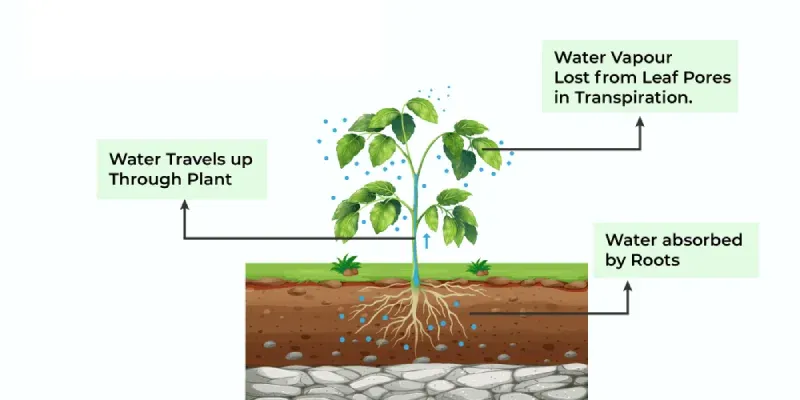
Types of Transpiration
There are mainly three types of transpiration that occur:
**1. Stomatal Transpiration
The process of loss of water through the stomata of leaves is known as Stomatal Transpiration.
- When the spongy mesophyll cells become filled with water, the water moves to the intercellular space, which lies just next to the mesophyll cells.
- When the intercellular space gets saturated with water vapour, they transfer the extra water vapour to the substomatal space, which is in direct contact with the stomata present on the lower epidermis. And thus the excess water moves out from the stomata. This is the whole mechanism of Stomatal Transpiration.
**2. Cuticular Transpiration
The process of loss of water through the cuticles of leaves is known as Cuticular Transpiration.
- Cuticular transpiration mostly takes place at night or when stomata are closed during dry conditions, and more water is transpired through the cuticles.
- Plants containing thin cuticles allow more cuticular transpiration.
**3. Lenticular Transpiration
The process of loss of water through lenticels of the stem is known as Lenticular Transpiration.
- It is also involved in gaseous exchange.
- Lenticel pores consist of loosely packed cells and thin-walled cells.
- Their cell shape is oval and spherical.
Factors Affecting Transpiration in Plants
The factors affecting the rate of transpiration are as follows:
1. Environment Factors
Some environmental factors affect transpiration:
- **Humidity: Higher humidity slows down transpiration, while lower humidity increases it. (Inversely proportional)
- Air Movement: Fast-moving air removes moist air around leaves and increases transpiration; still air reduces it. (Directly proportional)
- **Temperature: Higher temperature increases transpiration by reducing atmospheric humidity and speeding evaporation. (Directly proportional)
- **Light: More light keeps stomata open and raises temperature, both of which increase transpiration. (Directly proportional)
2. Cellular factors
Some cellular factors that affect the rate of transpiration are given below:
- **Surface Area of Leaf: Bigger leaves lose more water, so transpiration is higher. But per unit area, smaller leaves transpire more due to more stomata.
- **Water Availability: If roots get less water, leaves dehydrate and wilt, reducing transpiration.
- **Stomata: Open stomata increase transpiration; closed stomata decrease it.
- **Ascent of Sap: Water evaporating from leaves creates a pull (transpiration pull) that helps draw water upward through the plant.
Opening and Closing of Stomata
Stomata are present on the lower part of the leaf epidermis. A smaller number of stomata is seen on the upper part of the leaf. Stomata remain open in the daytime and closed during the night. The opening and closing of the stomata depend on the guard cells.

Characteristics of Stomata are:
- Stomata contain one pair of guard cells, and between the guard cells, an aperture is present.
- The aperture of the stomata is covered with the flexible inner layer of the guard cell.
- When the turgidity increases due to excessive water in the guard cell, it leads to the stomata opening. The inner layer of the guard cell becomes concave and forms a crescent shape. The pattern of the microfibrils also helps in the opening of the stomata.
- If the microfibril is radial, then the stomata open. When the water is lost, then the turgidity of the guard cell also decreases, and the stomata close.
Significance of Transpiration
Significance of transpiration is as follows:
- Transpiration is responsible for the cooling effect.
- Suction Force is experienced by plants during more transpiration.
- Plants get a proper distribution of minerals due to transpiration.
- Transpiration helps in maintaining the turgidity of the cells and thus helps in cell division.
Disadvantages of Transpiration
Even though transpiration is a very important process, it has a few drawbacks.
- **Wilting of leaves: Due to excessive transpiration, wilting and loss of turgidity are quite common, which in turn reduces photosynthesis and other metabolic processes.
- **Loss of energy: A lot of energy is lost during transpiration for absorption and conduction of water, as 98-99% of absorbed water is lost through transpiration.
- **Reduced Growth: Due to transpiration, the water availability inside the plant gets reduced, thus giving the plant shorter growth.