Cell Wall (original) (raw)
Last Updated : 24 Apr, 2026
A cell wallis a rigid, protective layer that surrounds the cell membrane of plant cells, fungi, and some prokaryotic cells. It provides structural support and protection to the cell. It serves as a filtration system as well as structural support and protection for the cell. Cell walls are absent in many eukaryotes, including animals.
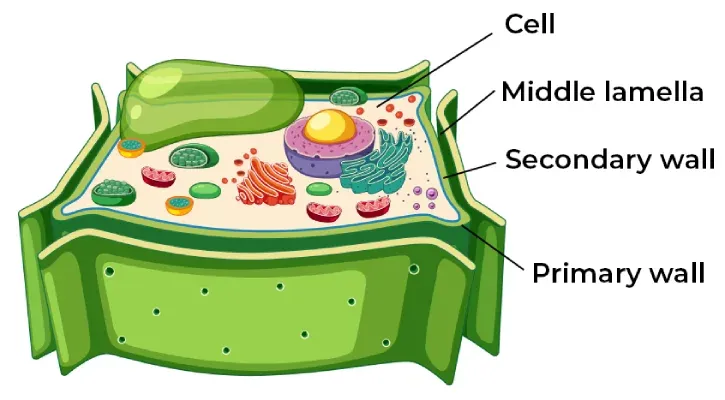
Structure of the Cell Wall
Plant cells must have strong enough tensile walls to withstand the internal osmotic pressures that come from the difference in solute concentration between the interior and exterior solutions, which can be many times higher than atmospheric pressure. Plant cell walls can range in thickness from 0.1 to several micrometres.
Layers of Cell Wall
Plant cell walls may have up to three strata or layers:
- **The primary cell wall: It is often a thin, extensible layer generated as the cell grows.
- **The secondary cell wall: After the cell has fully developed, a thick layer called the secondary cell wall is created inside the primary cell wall. Some cells have a secondary wall made of lignin that strengthens and waterproofs the wall, such as the conducting cells in the xylem.
- **The middle lamella: A stratum high in pectin is called the middle lamella. The middle lamella is a pectin-rich layer that lies between adjacent plant cells and helps in cell adhesion.

Composition of Cell Wall
The three main types of carbohydrates found in the primary cell wall are cellulose, hemicellulose, and pectin. The cellulose-hemicellulose network, which is embedded in the pectin matrix, is made up of cellulose microfibrils connected by hemicellulosic tethers.
- Xyloglucan is the most prevalent hemicellulose found in primary cell walls.
- Expansins are proteins that loosen the cell wall by weakening bonds between its components, allowing cell expansion.
- The cuticle is a waxy layer secreted by epidermal cells that covers the outer surface of the cell wall.

A large variety of extra substances found in secondary cell walls changes their mechanical and permeability characteristics. The principal polymers that comprise secondary cell walls are as follows:
- 35–50% cellulose
- 20–35% of the hemicellulose is xylan.
- In the cell wall's gaps between the components of cellulose, hemicellulose, and pectin, lignin, a complex phenolic polymer that ranges in concentration from 10 to 25%, add rigidity and reduces water permeability.
Characteristics of the Cell Wall
- A cell wall is a structural layer that lies next to the cell membrane and serves primarily to give the cell strength and protection against mechanical stress.
- Its primary role is to offer the cell rigidity, durability, and resistance against stress from mechanical forces.
- Plants, fungi, protists, particularly moulds and algae, and the majority of bacteria, except mycoplasma and L-form bacteria, are examples of creatures with cell walls.
- It is absent in animal cells but present in many protists like algae
- Chitin, glucan, and protein compose the cell wall of fungi.
Evolution of the Cell Wall
- The cellulose cell walls of the photosynthetic eukaryotes are one of the key factors in the development of multicellularity, territorialization, and vascularisation.
- Because of endosymbiosis, the CesA cellulose synthase originated in cyanobacteria and was later transported into brown algae and oomycetes through secondary endosymbiosis events.
- Later, as plants developed different genes from CesA, the Csl (cellulose synthase-like) family of proteins and other Ces proteins were among them.
- In conjunction with other glycosyltransferases (GT), they made it possible to create more intricate chemical structures.
Function of the Cell Wall
The cell wall is an essential part of every plant cell and performs a number of important functions. Among the most important cell wall functions are the following:
- Plant cell walls give plants a clear shape, strength, and rigidity.
- Also, it offers protection against mechanical stress and physical shock.
- It prevents excessive expansion due to osmotic pressure.
- It helps regulate water movement and prevent excessive water loss.
- Between the internal cellular components and the outside world, it serves as a barrier.