Morphology of Flowering Plants (original) (raw)
Last Updated : 29 Jan, 2026
Morphology is the study of the form and structure of organisms and their parts. The morphology of flowering plants refers to their physical structure, including roots, stems, leaves, flowers, and reproductive organs. Understanding the morphology of flowering plants is essential as it provides insights into plant identification, classification, and function. Flowering plants, also known as angiosperms, are a diverse group of plants.

There are approximately 300,000 species of flowering plants on Earth. Flowering plants are characterised by the presence of flowers and seeds enclosed within a fruit. They represent the most abundant and widespread group of plants on Earth. Flowering plants encompass a diverse range of species, from small herbs to tall trees.
**Root of Flowering Plants
A root is the underground part of a plant that typically grows downward into the soil. The root arises from the radicle. Its main functions are to anchor the plant, absorb water and nutrients from the soil, and store food reserves. The different branches of the root form the root system, which varies in monocots and dicots.
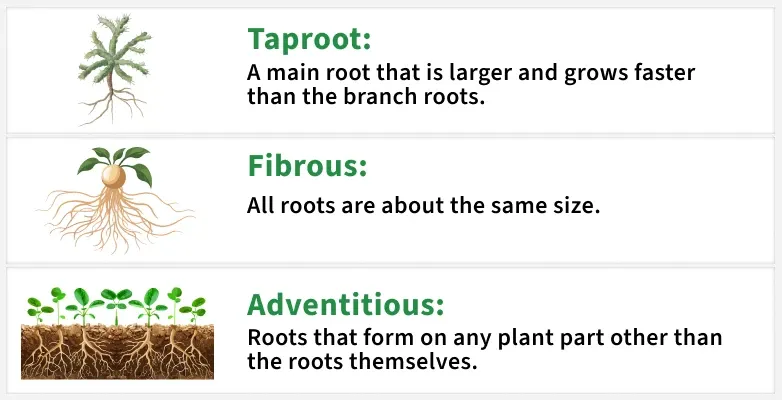
The different types of root systems are:
- **Taproot System: This type of root system is commonly seen in dicots. The taproot system is characterised by a main root, known as the taproot, which grows vertically downward. It gives rise to smaller lateral roots. These roots provide structural support and help in the absorption of water and nutrients from deep within the soil. Examples of plants with a taproot system are carrot, mustard, and mango.
- **Fibrous Root System: The fibrous root system is characterised by a network of thin, branching roots that spread out close to the soil surface. This type of root system is typical in monocotyledonous plants. Fibrous roots provide excellent anchorage and efficient absorption of water and nutrients from the soil. Examples of plants with a fibrous root system are grasses and cereals.
- **Adventitious Root System: An adventitious root system consists of roots that arise from any part of the plant other than the radicle. These roots may develop from stems, leaves, or even other roots, and they serve functions such as support, anchorage, and nutrient uptake. Adventitious roots are common in plants like ivy, mangroves, and maize.
**Regions of Root
- The root is covered with a root apex, also known as a root cap, which protects the tender apex of the root as it grows through the soil.
- The region of meristematic activity, although very small, repeatedly divides and forms the root enlargement, causing the root to grow in different directions.
- Another region is the root elongation zone, responsible for increasing the root's length.
- The region of maturation, located at the base of the root in the ground, contains hair-like structures called root hairs, which aid in the absorption of water from the soil.

**Modification of Root
In some plants, roots change their structure and shape to perform functions other than water and mineral absorption. Roots can develop from various regions of the plant, including branches, and may grow upwards into the soil. Additionally, some roots, such as carrot, turnip, and sweet potato, serve as storage organs. Also, roots play a role in respiration through various mechanisms.
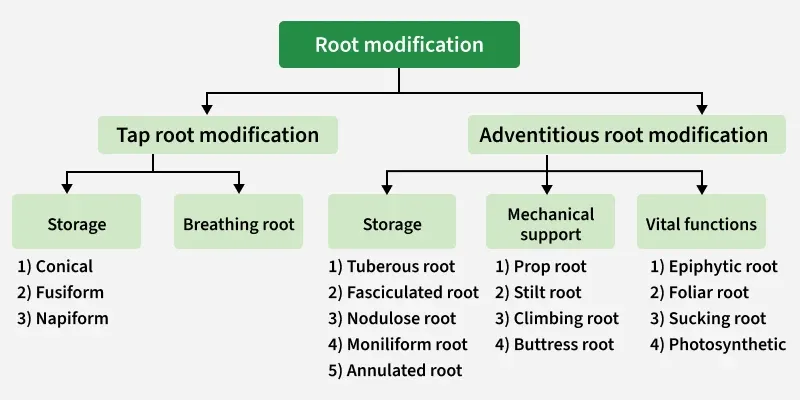
To perform these functions Roots are modified into different forms like:
- **Storage roots: These roots are modified to store food. Eg: Carrot, Turnip, adventitious roots of Sweet Potato, and Asparagus.
- **Prop roots: These hanging structures are meant to provide support to the plant. Eg: Banyan.
- **Stilt roots: These are supporting roots coming out of the lower nodes of the stem. Eg: Maize, Sugarcane.
- **Pneumatophores: These roots grow in swampy areas and come out of the soil vertically upwards to aid in the respiration process. Eg: Rhizophora.
Function of Root
- Anchors the plant in the soil
- Absorbs water and minerals from the soil
- Stores food reserves
- Facilitates the uptake of nutrients through root hairs
Stem of Flowering Plants
The shoot system of a plant refers to the above-ground part of the plant that is responsible for photosynthesis, reproduction, and support. It includes stems, leaves, flowers, and fruits. The shoot system plays a crucial role in the plant's growth, development, and interaction with the environment. The shoot arises from the plumule of the seed.

The stem is the ascending part of the axis bearing branches, leaves, flowers, and fruits. They have the nodes and internodes. The region where the leaves are born is called nodes and the internodes are present between the nodes. The stem bears buds which may be terminal or axillary. The stem is generally green; later, it becomes wood, and it turns dark brown.
**Modification of Stem
Modification of stems refers to the changes in structure and function that occur in certain plants to adapt to specific environmental conditions or to perform certain tasks. The modified stems help to provide protection, vegetative propagation, and other functions which helps plant survive.

To perform these functions Stems are modified into different forms like:
**Underground Stem Modification
Underground stems are, as their name suggests, stems that emerge from the ground. Most of these stems aid in reproduction, permanency, and the storage of food, water, or minerals. These include, but are not limited to, corms, rhizomes, bulbs, and tubers.
- **Rhizome: Ginger and turmeric
- **Bulb Modification: Onions and garlic
- **Corm: Crocus and Colocasia.
- **Tuber: Potatoes
**Aerial Stem Modifications
The aerial stem is a stem that grows vertically or erect above the earth. The two types of aerial stems are reduced stems and erect stems. Aerial stem modifications serve a variety of unique purposes, including climbing, food storage, plant protection, and vegetative propagation. The aerial stem can be modified in 6 different ways.
- **Stem Tendrils: Cucurbita, Grapevine, Passiflora
- **Thorns: Duranta and Citrus
- **Phylloclade: Euphorbia, coccoloba, etc.
- **Cladophylls: Ruscus, asparagus
**Subaerial Stem Modification
In a stem of this kind, a portion of the stem remains underground while the other portion develops aerial roots. On the stem, a dormant bud becomes active and forms lateral branches for vegetative reproduction.
- **Runner: lawn grass and wood sorrel.
- **Sucker: Chrysanthemum and mentha
- **Stolon: Jasmine and Colocasia
- **Offset: Pistia, eichhornia,
Functions of Stem
- Supports the plant and holds up leaves, flowers, and fruits
- Transports water, nutrients, and sugars between roots and leaves
- Stores food reserves for future use
- Produces new shoots and branches through vegetative propagation
- Provides structural support for climbing plants
**Leaves of Flowering Plants
The leaf is a flattened structure borne on the stem. Leaves develop at the node and bear a bud in their axils. Later, the axillary bud develops into a branch. Leaves originate from the shoot apical meristem and are arranged in an acropetal order, making them the most important vegetative organs for photosynthesis. A typical leaf consists of three main parts: the leaf base, petiole, and lamina. The leaf attaches to the stem through the leaf base and may bear two lateral small leaf-like structures called stipules.
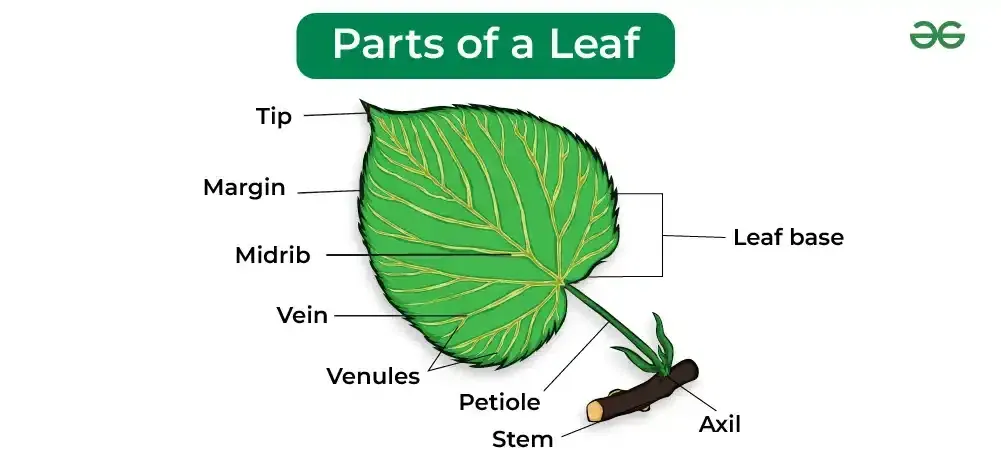
Structure of Leaves
Mainly, plants have leaf bases, petioles, and lamina; all these together form the main parts of the Leaves.
- **Leaf Base: The part at which the leaf attaches to the stem, leaf-like,is called the leaf base. It has two leaf-like structure which are called stipules.
- **Petiole: It is a thin, long stalk that joins the leaf blade to the stem, and it helps hold the blade to the light.
- **Lamina: It is the green-coloured flat surface of the leaf, which is also known as the leaf blade. The surface of the lamina is divided into two, which are called the midrib. Lamina also consists of small, branched veins and veinlets. Veins and veinlets help in the transportation of water and minerals, and also provide the rigidity to the lamina.
Venation of leaves
The arrangement of the leaves to the veins and veinlets in the lamina of the leaf is called venation. When there is a network-like structure is called reticulate venation, and when the leaves are arranged in equal or one on each side of veins and veinlets, it is called parallel venation. Some trees have reticulate venation, and some have parallel venation. Reticulate venation mostly shows on the dicot plants, and parallel venation shows on the monocot plants.
**Phyllotaxy
The arrangement of leaves on a branch's stem is commonly referred to as phyllotaxy.
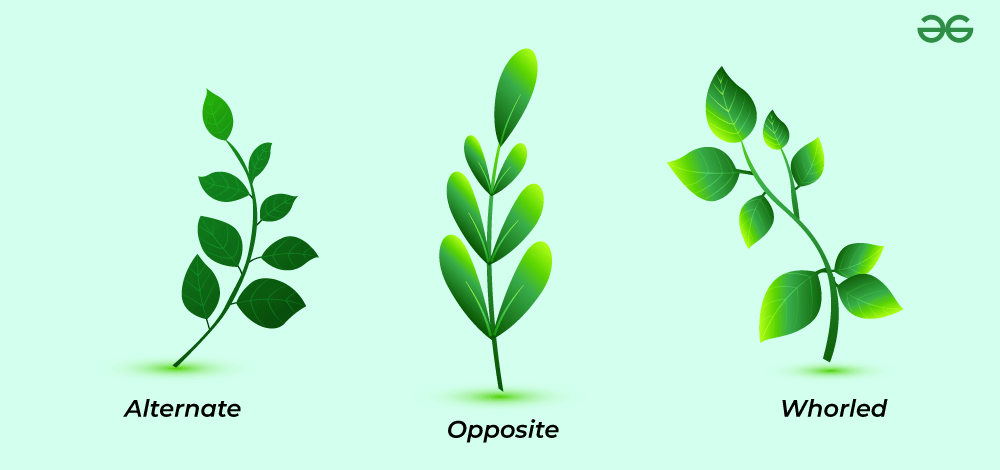
Phyllotaxy can be classified into three categories:
- **Opposite Phyllotaxy: Two leaves develop from the stem at the same node, on opposite sides of the stem, in an opposite leaf arrangement, or opposite phyllotaxy. Guava, Calotropis, olive leaves, mint, etc., are a few examples.
- **Alternative/Spiral Phyllotaxy: Each leaf develops at a distinct node on the stem in an alternative (spiral) pattern of phyllotaxy. Sunflower, peepal, mustard, etc., are a few examples.
- **Whorled Phyllotaxy: When numerous leaves appear to emerge from the same node on a stem, this is known as whorled phyllotaxy. Examples include Tulsi, Sergula, Alstonia, etc.
Types of Leaves
There are two main types of leaves: simple leaves and compound leaves.
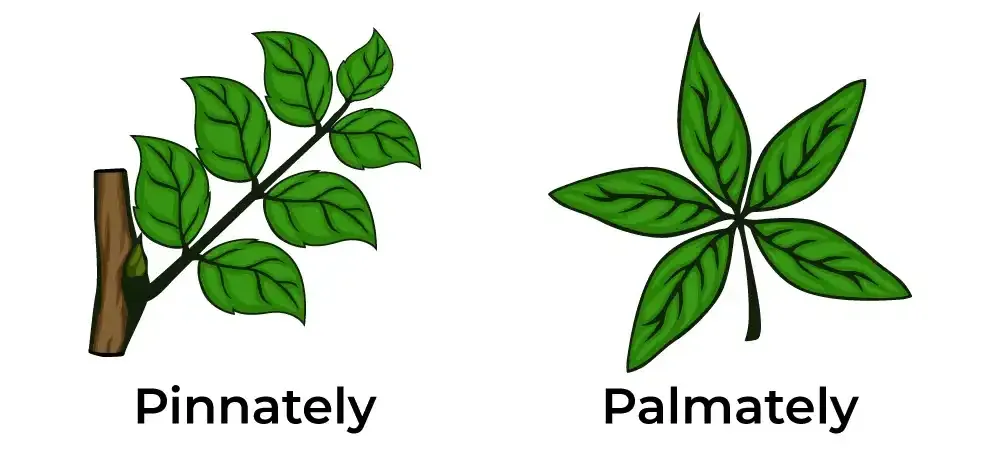
The difference between them is given below:
| Feature | Simple Leaves | Compound Leaves |
|---|---|---|
| Structure | Consists of a single leaf blade | Consists of multiple leaflets attached to a common petiole |
| Leaflet Presence | Not present | Present |
| Leaf Arrangement | Alternate, opposite, or whorled | Usually arranged in a pinnate or palmate pattern |
| Complexity | Less complex | More complex |
| Examples | Mango, guava, rose | Rosewood, mimosa, honeylocust |
Modification of Leaves
Mainly Leaves perform photosynthesis, but they also participate in different roles like storage of food, support, defence, etc.
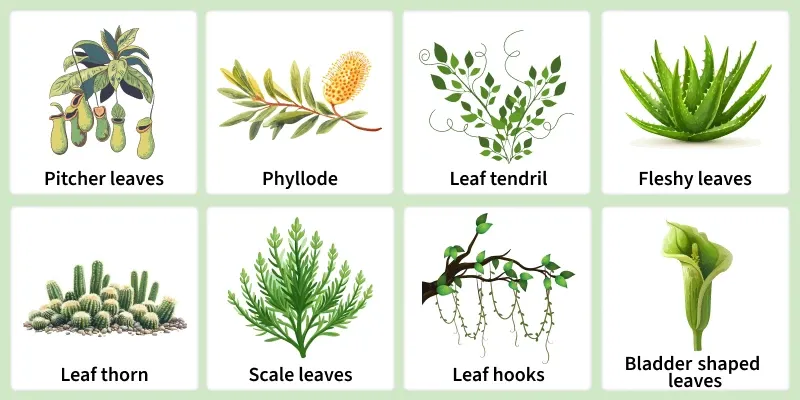
To perform these functions Leaves are modified into different forms like:
- **Tendrils: When Leaves are modified into wiry structures, then these are called as **tendrils; they help the climbers to climb.
- **Thorns: When Leaves are converted into pointed structure and, these structures protect the plant from herbivores.
- **Phyllode: When the petiole is modified into extended green structures that carry out photosynthesis.
- **Fleshy leaves: Due to the storage of water and food, these Leaves are become fleshy.
- **Leaf Hooks: Leaves modified into hooks to help the plant climb and support itself, and are useful for climbing plants that need support.
- **Scale Leaves: Scale leaves are small, dry, thin, and membranous leaves and Protect buds or underground stems and reduce water loss.
- **Leaf bladders: Leaves of some aquatic plants are modified into leaf bladders, which trap the small insects.
- **Leaf pitcher: Leaf lamina is modified into a lid which is called a **pitcher, and this traps the insects and fulfill nitrogen requirement.
**The Flower
The flower is the reproductive unit in angiosperms, comprising four distinct whorls arranged successively on the end of the pedicle known as the thalamus. These whorls are the calyx, corolla, androecium, and gynoecium. While the calyx and corolla serve as accessory organs, the androecium and gynoecium function as reproductive organs. In certain flowers like the lily, the calyx and corolla are distinct and collectively referred to as the perianth.

It has four main whorls:
- **Calyx (sepals): green, tiny leaf-like structures that protect the flower in the bud stage.
- **Corolla (petals): large, attractive, colourful, and have a pleasant odour. They are meant for attracting insects and animals for pollination purposes.
- **Gynoecium (pistils/carpels): It has three parts. The broad stigma serves as a landing platform for the pollen grains, the style, which is a fine tube aiding in the transfer of pollens to the ovary and the ovary, which is the female reproductive organ of the flower and produces the female gamete known as the egg.
- **Androecium (stamens): constitutes the male reproductive whorl of the flower and has two parts. The pollen-producing anther is at the tip of a thin, thread-like filament. Having learned the parts of flowers, let's now learn how flowers are arranged on the plant.
Classification of Flowers
Flowers are classified based on symmetry as actinomorphic or zygomorphic, and based on reproductive organs as bisexual or unisexual. They also differ in ovary position, being hypogynous (superior), perigynous (half-superior), or epigynous (inferior).
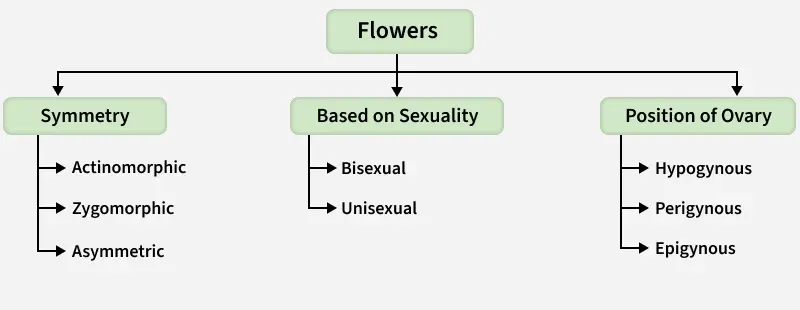
**1. Based on Symmetry
Flower symmetry refers to how a flower can be divided into equal halves. It reflects uniformity in shape and arrangement of floral parts.
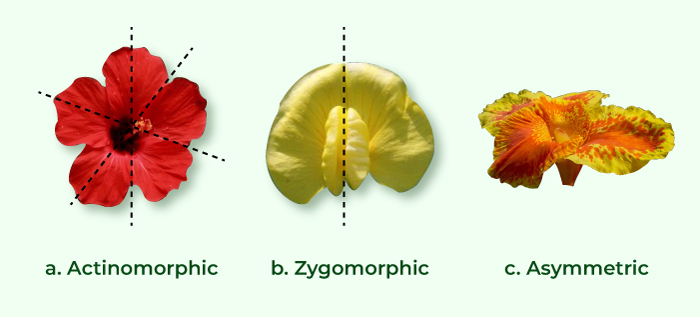
Based on symmetry, flowers are of two types:
- **Actinomorphic flowers can be divided into two equal radial halves in any plane passing through the centre, such as the chilli flower.
- **Zygomorphic flowers can only be divided into two similar halves in one particular vertical plane, exemplified by the bean flower. Floral appendages may occur in multiples of 3, 4, or 5, resulting in trimerous, tetramerous, or pentamerous configurations, respectively.
**2. Based on the Sexuality of the Flower
Flowers may vary in the type of reproductive structures they bear. Some contain both male and female organs, while others carry only one.
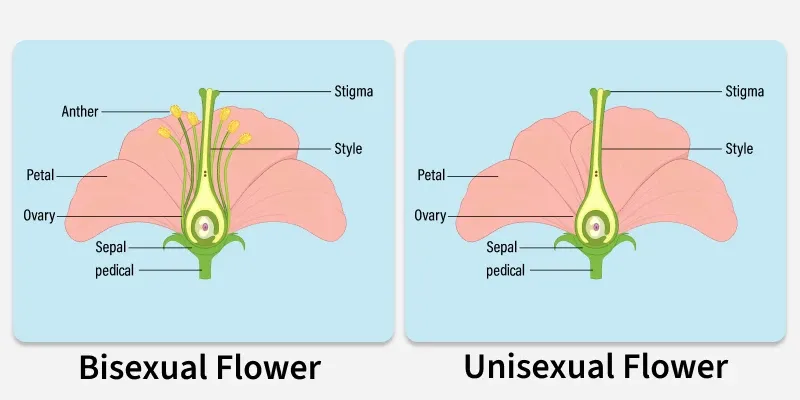
Based on Sexuality, flowers are classified into:
- **Unisexual Flowers: When a flower possesses only stamens, it is considered unisexual.
- **Bisexual Flowers: When a flower possesses both androecium and a gynoecium, it is termed bisexual.
**3. Based on the Position of the Ovary
The relative position of the ovary to other floral parts (sepals, petals, stamens) is an important taxonomic feature. It helps distinguish the superior and inferior ovaries.

Based on the position of the ovary, flowers are of two types:
- ****Hypogynous flower:**In this flower gynoecium is situated at a higher position, and the remaining parts are positioned below it. This type of ovary is considered superior, e.g., Mustard, China rose.
- **Perigynous flower_: In this flower gynoecium is located in the center and the remaining parts of the flower are positioned on the thalamus rim more or less at the same position. Here, the ovary is considered half inferior, e.g., Peach, Plum, Rose.
- **Epigynous flower_: In this flower, the thalamus margin grows upward surrounding the ovary totally, and, getting merged with it, the remaining floral parts arise over the ovary. Thus, the ovary is considered inferior eg-Sunflower ray florets, the flowers of guava, and the cucumber.
**Inflorescence
Inflorescence refers to the arrangement of flowers on the plant. At the axis of a plant, flowers are formed, which are a modified part of the seed plant. Variations in proportions, compressions, phyllotaxis, and internode length can all be included in the modification of plants.

The two main types of inflorescence are as follows:
- **Racemose Inflorescence: Here, the flowers are arranged in an acropetal succession, which means that new flowers are added on the top and the old flowers are found at the bottom. The main axis continues to grow as there is no flower at its tip.
- **Cymose inflorescence: Here, the flowers are arranged in a basipetal succession, which means that old flowers are present above the new flowers. New flowers are added in the downward direction. The main axis terminates in a flower and hence does not freely grow.
**Aestivation
In plants, it happens in summer, more or less; it is similar to hibernation and animal dormancy, where plants are inactive, and the metabolic rate is also decreased. The mode of arrangement of sepals and petals in a flower with respect to the other members of the same whorl is known as aestivation.
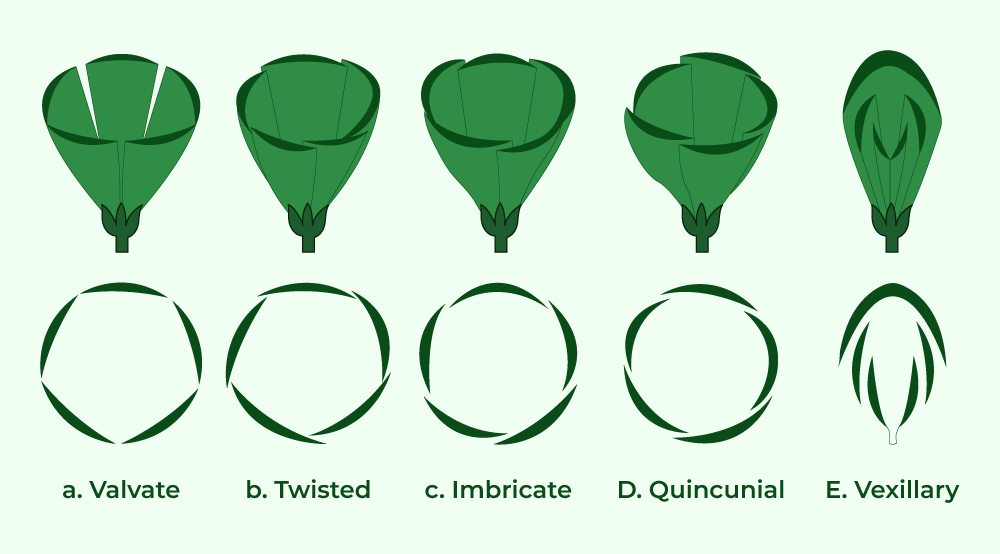
Five types of Aestivation are given below:
- **Valvate: Here, the sepals/petals just touch one another at the margin without overlapping. Eg: Calotropis.
- **Twisted: Here, one margin of the appendage overlaps the other. Eg: China rose, Cotton, Lady's finger.
- **Imbricate: Here, the margins of sepals/petals overlap one another but not in any particular direction, as in Cassia, Gulmohar.
- **Quincuncial: It is the type of Aestivation where one outer sepal or petal covers two interior sepals or petals, while the other outer sepals or petals are partially covered by two inner sepals or petals. This type of arrangement can be seen in the Flowers of Delonix, Cassia Flowers, etc.
- **Vexillary: Here, the largest petal, the standard, overlaps the two lateral petals called the wings, which in turn overlap the two smallest anterior petals called the keel. Eg: Pea, Bean.
**Placentation
The arrangement of the ovules within the ovary is called placentation. The nutrients from maternal tissue are provided to the developing embryo by the placenta. It also removes waste from the embryo, just like the function of the placenta in humans.
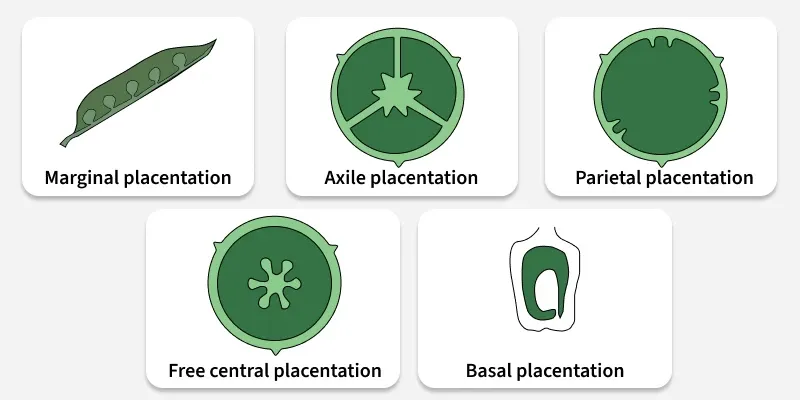
Its types are as follows:
- **Marginal: Here, the placenta forms a ridge along the ventral suture of the ovary, and the ovules are borne on this ridge, forming two rows. Eg: Pea.
- **Axile: Here, the placenta is axial, and the ovules are attached to it in a multilocular ovary. Eg: Lemon, Tomato, China rose.
- **Parietal: Here, the ovules develop on the inner wall of the ovary or on the peripheral part. e.g., Mustard, Argemone.
- **Free central: Here, the ovules are borne on the central axis, and septa are absent. Eg: Primrose, Dianthus.
- **Basal: Here, the placenta develops at the base of the ovary, and a single ovule is attached to it. Eg: Marigold, Sunflower.
Seeds of Flowering Plants
Seeds are essential for the reproduction of plants. They contain all the necessary components for the development of a new plant.

The various parts of the seed are:
- **Seed Coat: The outer protective layer of the seed, providing mechanical protection and regulating water absorption.
- **Embryo: The young plant inside the seed, consisting of the radicle, cotyledons (in dicots), or endosperm (in monocots), and plumule.
- **Radicle: The embryonic root, which develops into the primary root of the new plant.
- **Cotyledons: Leaf-like structures that store food reserves for the developing plant in dicot seeds.
- **Endosperm: Tissue containing nutrients for the developing plant in monocot seeds.
- **Plumule: The embryonic shoot, which develops into the stem and leaves of the new plant.
Layers of a Seed
The various layers of the seed are:
- **Testa: The outer layer of the seed coat, providing mechanical protection.
- **Tegmen: The inner layer of the seed coat, assisting in seed dormancy and protection.
Fruits of the Flowering Plants
After fertilisation, the mature ovary turns into a fruit. In other words, the fruit is the developed part of an ovary that is formed as a result of fertilisation. The fruit should be formed only from the ovary, but sometimes, parts of the flower, like the pistil, etc., also contribute to the formation of the fruit.

Generally, the pericarp can be divided into three parts.
- **Exocarp or Epicarp: It is the outer covering of the fruit and is generally the epidermis.
- **Mesocarp: It is the middle part of the fruit wall, which is mostly thick. Vascular handles are found in this. This part develops, and parenchyma is found in large quantities in it. Its cells are generally juicy or fleshy.
- **Endocarp: It is the innermost part of the fruit. It is thick and of different types.