Semi Technical Description of a Flowering Plant (original) (raw)
Last Updated : 18 Feb, 2026
Morphology refers to the study of forms or external features of an organism. While studying the morphology of an organism, we focus on its external appearance and on parts that are easily visible to the naked eye. Fruits, leaves, flowers, stems, and roots are the important parts of a flowering plant, which are included under the morphology of a plant.
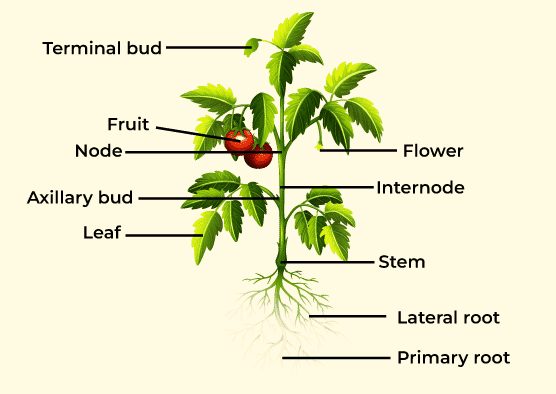
Approx. 3,00,000 species are included in the category of flowering plants. Wide diversity can be seen in this category. It is observed and believed by the ancestors that the first flowering plant was seen 140 million years ago. The most important part of the flowering plant is the flower, which is also the reproductive part of the plant. When pollen from the male flower goes to the stamen of the female flower, then fertilisation will take place, leading to the formation of a seed.
Roots
Roots are the part of the plant that is responsible for providing the proper amount of nutrients to the whole plant body by absorbing from the soil. Another main track, which is done by roots, is aerating, which helps in the proper growth and development of the plant. The roots grow into the soil and bear Primary, Secondary and Tertiary roots, and Root Hairs.
**Types of the Root System
A root is the underground part of a plant that typically grows downward into the soil. The root arises from the radicle. Its main functions are to anchor the plant, absorb water and nutrients from the soil, and store food reserves. The different branches of the root form the root system, which varies in monocots and dicots.
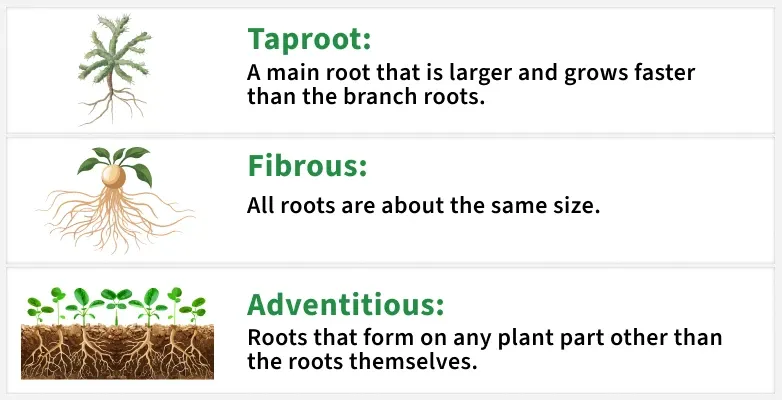
The different types of root systems are:
- ****Taproot:**It is a straight tapering root growing vertically downwards and forming the centre from which subsidiary rootlets spring. Generally, dicots possess tap roots. Eg: Mustard.
- ****Fibrous roots:**These are roots that have no prominent central axis and branches in all directions. Monocots possess these types of roots. Eg: Wheat.
- **Adventitious root: When roots arise from parts other than the radicle, the roots are called adventitious roots. Eg: Monstera, Banyan, Grasses.
**Regions of Root
The root has various regions:
- **Root cap: It is a thimble-like structure that protects the root tips.
- **Region of meristematic activity: The cells of this region are small, thin-walled, and have dense protoplasm.
- **Region of elongation: The enlargement of these cells leads to an increase in the length of the root.
- **Region of maturation: The cells of elongation mature and differentiate, and form these cells.
- **Root hair: The epidermal cells possess fine, delicate, thread-like structures called root hairs.

**Modifications of Roots
In some plants, roots change their structure and shape to perform functions other than water and mineral absorption. Roots can develop from various regions of the plant, including branches, and may grow upwards into the soil. Additionally, some roots, such as carrot, turnip, and sweet potato, serve as storage organs. Also, roots play a role in respiration through various mechanisms.
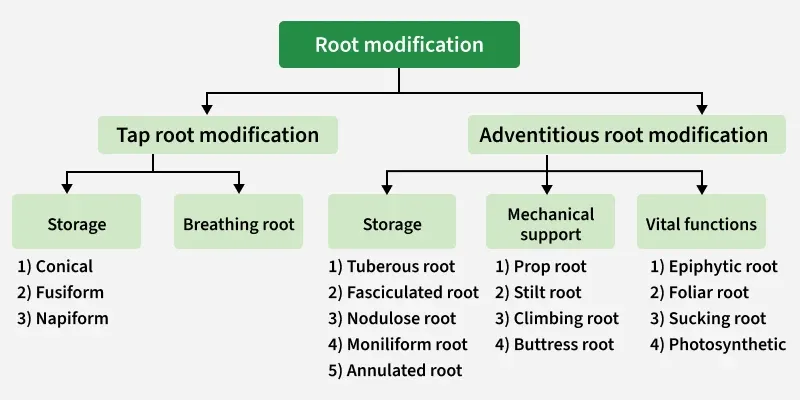
To perform these functions Roots are modified into different forms like:
- **Storage roots: These roots are modified to store food. Eg: Carrot, Turnip, adventitious roots of Sweet Potato, and Asparagus.
- **Prop roots: These hanging structures are meant to provide support to the plant. Eg: Banyan.
- **Stilt roots: These are supporting roots coming out of the lower nodes of the stem. Eg: Maize, Sugarcane.
- **Pneumatophores: These roots grow in swampy areas and come out of the soil vertically upwards to aid in the respiration process. Eg: Rhizophora.
**Stem
The main structure of vascular plants, besides roots, is the stem. Supply of dissolved substances to flowers, fruits, and leaves from roots is done by stems only. The area from one node to another is known as the internode. Stems help in giving support and in the growth of leaves, fruits, and flowers. The stem bears organs like Leaves, Flowers, Fruits, Branches, Nodes, Internodes, etc.
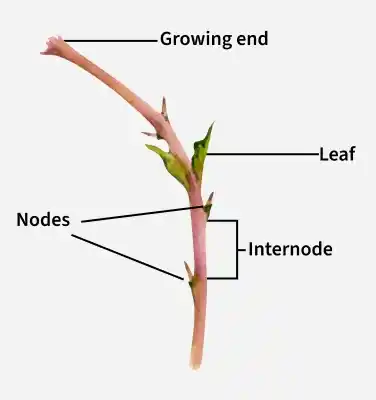
The stem is the ascending part of the axis bearing branches, leaves, flowers, and fruits. They have the nodes and internodes. The region where the leaves are born is called nodes and the internodes are present between the nodes. The stem bears buds which may be terminal or axillary. The stem is generally green; later, it becomes wood, and it turns dark brown.
**Modifications of Stem
Modification of stems refers to the changes in structure and function that occur in certain plants to adapt to specific environmental conditions or to perform certain tasks. The modified stems help to provide protection, vegetative propagation, and other functions which helps plant survive.

To perform these functions Stems are modified into different forms like:
- **Storage stems: These stems are modified for food storage. Eg: Potato, Ginger, Turmeric, Zaminkand, Colocasia.
- **Stem tendrils: These are modified axillary buds that help plants in climbing. Eg: Cucumber, Pumpkins, Watermelon, and Grapevines.
- **Thorns: Axillary buds of the stem get modified into woody, straight and pointed thorns. Eg: Bougainvillaea, Citrus.
- **Phylloclade: It is a flattened branch or stem-joint resembling and functioning as a leaf. Eg: Opuntia, Euphorbia.
- **Underground stems are present in Grass and strawberries.
- **Sub-aerial stems are present in Mint and Jasmine.
- **Aquatic roots are found in Pistia and Eichhornia.
- **Sub-aerial lateral branches are found in Banana, Pineapple, and Chrysanthemum.
**Leaf
The principal appendage of any vascular plant or leaves. Collectively, leaves are known as foliage. The colour of leaves is dependent on the presence of the pigment in them. If they have a green pigment called chlorophyll, then the leaves will be of green; if another pigment is present, then it will give colour to the leaves accordingly. It is a lateral, flattened structure arising from the axial or below the node.
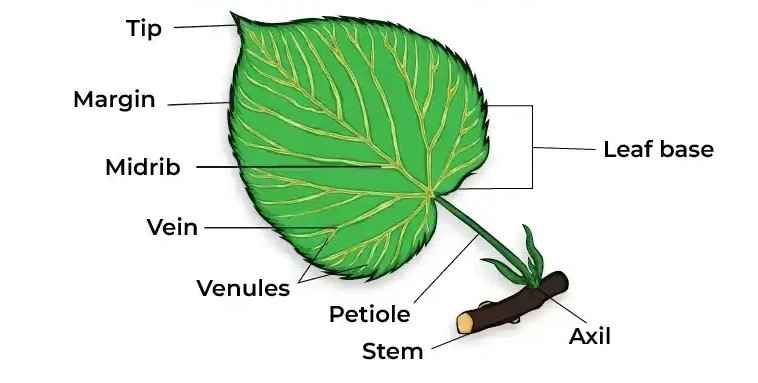
Structure of Leaves
Mainly, plants have leaf bases, petioles, and lamina; all these together form the main parts of the Leaves.
- **Leaf Base: The part at which the leaf attaches to the stem, leaf-likeis called the leaf base. It has two leaf-like structure which are called stipules.
- **Petiole: It is a thin, long stalk that joins the leaf blade to the stem.
- **Lamina: It is the g flat surface of the leaf, which is also known as the leafblade. The surface of the lamina is divided into two, which is called midribthe. Lamina also consists of small, branched veins and veinlets. Veins and veinlets help in the transportation of water and minerals, and also provide the rigidity to the lamina.
**Venation
The arrangement of veins and veinlets is known as venation. Mainly, it is of two types:
- **Reticulate Venation: Here, the veins and veinlets are unevenly dispersed throughout the whole lamina, producing a network. Found in dicots.
- **Parallel Venation: It is a vein configuration in which the veins run parallel to one another. It is mostly found in monocot leaves.
**Types of Leaves
Types of Leaves can be classified based on several features such as structure, duration, venation, phyllotaxy, and shape.
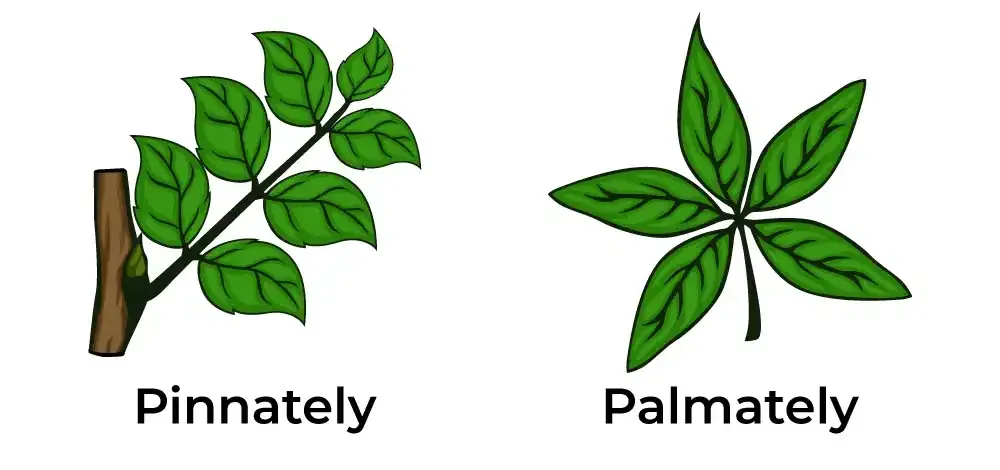
Two main types of leaves are given below:
**1. Simple Leaf: Here, the lamina is entire, or when incised, the incisions don't reach the midrib.
**2. Compound Leaf: Here, the incisions reach the midrib, dividing the leaf into many small leaflets. There are two further types:
- **Pinnately compound: Here, several leaflets are present on a common axis called the rachis. Eg: Neem.
- **Palmately compound: Here, the leaflets are attached at a common point. Eg: Silk cotton.
**Phyllotaxy
Most of the distinctive classes of patterns in nature are made due to phyllotactic spirals. There is a variety of different patterns in which the leaves are arranged in different plants, which give them a unique appearance. It is the pattern of arrangement of leaves on the stem or branch.
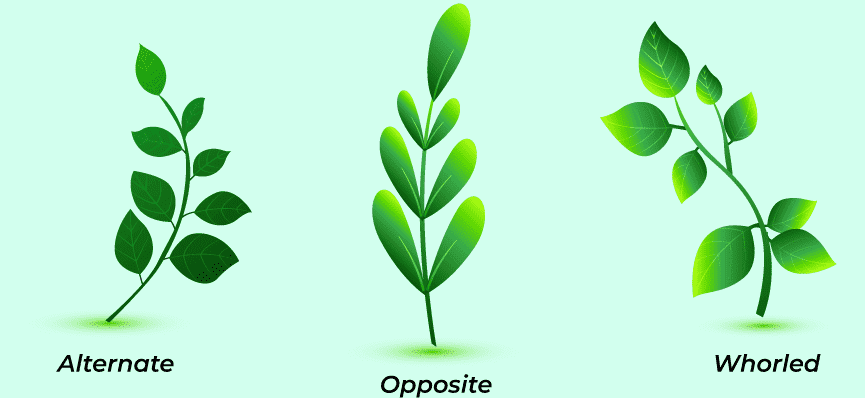
Its types are:
- **Alternate: Here, a single leaf arises at each node alternately. Eg: China rose, Mustard, Sunflower.
- **Opposite: Here, a pair of leaves arises at each node. Eg: Calotropis, Guava.
- **Whorled: Here, more than two leaves arise at a node. Eg: Alstonia.
**Modifications of Leaves
Mainly Leaves perform photosynthesis, but they also participate in different roles like storage of food, support, defence, etc.
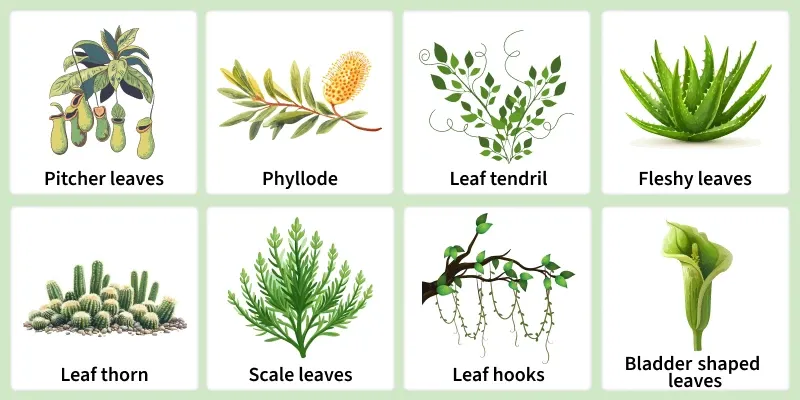
To perform these functions Leaves are modified into different forms like:
- **Tendrils: When Leaves are modified into wiry structures, then these are called as **tendrils; they help the climbers to climb.
- **Thorns: When Leaves are converted into pointed structure and, these structures protect the plant from herbivores.
- **Phyllode: When the petiole is modified into extended green structures that carry out photosynthesis.
- **Fleshy leaves: Due to the storage of water and food, these Leaves are become fleshy.
- **Leaf Hooks: Leaves modified into hooks to help the plant climb and support itself, and are useful for climbing plants that need support.
- **Scale Leaves: Scale leaves are small, dry, thin, and membranous leaves and Protect buds or underground stems and reduce water loss.
- **Leaf bladders: Leaves of some aquatic plants are modified into leaf bladders, which trap the small insects.
- **Leaf pitcher: Leaf lamina is modified into a lid which is called a pitcher, and this traps the insects and fulfill nitrogen requirement.
**Flower
The flower is the reproductive unit in angiosperms, comprising four distinct whorls arranged successively on the end of the pedicle known as the thalamus. These whorls are the calyx, corolla, androecium, and gynoecium. While the calyx and corolla serve as accessory organs, the androecium and gynoecium function as reproductive organs. In certain flowers like the lily, the calyx and corolla are distinct and collectively referred to as the perianth.

It has four main whorls:
- **Calyx (sepals): green, tiny leaf-like structures that protect the flower in the bud stage.
- **Corolla (petals): large, attractive, colourful, and have a pleasant odour. They are meant for attracting insects and animals for pollination purposes.
- **Gynoecium (pistils/carpels): It has three parts. The broad stigma serves as a landing platform for the pollen grains, the style, which is a fine tube aiding in the transfer of pollens to the ovary and the ovary, which is the female reproductive organ of the flower and produces the female gamete known as the egg.
- **Androecium (stamens): constitutes the male reproductive whorl of the flower and has two parts. The pollen-producing anther is at the tip of a thin, thread-like filament. Having learned the parts of flowers, let's now learn how flowers are arranged on the plant.
**Inflorescence
Inflorescence refers to the arrangement of flowers on the plant. At the axis of a plant, flowers are formed, which are a modified part of the seed plant. Variations in proportions, compressions, phyllotaxis, and internode length can all be included in the modification of plants.

The two main types of inflorescence are as follows:
- **Racemose Inflorescence: Here, the flowers are arranged in an acropetal succession, which means that new flowers are added on the top and the old flowers are found at the bottom. The main axis continues to grow as there is no flower at its tip.
- **Cymose inflorescence: Here, the flowers are arranged in a basipetal succession, which means that old flowers are present above the new flowers. New flowers are added in the downward direction. The main axis terminates in a flower and hence does not freely grow.
**Aestivation
In plants, it happens in summer, more or less; it is similar to hibernation and animal dormancy, where plants are inactive, and the metabolic rate is also decreased. The mode of arrangement of sepals and petals in a flower with respect to the other members of the same whorl is known as aestivation.
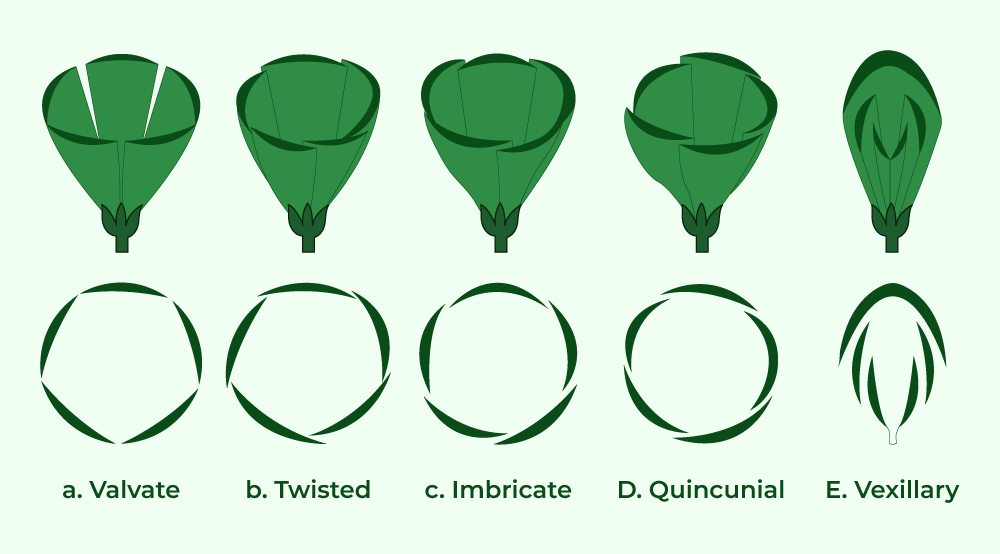
Five types of Aestivation are given below:
- **Valvate: Here, the sepals/petals just touch one another at the margin without overlapping. Eg: Calotropis.
- **Twisted: Here, one margin of the appendage overlaps the other. Eg: China rose, Cotton, Lady's finger.
- **Imbricate: Here, the margins of sepals/petals overlap one another but not in any particular direction, as in Cassia, Gulmohar.
- **Quincuncial: It is the type of Aestivation where one outer sepal or petal covers two interior sepals or petals, while the other outer sepals or petals are partially covered by two inner sepals or petals. This type of arrangement can be seen in the Flowers of Delonix, Cassia Flowers, etc.
- **Vexillary: Here, the largest petal, the standard, overlaps the two lateral petals called the wings, which in turn overlap the two smallest anterior petals called the keel. Eg: Pea, Bean.
**Placentation
The arrangement of the ovules within the ovary is called placentation. The nutrients from maternal tissue are provided to the developing embryo by the placenta. It also removes waste from the embryo, just like the function of the placenta in humans.
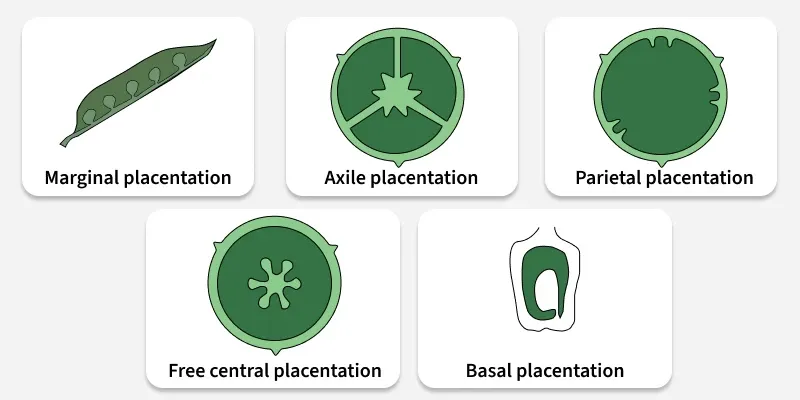
Its types are as follows:
- **Marginal: Here, the placenta forms a ridge along the ventral suture of the ovary, and the ovules are borne on this ridge, forming two rows. Eg: Pea.
- **Axile: Here, the placenta is axial, and the ovules are attached to it in a multilocular ovary. Eg: Lemon, Tomato, China rose.
- **Parietal: Here, the ovules develop on the inner wall of the ovary or on the peripheral part. e.g., Mustard, Argemone.
- **Free central: Here, the ovules are borne on the central axis, and septa are absent. Eg: Primrose, Dianthus.
- **Basal: Here, the placenta develops at the base of the ovary, and a single ovule is attached to it. Eg: Marigold, Sunflower.
**Important Terminologies
- **Perianth: When the calyx and corolla are not separate whorls, this single whorl is called the perianth. Eg: Lily.
- **Unisexual: It is the flower-bearing only one type of sex organ, either male or female.
- **Bisexual: It bears both male and female flowers.
- **Actinomorphic: These are flowers possessing radial symmetry. A flower cut through any plane divides into two halves. Eg: Mustard, Datura, Chilli.
- **Zygomorphic: This type possesses bilateral symmetry. These flowers have two planes of symmetry. Eg: Gulmohar, Pea, Bean, Cassia.
- **Asymmetric: This type of flower doesn't possess any axis of symmetry. Eg: Canna.
- **Trimerous: These are flowers bearing floral appendages in multiples of three.
- **Tetramerous: These are flowers bearing floral appendages in multiples of four.
- **Pentamerous: These are flowers bearing floral appendages in multiples of five.
- **Bracteate: These flowers bear small, reduced leaves called bracts at their base.
- **Ebracteate: These flowers don't bear bracts.
- **Hypogynous: These flowers have a superior ovary, i.e. gynoecium above all other floral whorls. Eg: China rose, Mustard, Brinjal.
- **Perigynous: These flowers have a half-inferior ovary, i.e. gynoecium lies in the same line as the other floral whorls. Eg: Plum, Rose, Peach.
- **Epigynous: These flowers have an inferior ovary, i.e. gynoecium, below other floral whorls. Eg: Guava, Cucumber, and Ray florets of sunflowers.
- **Gamosepalous: When sepals are united together.
- **Polysepalous: When the sepals are free from each other.
- **Polypetalous: When the petals are united together.
- **Epipetalous: When the stamens are attached to the petals.
- **Epiphyllous: When the stamens are fused with the tepals, i.e. perianth.
- **Polyandrous: When the sepals are free from each other.
- **Mono/ Di/ Tri adelphous: When the sepals are grouped in one, two, and three bundles, respectively.
- **Apocarpous: When the petals are free from each other.
- **Syncarpous: When the petals are fused.
**Some Important Families
1. Solanaceae
Solanaceae place among developed species, and some others, like potato, pepper, and tomato, play a deciding role in the human diet and the economy of the nations. Others are generally developed as fancy plants or for medicinal and drug purposes. Infectious diseases have a genuine and, surprisingly, horrendous effect and could in fact challenge these harvests in both mild and equatorial areas.

The following table outlines the floral formula and structural features of the flower:
| ⊕ | Actinomorphic (Radial Symmetry) |
|---|---|
| ⚥ | Bisexual |
| K(5) | Calyx - 5 sepals, gamosepalous (joined together) |
| C(5) | Corolla - 5 petals, gamopetalous |
| A5 | Androecium - 5 stamens, polyandrous(free), epipetalous (attached to petals) |
| G(2) | Gynoecium - Bicarpellary, syncarpous (united), superior ovary |
**Characters of the family Solanaceae
- Flowering plants have small dust grains that distribute hereditary data, from one and then onto the next.
- Angiosperms have stamens conceptive designs delivering dust grains conveying hereditary data (male)
- Blooming plants produce endosperm.
**Vegetative Characters
- **Habit: For the most part, yearly or getting through flavours, some are shrubs, and a couple are climbers.
- **Root system: Tap, and spread.
- **Stem: Herbaceous, erect, extended, fuzzy, or prickly, underground in potato outlining tubers
- **Leaf: Exstipulate, substitute, essential, entire or lobed, pinnately compound in tomato, unicostate reticulate venation. Herbal Characters.
**Floral Characters
- **Inflorescence: Commonly an axillary cyme or blend of cymes, now and again helicoid
- **Flower: Pentamerous, bisexual, rarely unisexual, regular, rarely irregular (Hyoscyamus), hypogynous
- **Calyx-Five: Gamosepalous, persistent as in Withania, cape-gooseberry, and eggplant, inferior
- **Corolla: Five petals, gamopetalous, valvate aestivation
- **Androecium: Five Stamens, anther Basifixed, epipetalous
- **Gynoecium: Syncarpous, binocular, superior ovary, bicarpellary, axile placentation
- **Fruit: Capsule/ Berry
- **Seed: Endospermous, Many seeds
2. Fabaceae
Fabaceae (pea family) is a huge group of angiosperms. It is otherwise called Leguminosae, and the plants are generally known as vegetables. It is generally conveyed everywhere. It incorporates numerous significant heartbeats like peas, soybeans, chickpeas, and so forth.
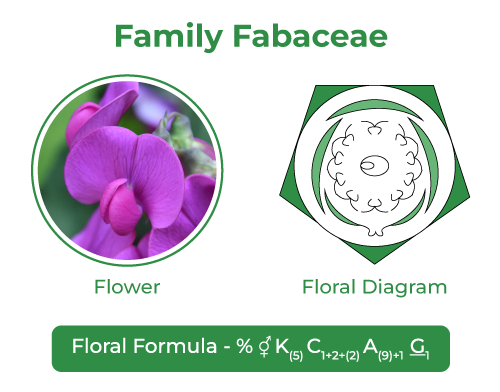
The following table outlines the floral formula and structural features of the flower:
| % | Zygomorphic (two-sided evenness) |
|---|---|
| ⚥ | Bisexual |
| K(5) | Calyx - 5 sepals, gamosepalous (joined together) |
| C1+2+(2) | Corolla - 5 petals, polypetalous |
| A(9)+1 | Androecium - 10 stamens, diadelphous |
| G1 | Gynoecium - monocarpellary, predominant ovary |
**Characteristics of the Fabaceae Family
- Plants of this family are spices, bushes, plants, or moving by twining or ringlets.
- Blossoms are normally sexually unbiased, petals are standard or unpredictable cup molded hypanthium. Petals are, by and large, five in number.
- This is imbricate or basally connate, standard, and normally valvate.
- The androecium is with one to various stamens, however typically ten, concealed by the perianth to long-applied and in some cases gaudy fibres, particular or connate.
- On the off chance that connate is monodelphous or diadelphous, dust grains are tricolporate, tricolpate or triporate.
- Gynoecium of one carpel, particularly, is normally prolonged and has a short gynophore.
- The ovary is prevalent with parietal (peripheral) placentation.
- Ovules are anatropous to campylotropous.
- Natural products are normally vegetables.
- Seeds are hard external, incipient organisms directly bent with no or little endosperm.
- This family was previously called Papilionoideae, a subfamily of the Leguminosae family.
**Vegetative Characters
- **Root system: Trees, bushes, herbs root with root nodules. The root contains root knobs that have nitrogen-fixing microscopic organisms (rhizobium), and regularly non-protein amino acids are found.
- **Stem: Erect or climbing leaves: substitute, pinnately compound or straightforward
- **Leaf: Venation reticulate. Leaves are generally pinnate and are spirally organised, with the pulvinus of the leaf and individual pamphlets being advanced.
**Floral Characters
- **Floral characters: Inflorescence racemose
- **Flower: sexually open, zygomorphic
- **Calyx: sepals five, gamosepalous; imbricate aestivation
- **Corolla: petals five, polypetalous, papilionaceous, comprising a back norm, two lateral wings, two foremost ones framing a fall (encasing stamens and pistil), vexillary aestivation
- **Androecium: ten, diadelphous, anther dithecous
- **Gynoecium: ovary predominant, mono carpellary, unilocular with numerous ovules, style single
- **Fruit: vegetable; seed: one to many, non-Economic significance: Many plants having a place with the family are wellsprings of heartbeats like gram, arhar; edible oil like soybean, groundnut; colour like Indigofera; fibre like sun hemp; grain like Sesbania, Trifolium, ornamentals like lupin, sweet pea; medication like muliathi.
**Examples: groundnut, soybean
3. Liliaceae
About 2500 species of perennial, herbaceous monocots make up the Liliaceae family. They are also known as the "lily family" There are 4000 different species and 250 genera of plants in the Liliaceae family. In contrast, there are 169 species in India. They serve as the foundational monocot stock from which the other monocot family has descended and are regarded as typical monocot families.

The following table outlines the floral formula and structural features of the flower:
| **Br | Bracteate |
|---|---|
| **⊕ | Actinomorphic |
| **⚥ | Bisexual |
| **P(3+3) | Perianth – 6 tepals in two whorls, gamophyllous |
| **A3+3 | Androecium – 6 stamens, polyandrous (free), epiphyllous (attached to tepals) |
| **G(3) | Gynoecium – tricarpellary, superior ovary, and syncarpous (united). |
Characters of Family Liliaceae
- Pollination: Entomophilous pollination, that is, they are pollinated by insects.
- Their endosperms are oily in nature.
- At the base of the petal, there is the production of nectar.
- They include the species that have the largest genomes within the angiosperms.
**Vegetative Characters
- **Root: fibrous root system
- **Stem: Erect; the Liliaceae family of plants comprises perennial herbs that are spread by rhizomes or bulbs.
- **Leaves: Parallel venation; alternate, simple; exstipulate.
**Floral Characters
- The inflorescence is cymose, consisting of solitary flowers or umbellate clusters.
- Flowers are complete, actinomorphic, and bisexual, with a well-developed perianth.
- The perianth is composed of six tepals arranged in two whorls (3+3); tepals are often united and show valvate aestivation, with no distinction between sepals and petals.
- The androecium consists of six stamens arranged in two whorls (3+3).
- The gynoecium is tricarpellary, syncarpous, and trilocular, exhibiting axile placentation.
- The fruit is usually a capsule, though berries may occasionally occur.
- Seeds are endospermic.