Symbiosis and Symbiotic Relationship (original) (raw)
Last Updated : 28 Nov, 2025
Symbiosis is referred to as a term that is a close, frequently ongoing relationship between two different species in an ecosystem. In simple words, it is a connection between two organisms.
Symbiotic relationships play a critical role in the development of ecological communities, the promotion of biodiversity, and the overall health and harmony in ecosystems.

Types of Symbiosis
The interdependent relationships of symbiosis are most commonly grouped into three types:
- Mutualism
- Parasitism
- Commensalism
**Mutualism
In a mutualistic symbiosis, both of the involved species benefit from the relationship. For example, the interactions between plants and pollinating organisms, such as those between bees and flowers, in which the plant offers nectar as a food source and the pollinator helps in the reproduction of the plant by spreading pollen. A few other examples of Mutualism are given below.
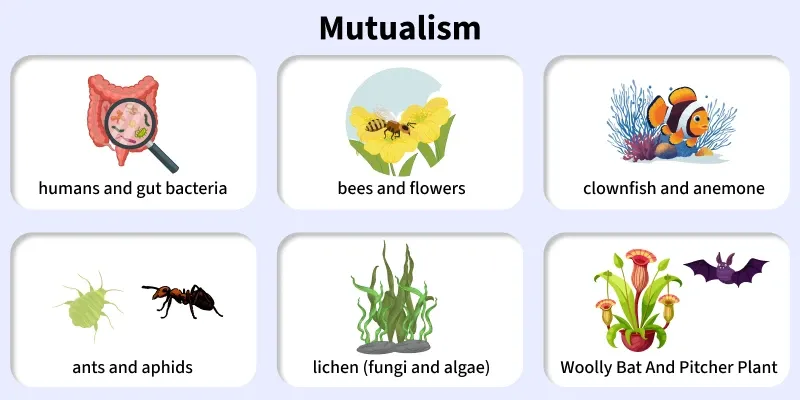
Two types of Mutualism are:
- **Obligate Mutualism: Both organisms are so closely dependent on each other that they cannot survive independently.For example, plants and mycorrhizal fungi that rely on each other for nutrients and food.
- **Facultative Mutualism: Both species gain from their interaction, but they may live on their own without harm. For example, the association of oxpeckers with huge beasts in Africa, the birds consume parasites on the beast's skin.
**Parasitism
In a parasitic relationship, one species gains at the expense of the other. For instance, Fleas that feed on mammals, tapeworms that live in animals' intestines and numerous pathogens. A few other examples of Parasitism are given below:
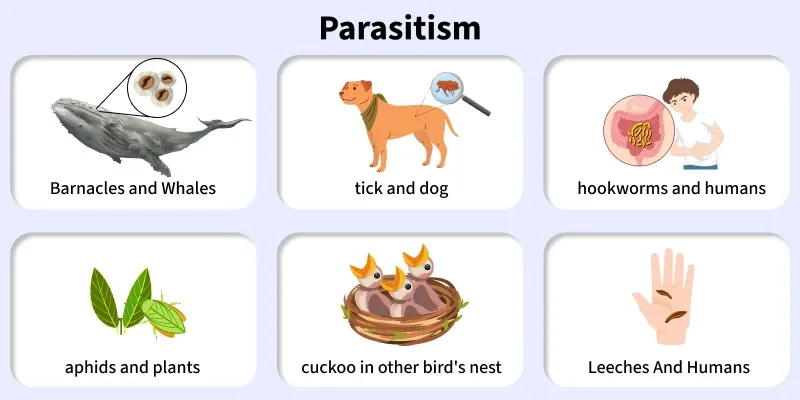
Types of Parasitism are:
- **Endo parasitism: Parasites that live inside their host. For example, tapeworms in the intestines.
- **Ecto parasitism: These are the parasites that live on the surface of their host. For example, ticks, fleas and lice.
- **Brood Parasitism: Some birds, like cuckoos, lay their eggs in the nests of other bird species, leaving the host birds to care for their young.
- **Parasitoidism: Certain wasps lay their eggs inside the bodies of other insects. When the wasp larvae hatch, they consume the host from the inside.
**Commensalism
It is an interaction in which one species gains while the other is not severely damaged or benefited. As an example, consider how barnacles may stick to the skin of a whale or the shell of a sea turtle and have access to the nutrients in the ocean without severely harming the host. A few other examples of Commensalism are given below.
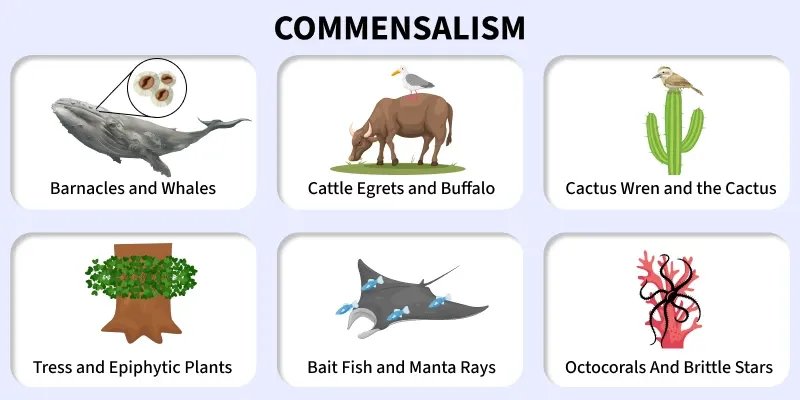
Types of Commensalism are:
- **Phoresy: When one organism transports another without endangering the host. For instance, mites can use insects as a means of transportation by attaching to them.
- **Microbiota: Different kinds of bacteria live in the human digestive system that benefit the environment while having a small or no effect on the person.
- **Epiphytism: Orchids and other epiphytic plants grow on the root systems of trees. They don't hurt the tree and just use it as a support.
Advantages of Symbiosis
The following are the advantages of symbiosis:
- **Resource conservation: In commensalism and mutualism, species can save energy and resources by cooperating on tasks or receiving the benefits of their partners' efforts, as in the instance of gut bacteria aiding in digestion.
- **Nutrient Exchange: Exchange of critical nutrients and resources between symbiotic partners is common and can help to promote each other's growth, development, and general fitness.
- **Benefits for Reproduction: Many symbiotic relationships, particularly mutualism, promote reproduction by behaviours like pollination, seed dissemination or even offspring protection.
- **Increased Biodiversity: By fostering the coexistence of many species in ecosystems and generating roles for them to occupy, symbiotic connections contribute to the general diversity of life.