Microorganisms (original) (raw)
Last Updated : 19 Nov, 2025
Microorganisms are microscopic life forms that are found everywhere. They can be unicellular or multicellular and can be harmful or beneficial. They play diverse roles in nutrient cycling, food fermentation, antibiotic production, and many more.
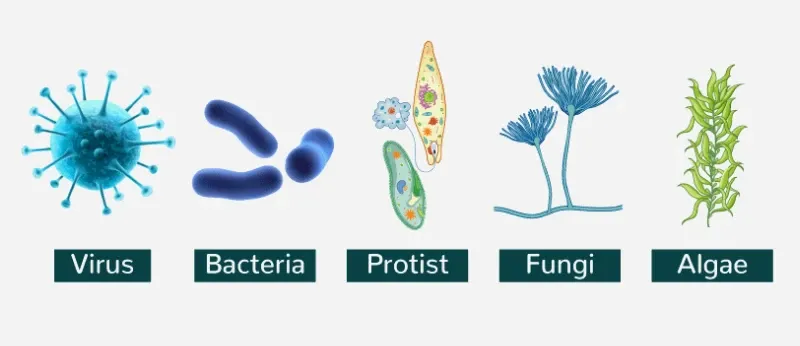
Types of Microorganisms
On the other hand, they are also responsible for causing diseases in plants and animals, food spoilage, and posing environmental challenges.
Classification of Microorganisms
Microorganisms can be classified into **five major categories:
1. Viruses
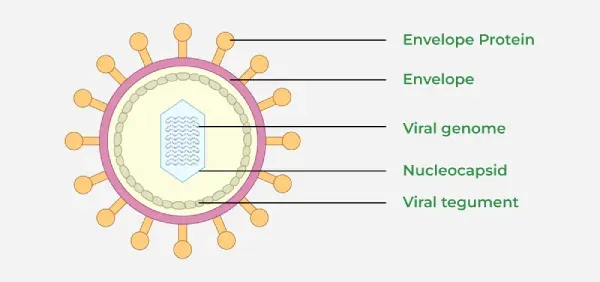
A virus is an extremely small infectious particle that depends entirely on a host cell for survival and reproduction. It invades living cells and uses their components to replicate. The structure of a typical virus is illustrated below:
**Characteristics of Viruses
Viruses display several unique traits that distinguish them from all other microorganisms:
- Viruses are acellular and non-cellular, with no organelles or cytoplasm.
- They contain either DNA or RNA (never both) enclosed in a protein coat.
- They are non-living outside a host and cannot carry out life processes on their own.
- Viruses are obligate parasites and can multiply only inside living host cells.
- They act as a link between living and non-living, showing life-like traits only in a host.
- Viruses can infect all forms of life, including humans, animals, plants, and microorganisms.
- Examples include HIV, Hepatitis virus, and Influenza virus.
2. Bacteria
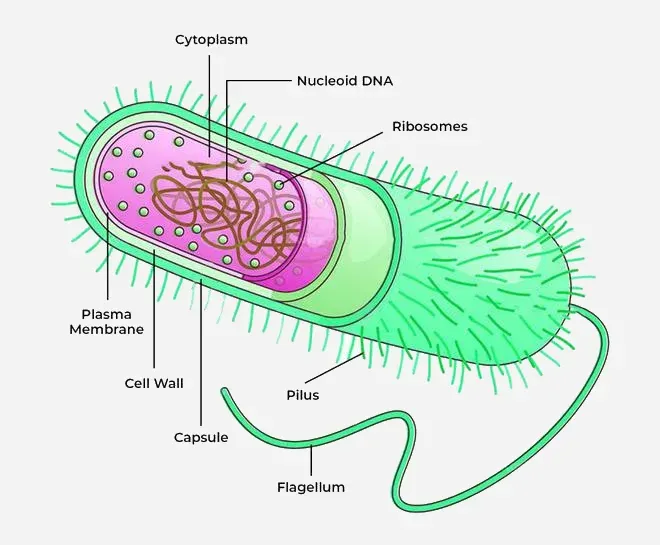
Bacteria are unicellular, prokaryotic microorganisms that lack a true nucleus and membrane-bound organelles. They come in different shapes like rods, spheres, and spirals, and can survive in almost every environment from soil and water to inside living organisms. The diagram of bacteria is shown below:
**Characteristics of Bacteria
Bacteria exhibit a wide range of structural and functional features that set them apart from other living organisms.
- Bacteria are unicellular organisms made up of a single cell.
- They are prokaryotic, meaning they do not have a true nucleus.
- Their cell wall contains peptidoglycan, which gives them strength and shape.
- They appear in different shapes such as cocci, bacilli, and spirilla.
- Bacteria reproduce rapidly through binary fission, a type of asexual reproduction.
- They can be autotrophic or heterotrophic depending on their mode of nutrition.
- Bacteria may be aerobic or anaerobic and can survive in a wide range of habitats.
- Examples include _E. coli, Streptococcus.
3. Protista
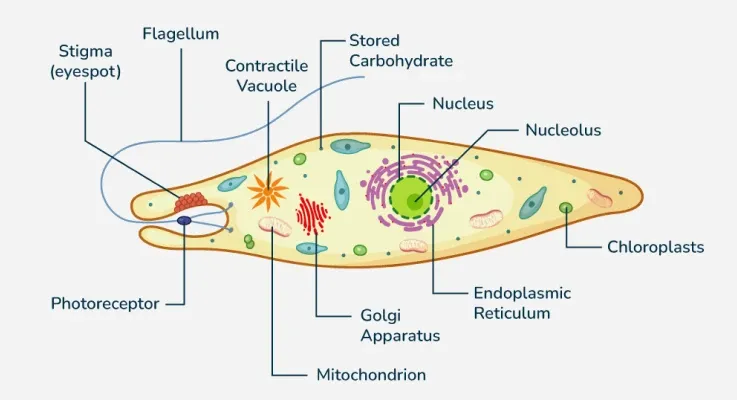
Protista are primitive eukaryotic organisms that are mostly unicellular but show greater complexity than bacteria.example The example of Protists are shown below:
**Characteristics of protists
Protists display diverse structural and functional adaptations that distinguish them from plants, animals, and fungi.
- Protists are mostly unicellular organisms, though some are multicellular or form colonies.
- They are eukaryotic, meaning they have a true nucleus and membrane-bound organelles.
- Protists live mostly in aquatic or moist environments.
- They show diverse modes of nutrition, including autotrophic, heterotrophic, and mixotrophic types.
- Many protists move using structures like cilia, flagella, or pseudopodia.
- They reproduce by asexual methods like binary fission, and some also reproduce sexually.
- Protists can be plant-like, animal-like, or fungus-like based on their features and mode of living.
- Examples include _Amoeba, Paramecium.
4. Fungi
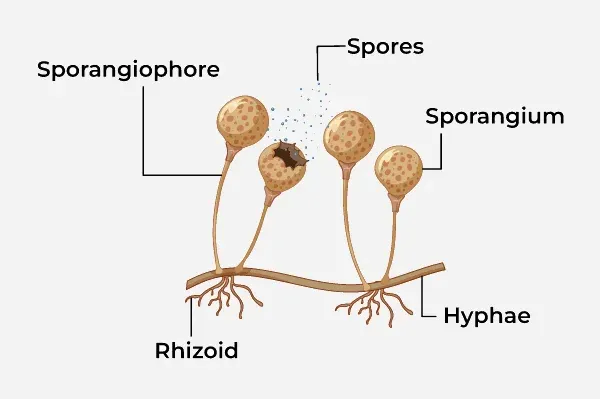
Fungi include organisms with a chitin-based cell wall, heterotrophic nutrition, and a filamentous body structure called mycelium. These eukaryotic organisms thrive by absorbing nutrients from external sources. One of the example of Fungi are shown below:
**Characteristics of Fungi
Fungi possess unique structural and nutritional features that clearly differentiate them from other groups of organisms.
- Fungi are eukaryotic organisms with a true nucleus and membrane-bound organelles.
- Most fungi are multicellular, while some like yeast are unicellular.
- Their cell wall is made of **chitin, which gives them rigidity and protection.
- Fungi are heterotrophic and obtain their food through absorption from decaying organic matter.
- Their body is made up of thread-like filaments called **hyphae, which together form a **mycelium.
- They reproduce by forming spores, which may be produced sexually or asexually.
- Fungi play a major role in ecosystems as decomposers, breaking down dead plants and animals.
- Common examples of fungi include mushrooms, moulds, and yeast.
5. Algae
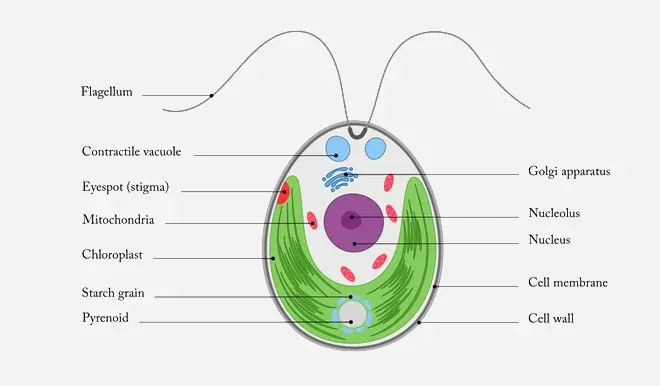
Algae are simple, mostly aquatic, photosynthetic organisms that have chlorophyll and can make their own food but do not have true roots, stems, or leaves. One of the green algae are shown below:
**Characteristics of algae
Algae show distinct structural and photosynthetic features that set them apart from other plant-like organisms.
- Algae are mostly aquatic organisms found in freshwater, marine water, or moist places.
- They are photosynthetic and contain chlorophyll, allowing them to make their own food.
- Algae can be unicellular, colonial, or multicellular depending on the group.
- Their body is called a thallus, which is not differentiated into true roots, stems, or leaves.
- They show different pigments like green, brown, and red, which give them various colors.
- Algae reproduce by vegetative, asexual, and sexual methods.
- They play an important ecological role by producing oxygen and serving as the base of aquatic food chains.
- Example include _Spirulina, Volvox
**How can Microbes be Useful to Us?
Microorganisms are beneficial to humankind in the following ways:
**1. Nutrient Cycling: Microbes decompose organic matter and help recycle nutrients in the ecosystem.
**2. Soil Fertility: Nitrogen-fixing microbes convert atmospheric nitrogen into usable forms for plants.
**3. Agriculture: Mycorrhizal fungi and other soil microbes help plants absorb nutrients and grow better.
**4. Fermentation: Bacteria and yeasts are used to make yoghurt, cheese, bread, and other fermented foods.
**5. Probiotics: Beneficial bacteria improve digestion, nutrient absorption, and immunity.
**6. Antibiotics & Vaccines: Certain microbes produce antibiotics and are used in the development of vaccines.
Some beneficial roles of the microbes are listed in the table:
| Microbial Group | Beneficial Role | Examples |
|---|---|---|
| Viruses | Bioremediation and genetic engineering. | Lambda phage, Bacteriophage. |
| Bacteria | Nutrient cycling and soil fertility, and fermentation. | _Rhizobium, Pseudomonas, Lactobacillus. |
| Fungi | Food industry, production of antibiotics. | _Saccharomyces, Penicillium. |
| Protists | Nutrient cycling. | _Euglena, Paramoecium. |
| Algae | Wastewater treatment, nutritional supplement. | _Chlorella, Spirulina. |
Harmful Microorganisms
Microorganisms can be harmful to humankind in the following ways:
**1. Outbreaks or Pandemics: Microbes like viruses can cause global outbreaks such as HIV, influenza, and COVID-19.
**2. Infectious Diseases: Pathogenic microbes cause illnesses like malaria, typhoid, and dengue in humans, animals, and plants.
**3. Allergic Responses: Some microbes trigger allergic reactions, asthma, and skin problems in sensitive individuals.
**4. Antimicrobial Resistance: Misuse of antibiotics leads to drug-resistant microbes (e.g., MDR Staphylococcus).
**5. Plant Diseases: Microbial infections reduce crop yield and cause major agricultural losses.
**6. Foodborne Illnesses: Contaminated food or water with microbes like Salmonella or E. coli causes stomach infections.
Some harmful effects caused by the microbes are listed in the table:
| Microbial Group | Harmful Effects | Examples |
|---|---|---|
| Virulent viruses | Infections in humans and animals. | Coronavirus, Hepatitis virus. |
| Pathogenic bacteria | Cause of infectious diseases. | _Salmonella, Shigella. |
| Harmful fungi | Pathogenic to plants and animals, causing spoilage. | Fusarium, Aspergillus. |
| Parasitic Protists | Cause of diseases. | _Plasmodium, Entamoeba. |
| Harmful Algae | Environmental threat: algal blooms. | _Karenia, Microcystis. |
Diseases Caused By Microorganisms
1. Diseases Caused by Microorganisms in Animals
Some diseases caused by microbes with their causative agent are listed below:
| Viruses | Bacteria | Fungi | Protozoa |
|---|---|---|---|
| Influenza (Influenza virus) | Tuberculosis (_Mycobacterium tuberculosis) | Trichophyton spp. (_Trichophyton spp. ) | Malaria (_Plasmodium falciparum) |
| Common cold (Rhinovirus ) | Cholera (_Vibrio cholerae) | Candidiasis (_Candida albicans) | Amoebiasis (_Entamoeba histolytica) |
| AIDS (Human Immunodeficiency Virus (HIV)) | Tetanus (_Clostridium tetani) | Aspergillosis (_Aspergillus spp.) | Giardiasis (_Giardia lamblia) |
| COVID (Severe Acute Respiratory Syndrome Coronavirus 2 (SARS-CoV-2)) | Gonorrhea (_Neisseria gonorrhoeae) | Cryptococcosis (_Cryptococcus neoformans) | Toxoplasmosis (_Toxoplasma gondii) |
| Hepatitis (Hepatitis A, B, C viruses) | Lyme disease (_Borrelia burgdorferi) | Histoplasmosis (_Histoplasma capsulatum) | Chagas disease (_Trypanosoma cruzi) |
2. Diseases Caused by Microorganisms in Plants
Some diseases caused by microbes in plants are listed below:
| Viruses | Bacteria | Fungi |
|---|---|---|
| Tobacco Mosaic Virus (TMV) | Fire Blight (_Erwinia amylovora) | Powdery Mildew (_Sphaerotheca spp.) |
| Tomato Yellow Leaf Curl Virus (TYLCV) | Bacterial Leaf Spot (_Xanthomonas, Pseudomonas) | Late Blight (_Phytophthora infestans) |
Food Spoilage by Microorganisms
Microorganisms can grow on food and change the physical and chemical properties of the food in such a way that they become inedible. Some points on food spoilage are listed below:
- Food spoilage is caused by bacteria and fungi majorly break down food components, altering their flavour and odour, causing discolouration, sliminess, and producing gas.
- Techniques such as proper food handling, storage, and processing are crucial for preventing microbial spoilage.
- Quality control (QC) measures, such as regular testing for contamination of food and water and maintaining sanitary conditions, are essential to prevent food spoilage.
- Microbial spoilage may pose health risks due to the production of toxins and the presence of pathogenic microorganisms, and it also leads to economic losses of the food, raising concerns about food security.
- Implementing a set of rules known as Hazard Analysis and Critical Control Points (HACCP) systems is crucial in managing microbial spoilage effectively.