Systems Approach to Management (original) (raw)
Last Updated : 20 May, 2026
General Systems Theory explains that an organisation is a complex open system made up of interconnected and interdependent parts called subsystems, where each part influences the functioning of the whole organisation. Instead of operating independently, these subsystems work together to achieve common goals. The theory also states that organisations constantly interact with their external environment by receiving resources, information, and energy, which affect their operations and decision-making. Because organisations are open systems, they can adapt to environmental changes, helping them survive, grow, and remain effective over time.
Features of Systems Approach to Management
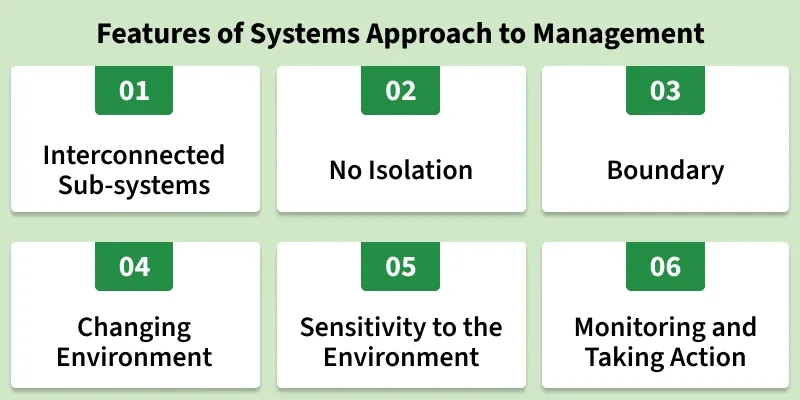
**Interconnected Sub-systems: An organisation is like a big puzzle made up of smaller pieces that work together. These pieces, called sub-systems, interact and depend on each other for the organisation to function properly.
**No Isolation: We can't understand the sub-systems by looking at them individually. Instead, we need to see how they relate to each other and to the organisation as a whole. It's like understanding how each puzzle piece fits into the larger picture.
**Boundary: An organisation has a boundary that sets it apart from other systems. It helps us identify which parts are inside (like employees) and which parts are outside (like customers). This boundary defines the organisation's scope and limits.
**Changing Environment: Organisations are dynamic systems because they are affected by their environment. They can be influenced by things, like power cuts, strikes, or shifts in customer preferences. That's why management needs to keep an eye on what's happening outside and make adjustments when needed.
**Sensitivity to the Environment: Because organisations are influenced by their environment, they need to be sensitive to changes. Just like we react when something unexpected happens, organisations must be responsive and adapt to external factors that may affect their operations.
**Monitoring and Taking Action: To ensure a healthy organisation, it's crucial to constantly monitor its well-being. Management needs to pay attention to signs of problems and take corrective action promptly. It's like regularly checking the pulse of the organisation to make sure everything is running smoothly.
Uses of Systems Approach
Some of the uses of the Systems Approach are:
**Meaningful Analysis: The systems approach provides a helpful way to understand organisations and how they are managed. It encourages us to look at the bigger picture and consider how different parts of the organisation interact with each other.
**Integrated Thinking: Instead of focusing on individual problems in isolation, the systems approach encourages us to think about how different problems and solutions are connected. This helps us see the organisation as a whole and make more informed decisions.
**Unified Focus: The systems approach helps bring everyone in the organisation together by giving a common focus. It helps align goals, strategies, and actions across different teams and departments, making sure everyone is working towards the same objectives.
**Dynamic Nature: Organisations are always changing, and the systems approach recognizes this. It reminds us that organisations need to be adaptable and flexible to keep up with the constantly evolving business environment.
**Understanding Interactions: The systems approach highlights the importance of how different things in the organisation interact and depend on each other. It helps us see the ripple effects of changes and decisions, allowing us to make better choices.
Limitations of Systems Approach
The following are the limitations of the systems approach:
**Simplification: While the systems approach is helpful, it may oversimplify the complexity of real-life organisations. Real organisations can be much more intricate and have more nuances than what the systems approach may capture.
**Subjectivity: Applying the systems approach requires interpretation and judgment, which can vary from person to person. Different managers may see things differently, leading to potential variations in analysis and decision-making.
**Time and Resource Constraints: Using the systems approach can take time and resources. It may be challenging to gather and analyze all the necessary data, especially for larger and more complex organisations.
**Overemphasis on Interactions: While understanding interactions is crucial, focusing solely on them may overlook the unique qualities and contributions of individual elements in the organisation.
**Lack of Precision: The systems approach provides a general framework rather than specific step-by-step instructions. Its concepts are open to interpretation and can vary depending on the situation.