Business Process Reengineering (BPR): Features, Objectives, Causes of Failure and Conditions for Success (original) (raw)
Last Updated : 22 May, 2026
Business Process Re-engineering (BPR) is a method of improving business processes by redesigning them to increase efficiency, performance, and customer satisfaction. It encourages organisations to rethink old methods, use innovative ideas, improve workflow, and make better use of technology. BPR also promotes teamwork, customer focus, and effective change management. By continuously improving processes, BPR helps organisations reduce costs, increase productivity, and remain competitive.
Features of Business Process Re-engineering(BPR)
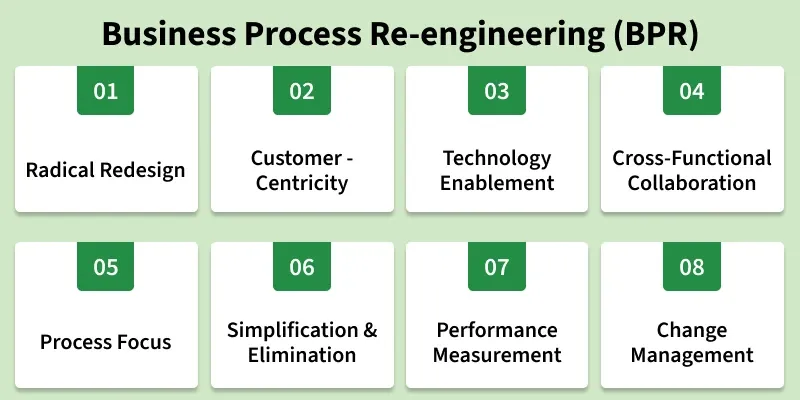
**Radical Redesign: BPR goes beyond incremental adjustments by advocating a radical overhaul of existing processes. It encourages organisations to challenge conventional thinking, question established norms, and envision entirely new ways of performing tasks.
**Process Focus: BPR adopts a holistic view, considering organisations as interconnected processes rather than isolated departments or functions. It places emphasis on analyzing end-to-end processes, identifying inefficiencies, and finding opportunities for optimization. By understanding the interdependencies and interactions between various processes, organisations can achieve enhanced efficiency and effectiveness.
**Customer-Centricity: BPR places paramount importance on understanding and meeting customer needs and expectations. It emphasizes aligning business processes with customer requirements to deliver exceptional value and ensure high levels of satisfaction. By centring their efforts around customer-centricity, organisations can cultivate strong relationships, foster loyalty, and gain a competitive edge.
**Simplification and Elimination: BPR advocates for simplifying processes by eliminating unnecessary steps, reducing complexities, and removing redundant activities. By streamlining workflows and eliminating non-value-added tasks, organisations can enhance efficiency, minimize errors, and expedite the completion of activities.
**Technology Enablement: BPR recognizes the transformative potential of technology in optimizing processes. It encourages organisations to leverage innovative technologies, automation, and digital solutions to streamline operations, enhance data analysis capabilities, and facilitate real-time decision-making.
**Performance Measurement: BPR stresses the importance of establishing robust performance metrics and measurement systems to assess the effectiveness of process improvements. By defining clear indicators and tracking progress, organisations can monitor the impact of changes, identify areas for further enhancement, and ensure alignment with strategic objectives.
**Cross-Functional Collaboration: BPR fosters a culture of collaboration and teamwork across different functions and departments. It breaks down silos, encourages open communication, and promotes cross-functional collaboration to improve the flow of information, leverage diverse perspectives, and drive collective success.
**Change Management: BPR acknowledges the significance of effective change management in successfully implementing process changes. It entails managing resistance to change, engaging stakeholders at all levels, providing training and support, and fostering a culture that embraces innovation and continuous improvement.
Objectives of BPR
The objectives of Business Process Re-engineering (BPR) encompass a range of goals aimed at driving significant advancements in organisational performance, efficiency, and effectiveness. Some of the key objectives of BPR are:
**Process Optimization: Business Process Re-engineering (BPR) aims to improve business processes by removing inefficiencies, unnecessary steps, and delays. It focuses on redesigning workflows to make them simpler, faster, and more effective. This helps organisations reduce time, improve efficiency, and work more smoothly
**Cost Reduction: BPR focuses on removing activities that do not add value and reducing waste of resources in business processes. It simplifies procedures, cuts unnecessary steps, and uses resources more effectively. This helps organisations lower costs, improve financial performance, and make better use of available resources..
****Customer Satisfaction:**BPR focuses on improving customer satisfaction by redesigning processes according to customer needs and expectations. It removes problems, improves speed and service quality, and helps deliver better products or services. This leads to happier customers and builds long-term loyalty.
**Quality Improvement: BPR aims to improve process quality by removing errors, defects, and unnecessary rework. It redesigns processes and uses better control measures to improve accuracy and consistency. This helps organisations deliver higher-quality outputs and continuously improve their performance
**Innovation and Competitive Advantage: BPR fosters a culture of innovation by encouraging organisations to challenge the status quo and embrace new ideas. By leveraging technology, exploring innovative approaches, and incorporating best practices, organisations can gain a competitive advantage, drive industry innovation, and stay ahead of the curve.
**Employee Engagement and Empowerment: BPR recognizes the crucial role of engaged and empowered employees in driving process improvement. By involving employees in the redesign process, providing training and support, and fostering a culture of continuous learning and improvement, organisations can boost employee morale, motivation, and productivity.
Causes of Failure of BPR
The failure of Business Process Re-engineering (BPR) can be attributed to various factors and challenges that organisations may encounter during the implementation process. Recognizing these causes is crucial as it allows organisations to proactively address them and enhance the chances of successful BPR initiatives. Here are some common causes of failure in BPR:
**Lack of Clear Vision and Strategy: BPR requires a clearly defined vision aligned with organisational goals. In the absence of a clear direction, re-engineering efforts may become unfocused, leading to confusion and ineffective outcomes.
**Inadequate Leadership Support: Strong commitment and involvement from top management are essential for successful BPR. Without leadership support, employees may lack motivation and confidence to adopt radical changes, resulting in poor implementation.
**Resistance to Change: Employees often resist BPR initiatives due to fear of job loss, uncertainty, or lack of awareness about its benefits. Such resistance can slow down or completely derail the re-engineering process if not managed effectively.
**Poor Communication and Stakeholder Engagement: Ineffective communication regarding the objectives, benefits, and impact of BPR can lead to misunderstanding and lack of stakeholder support. Continuous communication and involvement of stakeholders are crucial for smooth implementation.
**Insufficient Resources and Expertise: Successful BPR requires adequate financial, technological, and human resources. A lack of skilled personnel or insufficient investment can restrict progress and prevent organisations from achieving desired improvements.
Conditions for Success in BPR
To maximize the chances of success in Business Process Re-engineering (BPR) initiatives, organisations should meet specific conditions and adopt effective approaches. By considering the following factors, organisations can significantly increase their likelihood of achieving successful outcomes in BPR:
**Clear Vision and Leadership Commitment: A clear and well-defined vision aligned with organisational objectives is essential for BPR success. Strong commitment from top management provides direction, motivation, and the necessary resources to drive large scale process changes.
**Strong Change Management: Effective change management helps organisations deal with employee resistance and uncertainty. Open communication, employee involvement, and continuous support encourage acceptance of new processes and facilitate smooth transition.
**Thorough Process Analysis: Successful BPR depends on a detailed analysis of existing processes. Identifying inefficiencies, delays, and bottlenecks enables organisations to redesign processes effectively and achieve significant performance improvements.
**Collaboration and Cross-Functional Involvement: BPR requires active participation from employees across different departments. Involving cross-functional teams ensures better understanding of processes, encourages ownership, and leads to practical and effective process redesign.
**Effective Performance Measurement: Clear performance measures and Key Performance Indicators (KPIs) are necessary to evaluate the impact of BPR initiatives. Continuous monitoring helps assess progress, identify gaps, and support informed decision making.