Atomic Number (original) (raw)
Last Updated : 23 Jul, 2025
Atomic number of an element refers to the number of protons present in its nucleus. It's also called the **nuclear charge number and is symbolized by Z. In a nonionized atom, the atomic number equals the number of orbiting electrons.
The atomic number defines the identity of an element. For instance, carbon, with six protons, remains a carbon atom irrespective of how many neutrons it has neutron. The atomic number serves as the unique identifier for each element.
What is Atomic Number?
The amount of protons in an element determines its atomic number, which is used to differentiate one element from another. The amount of protons and neutrons combined determines an element's mass number.
Modern periodic table is arranged so that all elements have an increasing atomic number and, as a result, an increasing mass number. But do you know what a mass number or atomic number, is? As you may know, an atom is made up of electrons, protons, and neutrons. The amount of electrons in the atom's outermost shell determines its valency. Similarly, the number of protons and neutrons in an atom is related to its atomic number and mass number.
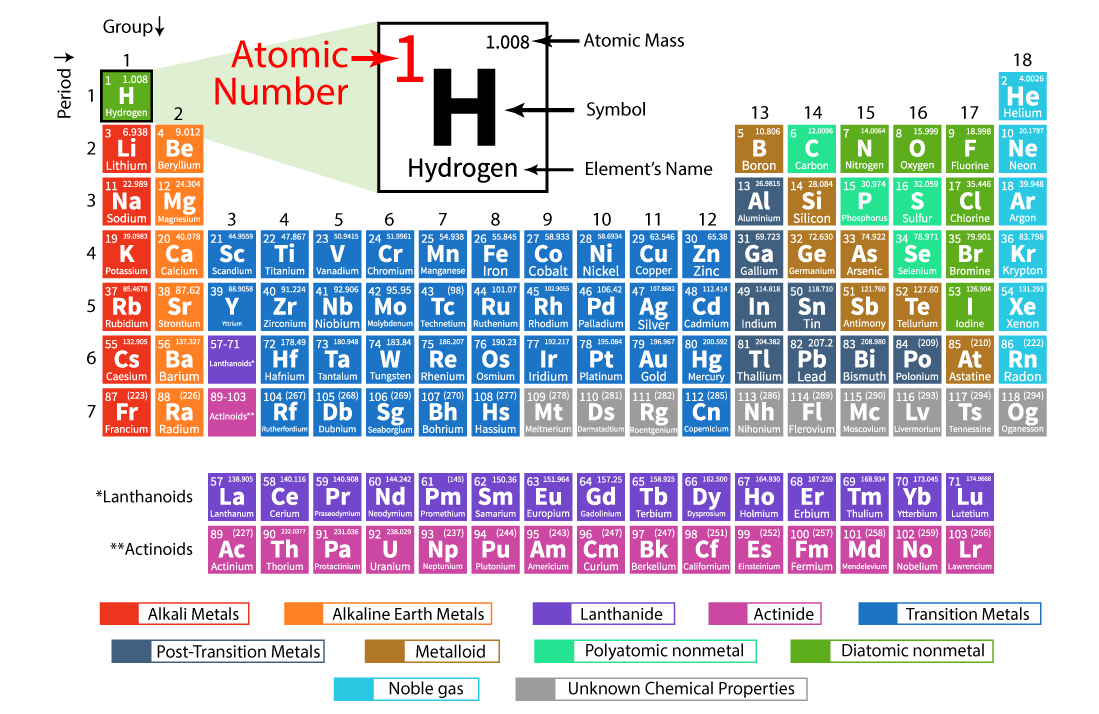
Hence, atomic number is the total number of protons present in a nucleus of an atom. It is generally represented by the symbol Z.
Atomic Number Definition
Atomic Number (Z) of a chemical element is equal to the number of protons occupied by the nucleus of an atom of the element. The atomic Number of Elements is simply the charge number of the nucleus as neutrons carry no net electrical charge.
Atomic Number Definition NCERT
The atomic number is defined as the total number of protons present in the nucleus of an atom.
Elements are characterised by their proton count. In hydrogen, Z = 1, as it contains a single proton in its nucleus. Likewise, for carbon, Z = 6, denoting its six protons.
The atomic number determines the identity of an element and many of its chemical properties. The modern periodic table is ordered by increasing atomic numbers.
Notation of an Element
The atomic number is typically denoted by the symbol **Z and is usually found above the symbol of the element in the periodic table. The notation of an atom typically includes the following components:
- **Element Symbol: This is the abbreviated representation of the element's name, usually one or two letters. For example, "H" for hydrogen, "He" for helium, "C" for carbon, and so on.
- **Atomic Number: As mentioned earlier, the atomic number (represented by _Z) indicates the number of protons in the nucleus of the atom.
- **Mass Number: The mass number (_A) of an atom represents the total number of protons and neutrons in the nucleus.
The notation of an atom is often represented as:
(Element Symbol)_{Atomic Number (Z)}^{Mass Number (A)}
**For example:
- The notation of a carbon atom with 6 protons and 6 neutrons in its nucleus would be C_6^{12}. This represents carbon-12, the most common isotope of carbon.
- The notation of a hydrogen atom with 1 proton and 0 neutrons in its nucleus (the most common isotope) would be H_1^1, representing hydrogen-1.
Atomic Number Examples
An atom's atomic number is equal to the number of protons in its nucleus or the number of electrons in an electrically neutral atom.
**Atomic Number = Number of Protons
For example, the Copper element has 29 electrons and 29 protons in its atom, therefore the Atomic Number of Copper is 29. Similarly, a Sodium atom has 11 electrons and 11 protons, thus its atomic number is 11.
List of 118 Elements - Their Symbols and Atomic Number
Here is the complete list of 118 elements present in the Periodic Table, with their Chemical Symbols and Atomic Numbers, is given below:
| Atomic Number | Name of the Element | Symbol of the Element |
|---|---|---|
| 1 | **Hydrogen | H |
| 2 | **Helium | He |
| 3 | **Lithium | Li |
| 4 | **Beryllium | Be |
| 5 | **Boron | B |
| 6 | **Carbon | C |
| 7 | **Nitrogen | N |
| 8 | **Oxygen | O |
| 9 | **Fluorine | F |
| 10 | **Neon | Ne |
| 11 | **Sodium | Na |
| 12 | **Magnesium | Mg |
| 13 | **Aluminium | Al |
| 14 | **Silicon | Si |
| 15 | **Phosphorus | P |
| 16 | **Sulphur | S |
| 17 | **Chlorine | Cl |
| 18 | **Argon | Ar |
| 19 | **Potassium | K |
| 20 | **Calcium | Ca |
| 21 | **Scandium | Sc |
| 22 | **Titanium | Ti |
| 23 | **Vanadium | V |
| 24 | **Chromium | Cr |
| 25 | **Manganese | Mn |
| 26 | **Iron | Fe |
| 27 | **Cobalt | Co |
| 28 | **Nickel | Ni |
| 29 | **Copper | Cu |
| 30 | **Zinc | Zn |
| 31 | **Gallium | Ga |
| 32 | **Germanium | Ge |
| 33 | **Arsenic | As |
| 34 | **Selenium | Se |
| 35 | **Bromine | Br |
| 36 | **Krypton | Kr |
| 37 | **Rubidium | Rb |
| 38 | **Strontium | Sr |
| 39 | **Yttrium | Y |
| 40 | **Zirconium | Zr |
| 41 | **Niobium | Nb |
| 42 | **Molybdenum | Mo |
| 43 | **Technetium | Tc |
| 44 | **Ruthenium | Ru |
| 45 | **Rhodium | Rh |
| 46 | **Palladium | Pd |
| 47 | **Silver | Ag |
| 48 | **Cadmium | Cd |
| 49 | **Indium | In |
| 50 | **Tin | Sn |
| 51 | **Antimony | Sb |
| 52 | **Tellurium | Te |
| 53 | **Iodine | I |
| 54 | **Xenon | Xe |
| 55 | **Cesium | Cs |
| 56 | **Barium | Ba |
| 57 | **Lanthanum | La |
| 58 | **Cerium | Ce |
| 59 | **Praseodymium | Pr |
| 60 | **Neodymium | Nd |
| 61 | **Promethium | Pm |
| 62 | **Samarium | Sm |
| 63 | **Europium | Eu |
| 64 | **Gadolinium | Gd |
| 65 | **Terbium | Tb |
| 66 | **Dysprosium | Dy |
| 67 | **Holmium | Ho |
| 68 | **Erbium | Er |
| 69 | **Thulium | Tm |
| 70 | **Ytterbium | Yb |
| 71 | **Lutetium | Lu |
| 72 | **Hafnium | Hf |
| 73 | **Tantalum | Ta |
| 74 | **Tungsten | W |
| 75 | **Rhenium | Re |
| 76 | **Osmium | Os |
| 77 | **Iridium | Ir |
| 78 | **Platinum | Pt |
| 79 | **Gold | Au |
| 80 | **Mercury | Hg |
| 18 | **Thallium | Tl |
| 82 | **Lead | Pb |
| 83 | **Bismuth | Bi |
| 84 | **Polonium | Po |
| 85 | **Astatine | At |
| 86 | **Radon | Rn |
| 87 | **Francium | Fr |
| 88 | **Radium | Ra |
| 89 | **Actinium | Ac |
| 90 | **Thorium | Th |
| 91 | **Protactinium | Pa |
| 92 | **Uranium | U |
| 93 | **Neptunium | Np |
| 94 | **Plutonium | Pu |
| 95 | **Americium | Am |
| 96 | **Curium | Cm |
| 97 | **Berkelium | Bk |
| 98 | **Californium | Cf |
| 99 | **Einsteinium | Es |
| 100 | **Fermium | Fm |
| 101 | **Mendelevium | Md |
| 102 | **Nobelium | No |
| 103 | **Lawrencium | Lr |
| 104 | **Rutherfordium | Rf |
| 105 | **Dubnium | Db |
| 106 | **Seaborgium | Sg |
| 107 | **Bohrium | Bh |
| 108 | **Hassium | Hs |
| 109 | **Meitnerium | Mt |
| 110 | **Darmstadtium | Ds |
| 111 | **Roentgenium | Rg |
| 112 | **Copernicium | Cn |
| 113 | **Nihonium | Nh |
| 114 | **Flerovium | Fl |
| 115 | **Moscovium | Mc |
| 116 | **Livermorium | Lv |
| 117 | **Tennessine | Ts |
| 118 | **Oganesson | Og |
Atomic Number and Orbital Energy Levels
When an electron reaches a given energy level, it is more likely to be located in certain parts of that level than in others. These parts are known as orbitals. Sublevels are formed by orbitals with the same energy. Each orbital may hold a maximum of two electrons.
Drawing diagrams like the one above is the most frequent means of depicting the distribution of electrons in an atom.
.jpg)
History of Atomic Number
- **Early Observations:
- In the 19th century, scientists recognized that elements had distinct properties.
- John Dalton proposed the atomic theory, suggesting that each element consisted of unique, indivisible atoms.
- **Mendeleev's Periodic Table:
- Dmitri Mendeleev organized elements based on their atomic weights, noticing periodic trends in their properties.
- While the periodic table was a significant advancement, it did not directly incorporate the concept of atomic number.
- **Moseley's Discovery:
- In 1913, Henry Moseley conducted X-ray experiments on elements.
- Moseley discovered that elements' properties correlated better with their atomic numbers than their atomic weights.
- He proposed that the atomic number represented the positive charge in the nucleus of an atom.
- **Acceptance and Development:
- Moseley's work led to the widespread acceptance of the concept of atomic number.
- The atomic number became the fundamental property used to organize elements in the periodic table.
- It provided a systematic way to classify elements and predict their chemical behaviors.
What is Mass Number?
The mass number of an atom is calculated by adding the number of protons and neutrons. The letter 'A' is used to signify it.
Because protons and neutrons exist in the nucleus of an atom, they are collectively referred to as nucleons. A carbon atom, for example, has six protons and six neutrons. As a result, its mass number is 12.
While the number of protons in an element's atoms remains constant, the number of neutrons might fluctuate. As a result, atoms of the same element might have varying mass numbers, which are referred to as isotopes. An electron's weight is almost negligible. As a result, an atom's atomic mass is almost equal to its mass number.
History of the Periodic Table
Scientists hypothesized that element qualities are periodic functions of their atomic masses, thus Mendeleev arranged 63 elements in a vertical column called groups and horizontal rows called periods. However, this classification technique was unable to explain the positions of some elements, rare earth metals, and isotopes. As a result, it was rejected. So, in 1923, Henry Mosley introduced a new attribute of elements called "Atomic number." He believed an element's atomic number to be a more fundamental feature than its atomic mass.
According to Dobereiner’s Triads, when atoms are grouped in increasing atomic mass order, the atomic mass of the middle element is almost equal to the arithmetic mean of the other two, and its properties are intermediate between those of the other two, according to this law.
Mendeleev investigated the properties of all 63 elements known at the time, as well as their compounds. When he arranged the elements in increasing order of atomic mass, he discovered that elements with comparable qualities appear on a regular basis. He made this finding in the form of the following statement in 1869, which is known as Mendeleev's Periodic Law.
Difference between Valency, Atomic Number and Mass Number
Valency relates to an element's chemical behavior, atomic mass signifies its total mass, and atomic number identifies its elemental identity based on the number of protons. Below are some more details:
- **Valency:
- Valency refers to the **combining capacity of an element, indicating the number of electrons an atom can gain, lose, or share to achieve a **stable electron configuration.
- It determines how elements interact with other elements to form compounds.
- Valency is typically determined by the number of electrons in the outermost energy level (valence shell) of an atom.
- Valency can be represented by a positive or negative integer or by Roman numerals.
- **Atomic Mass:
- Atomic mass is the **total mass of an atom, measured in atomic mass units (amu).
- It includes the **mass of protons, neutrons, and electrons within the atom.
- Atomic mass is generally calculated by summing the masses of protons and neutrons in the nucleus, with electrons contributing a negligible amount.
- Atomic mass is crucial for determining the overall mass of elements and compounds.
- It is typically **represented by the symbol "A" and can vary for different isotopes of the same element.
- **Atomic Number:
- The atomic number of an element is the **number of protons in the nucleus of each of its atoms.
- It defines the identity of an element and its placement in the periodic table.
- The atomic number also determines the number of electrons in a neutral atom, as it is equal to the number of protons.
- Atomic number is **represented by the symbol "Z" and is a fundamental property used to classify elements and predict their chemical behavior.
- Elements with different atomic numbers are distinct elements, while isotopes of the same element have the same atomic number but different mass numbers.
Practice Questions on Atomic Number
**Q1. Describe the significance of the atomic number in determining the identity of an element. Explain how the atomic number is related to the number of protons and electrons in an atom.
**Q2. Compare and contrast the concepts of atomic number and mass number. Provide examples to illustrate their differences and explain how they contribute to understanding the structure of atoms.
**Q3. Discuss the role of isotopes in relation to the atomic number and mass number of an element. How do isotopes differ from one another, and how does the atomic number remain constant across isotopes of the same element?
**Q4. Explain how the periodic table organizes elements based on their atomic numbers. Discuss the trends observed in the periodic table with respect to atomic number and explain their significance in understanding the properties of elements.
**Q5. Investigate the concept of nuclear stability in relation to the ratio of protons to neutrons in the nucleus of an atom. Provide examples of isotopes and discuss how variations in the number of neutrons affect the stability and properties of an atom.