Chlorine (Cl) (original) (raw)
Last Updated : 5 Jan, 2026
Chlorine is a chemical element that is represented by the symbol Cl. Chlorine is present in the 17th Group (Halogen Group) and 3rd Period of the Periodic table. Chlorine is a yellow-green, pungent-smelling gas at room temperature with an atomic number of 17 and an atomic mass of 35.45. Chlorine in liquid form can burn the skin, and chlorine in gaseous form irritates the mucous membrane.

Characteristics of Chlorine
- Chlorine is the second lightest halogen that lies between Fluorine and Bromine in the halogen group
- On the periodic table, it is found between fluorine and bromine.
- It has a [Ne] 3s2 3p5 electronic configuration. The stable isotopes of chlorine are one and two.
- Sodium chloride is the most common chlorine chemical, while hydrogen chloride is the most basic.
- Sodium chloride has the molecular formula NaCl, whereas hydrogen chloride has the molecular formula HCl. It has high reactivity.
- Chlorine is used as a Disinfectant to clean swimming pools, etc, but is a toxic, corrosive gas that can be irritating to the eyes and respiratory system when coming in direct contact.
- Chlorine was discovered in 1774 by Carl Wilhelm Scheele, a Swedish scientist.
Structure of Chlorine
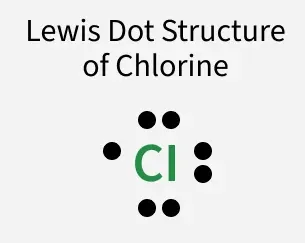
Chlorine has an atomic number of 17. This means that chlorine's atomic structure has a total of 17 protons and 17 electrons. These electrons are organised into three electron shells: K, L, and M. Chlorine has two electrons in its first electron shell and eight electrons in its second electron shell. Finally, the chlorine atom's outermost electron shell (also known as the valence shell) has a total of 7 electrons.

Electron-dot Structure of Chlorine
The valency of chlorine is frequently assumed to be 7. It's worth noting, though, that chlorine only requires one more electron to complete its octet structure. As a result, the valency of chlorine can also be thought of as 1.
Physical and Chemical Properties of Chlorine
Chlorine is a gas and has a greenish-yellow appearance at room temperature and atmospheric pressure.
Chlorine is the second halogen element of Group 17 (Halogen Group) of p-block elements with-
- Atomic Number (Z) or molar mass of Chlorine: 17
- Atomic Mass of Chlorine: 35.45
- Boiling Point of Chlorine: 239.11 K
- Melting Point of Chlorine: 171.6 K
- Density of Chlorine: 1.5625 g/cm3
- Electronegativity of Chlorine: 3.16
- Valency of Chlorine: 1
- Chemical Formula or Symbol of Chlorine: Cl
Chlorine is 2.5 times heavier than air.
Chlorine is a highly electronegative and electron-affinity element.
When charcoal is present, the reaction between Chlorine and Hydrogen occurs quickly in the dark. Because of its strong affinity for Hydrogen, Chlorine can react with a wide variety of molecules. For example, when Chlorine combines with hydrocarbons, chlorine atoms gradually replace the hydrogen atoms. However, chlorine atoms are easily added to the double or triple bond if the hydrocarbon is unsaturated.
Each Chlorine molecule contains two atoms (Cl2). Except for the lighter noble gases, practically all elements interact with chlorine to form Chlorides.
The Chlorides of most metals are ionic crystals, but those of semimetals and nonmetals are primarily molecules.
Isotopes of Chlorine
The element Chlorine (Cl) has a total of 25 isotopes ranging from 28Cl to 52Cl. Out of these 25 isotopes, only two are stable. The stable isotopes of Chlorine are 35Cl with 75.77% of abundance and 37Cl, which is 24.23% abundant, thus giving chlorine a standard atomic weight of 35.45. The radioactive isotope that lives longest is 36Cl, which has a half-life of 3.01 × 10⁵ years.
Uses of Chlorine
- It is used to eliminate the odour of putrefaction.
- It is employed as a disinfectant.
- To kill microorganisms, chlorine is utilised in the treatment of drinking water.
- It is employed in the cleaning of swimming pools.
- It is used in the manufacture of paper and paper-related products.
- It is employed as an antiseptic.
- It is used in the manufacture of medicines.
- It's utilised in the production of colours and polymers.
Solved Question
**Question 1: Is Chlorine a metal or a non-metal?
**Answer:
Yes, Chlorine is a non-metal; it is a yellowish-green gas with a high degree of reactivity. Chlorine reacts with various metals to form a wide range of compounds.
**Question 2: Write the electron dot structure for Potassium Chloride?
**Answer:
Since the number of valence electrons in Potassium (K) and Chlorine (Cl) is 1 and 7, respectively.
Hence, the electron dot structure for Potassium Chloride is below:

**Question 3: What happens when Lime Water reacts with Chlorine?
**Answer:
Lime water reacts with chlorine to give Calcium hypochlorite (CaOCl2) or Bleaching Powder as shown in the chemical reaction below:

**Question 4: Why does Bleaching powder give the smell of Chlorine?
**Answer:
Bleaching powder gives the smell of chlorine because it reacts with the Carbon dioxide present in nature to give Calcium carbonate and Chlorine, as shown in the reaction below:
