Chemical Reactions (original) (raw)
Last Updated : 6 May, 2026
A chemical reaction is a process in which one or more substances, called reactants, are converted into new substances known as products. These products have completely different physical and chemical properties from the reactants. In a chemical reaction, the atoms of the reactants rearrange themselves by breaking old chemical bonds and forming new bonds. This results in the formation of new substances.
**Example: When magnesium ribbon is heated in air, it reacts with oxygen to form magnesium burns with a bright white flame forming magnesium oxide
2Mg + O2 → 2MgO
Characteristics of a Chemical Reaction
A chemical reaction is generally accompanied by certain observable changes. These changes help in identifying that a chemical reaction has taken place and new substances have been formed.
- **Change in State: During a chemical reaction, the physical state of substances may change. For example, solid substances may form liquids or gases after the reaction.
- **Change in Colour: A change in colour is often observed when a chemical reaction occurs, indicating the formation of a new substance with different properties.
- **Evolution of Gas: Some chemical reactions result in the formation of a gas, which can be observed in the form of bubbles or detected by bubbles or effervescence.
- **Formation of Precipitate: In certain reactions, an insoluble solid substance called a precipitate is formed when two aqueous solutions are mixed.
- **Change in Temperature: Chemical reactions may involve a change in temperature. If heat is released, the reaction is called exothermic, and if heat is absorbed, it is called endothermic.
Chemical Equation
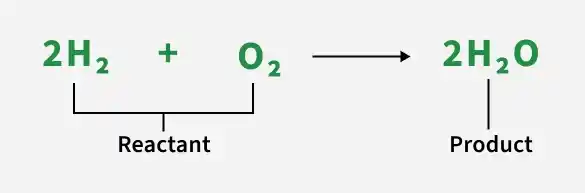
A chemical equation is the symbolic representation of a chemical reaction, in which the reactants and products are written using their chemical formulas.
- The substances that take part in the reaction are called reactants and are written on the left-hand side (LHS).
- The new substances formed are called products and are written on the right-hand side (RHS).
- An arrow (→) is used to show the direction of the reaction.
**Example:
When hydrogen reacts with oxygen to form water:
2H2 + O2 → 2H2O
Factors Affecting the Rate of Chemical Reaction
The rate of a chemical reaction is defined as the speed at which reactants are converted into products. Different reactions occur at different rates—some are very fast, while others are slow. The rate of a reaction depends on several factors, which are explained below:
- **Nature of Reactants: The chemical nature of the reactants plays an important role in determining the rate of reaction. Some substances react very quickly, while others react slowly depending on their reactivity and bond strength.
- **Concentration of Reactants: The rate of reaction increases with an increase in the concentration of reactants. This is because a higher concentration means more particles are present in a given volume, leading to more frequent collisions between them.
- **Temperature: An increase in temperature increases the rate of reaction. At higher temperatures, particles gain more kinetic energy and move faster. This results in more frequent and effective collisions between reacting particles.
- **Surface Area of Reactants: The rate of reaction increases with an increase in surface area of solid reactants. When a substance is in powdered form, it has a larger surface area compared to a solid piece, allowing more particles to participate in the reaction.
- **Catalyst: A catalyst is a substance that increases the rate of a chemical reaction without undergoing any permanent chemical change itself. It provides an alternative pathway for the reaction with lower activation energy.
Types of Chemical Reaction
Chemical reactions are classified into different types based on the way reactants are transformed into products.
- **Combustion Reaction: A combustion reaction is a reaction in which a substance reacts with oxygen and releases heat and light energy. These reactions are usually exothermic.
- **Decomposition Reaction: A decomposition reaction is one in which a single compound breaks down into two or more simpler substances by the action of heat, light, or electricity.
- **Single Displacement Reaction: In this reaction, a more reactive element displaces a less reactive element from its compound.
- **Double Displacement Reaction: In this reaction, two compounds exchange their ions to form two new compounds. These reactions often result in the formation of a precipitate.
- **Redox Reaction (Oxidation–Reduction): A redox reaction is a reaction in which oxidation and reduction occur simultaneously. Oxidation is loss of electrons or gain of oxygen. Reduction is gain of electrons or loss of oxygen.