Rutherford's Alpha Particle Scattering Experiment (original) (raw)
Last Updated : 23 Jul, 2025
Ernest Rutherford, a British scientist who won the Nobel Prize in 1908, conducted the alpha particle scattering experiment, which led to the development of the Rutherford Atomic Model. His primary goal was to understand how electrons were arranged within an atom. Rutherford's gold foil experiment, which involved directing alpha particles at gold foil, led to the discovery of the atomic nucleus and reshaped atomic theory.

Components of Alpha Particle Scattering Experiment
The alpha particle scattering experiment, conducted by Ernest Rutherford, involved several key components:
- **Gold Foil: A thin sheet of gold, around 100 nm thick, was used as the target for the alpha particles. Gold was chosen because it could be made into a very thin foil, allowing the particles to pass through and interact with the atoms.
- **Alpha Particles: These are positively charged particles (helium nuclei) emitted from a radioactive source. They were directed at the gold foil at high speeds in order to observe how they interacted with the atoms of the gold.
- **Zinc Sulfide Screen: A fluorescent screen coated with zinc sulfide was placed around the gold foil to detect the deflection of alpha particles. When an alpha particle struck the screen, it produced a tiny flash of light, which could be observed through a microscope.
- **Alpha Particle Source: The source of the alpha particles was typically a radioactive material such as radium, which emitted alpha particles in a steady stream.
- **Observation Equipment: A microscope or detector was used to observe and record the scattered alpha particles after they passed through or were deflected by the gold foil.
**In this experiment, Rutherford directed high-energy alpha particles at a thin sheet of gold foil. He expected the alpha particles, which are much heavier than the protons in a gold atom, to be deflected by only small angles. However, the results were surprising. He observed that:
- Some particles were deflected by small angles.
- Most particles passed straight through the gold foil without any deflection.
- Some particles were deflected by large angles, and some even bounced back (about 1 out of 12,000 particles).
.webp)
Observations of Rutherford’s Experiment
The observations of Rutherford’s Alpha Scattering Experiment are:
- First, he observe that most of the α-particles that are bombarded towards the gold sheet pass away the foil without any deflection, and hence it shows most of the space is empty.
- Out of all, some of the α-particles were deflected through the gold sheet by very small angles, and hence it shows the positive charge in an atom is non-uniformly distributed. The positive charge is concentrated in a very small volume in an atom.
- Very few of the alpha-particles(1-2%) were deflected back, i.e. only a very less amount of α-particles had nearly 180° angle of deflection. this shows that the volume occupied by the positively charged particles is very small as compared to the total volume of an atom.
Rutherford Atomic Model
Rutherford proposed the atomic structure of elements, on the basis of his experiment. According to Rutherford's atomic model:
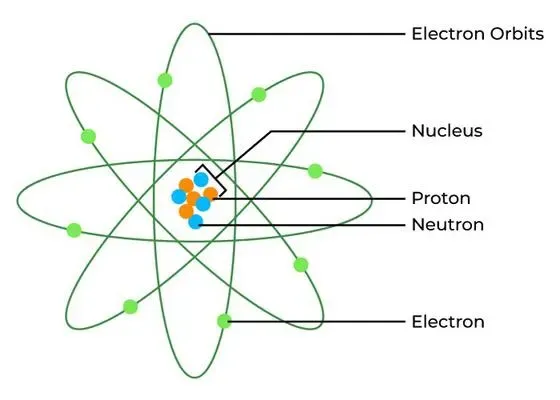
Rutherford's Atomic Model
- Positively charged particle was concentrated in an extremely small volume and most of the mass of an atom was also in that volume. He called this a nucleus of an atom.
- Rutherford proposed that there is negatively charged electrons around the nucleus of an atom. the electron surrounding the nucleus revolves around it in a circular path with very high speed. He named orbits to these circular paths.
- Nucleus being a densely concentrated mass of positively charged particles and electrons being negatively charged are held together by a strong force of attraction called electrostatic forces of attraction.
**Read More, Rutherford Atomic Model
Limitations of Rutherford Atomic Model
The Rutherford atomic model is failed to explain certain things :
- According to Maxwell's theory, an electron revolving around the nucleus should emit electromagnetic radiation because accelerated charged particles emit such radiation. However, the Rutherford model suggested that electrons revolve around the nucleus in fixed orbits. This motion would result in the emission of radiation, causing the electrons to lose energy and their orbits to shrink. Eventually, the electrons would spiral inward and collapse into the nucleus.
- As per the Rutherford model, calculations have shown that an electron would collapse in the nucleus in less than 10-8 seconds. So Rutherford model has created a high contradiction with Maxwell’s theory and Rutherford later could not explain the stability of an atom.
- Rutherford's model also failed to describe the arrangement of electrons in orbits, leaving this crucial aspect of atomic structure unexplained. Despite its limitations, the Rutherford model laid the foundation for future developments in atomic theory and quantum mechanics, inspiring further exploration into atomic behavior.
Sample Questions on Rutherford's Alpha Scattering Experiment
**Q1: Represent Element ‘X’ which contains 15 electrons and 16 neutrons.
**Answer:
Atomic number of element = No. of electron = 15
Mass number of element = no. of electrons + no. of neutrons = 15 + 16 = 31
Correct representation of element X is 31X15.
**Q2: Name particle and give its location in the atom which has no charge and has a mass nearly equal to that of a proton.
**Answer:
The particle which has no charge and has a mass nearly equal to that of a proton is a neutron and it is present in the nucleus of the atom.
**Q3: An atom has both electron attribute negative charge and protons attribute positive charge but why there is no charge?
**Answer:
Positive and negative charges of protons and electrons are equal in magnitude, they cancel the effect of each other. So, the atom as a whole is electrically neutral.
**Q4: What is Valency of Sodium Atom (Na)?
The atomic number of sodium = 11. Electronic configuration (2, 8, 1). By losing one electron it gains stability hence its valency is 1.
**Q5: Which property do the following pairs show? 209 X 84 and **210 X 84
Atomic number of X is the same hence the pair shows an isotopic property. So, 209X84 and 210X84 are isotopes.
Conclusion
Rutherford's alpha scattering experiment, or gold foil experiment, demonstrated that atoms are largely empty space, with a dense, positively charged nucleus at the center. When alpha particles were directed at a thin gold foil, most passed straight through, indicating the presence of empty space. Some particles were deflected at small angles, suggesting a concentrated positive charge, while a few were deflected back, indicating a small, dense nucleus.