Thomson's Atomic Model (original) (raw)
Last Updated : 8 May, 2026
Thomson suggested that atoms are made up of a positively charged sphere with negatively charged electrons embedded within it, which is also known as the "plum pudding model." The positive charge was thought to be evenly distributed throughout the sphere, balancing out the negative charge of the electrons. The electrons were held in place by electrostatic attraction to the positive charge.
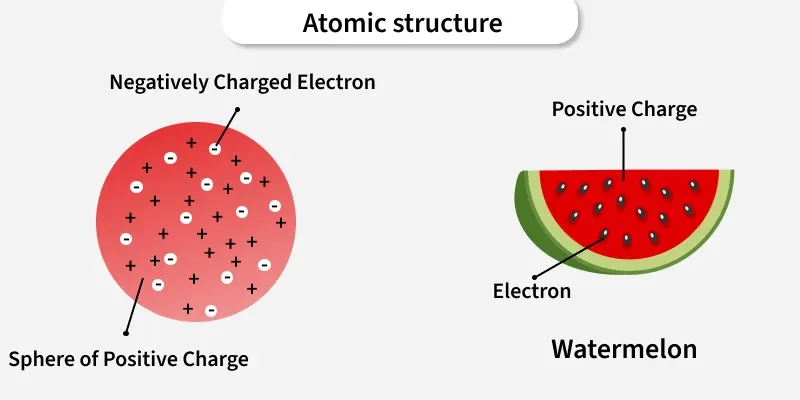
Structure of the Atom According to Thomson’s Plum Pudding Model
- This atomic model helped explain certain observations at the time, such as why atoms are electrically neutral and why cathode rays were negatively charged.
- It also provided a theoretical framework for understanding the distribution of electrons within an atom, offering insights into atomic structure.
**Postulates of Thomson's Atomic Model
The Thomson Atomic Model was proposed by J. J. Thomson after the discovery of the electron. To explain the structure of an atom, he suggested certain basic statements called postulates.
- **Spherical Structure of the Atom: The atom is a uniformly positively charged sphere in which negatively charged electrons are embedded.
- **Electrical Neutrality: The total positive charge of the sphere is equal to the total negative charge of the embedded electrons, making the atom electrically neutral.
- **Distribution of Electrons: The electrons are uniformly scattered within the positively charged sphere like plums (or raisins) embedded in a pudding, hence the name “plum pudding model.”
- **Electrostatic Attraction: The negatively charged electrons are held in place by the electrostatic force of attraction between the electrons and the positively charged sphere.
- **Freedom and Confinement of Electrons: Electrons were considered to be embedded in the positive sphere, but their exact motion was not clearly defined.
Physical Properties
According to the model, atoms have some important physical properties related to their structure and distribution of charges.
- **Shape of Atom: The atom is considered to be a uniform solid sphere.
- **Positive Charge Distribution: Positive charge is evenly spread throughout the atom.
- **Electrons: Negatively charged electrons are embedded inside the positive sphere.
- **Neutral Nature: Total positive charge = Total negative charge → Atom is electrically neutral.
- **Mass Distribution: Mass is uniformly distributed throughout the atom.
Chemical Properties
The arrangement of electrons and positive charge in the Thomson Atomic Model also helps explain some chemical properties of atoms, such as how atoms combine with other atoms and form compounds.
- **Chemical Neutrality: Since positive and negative charges are equal, atoms are neutral and stable.
- **Valency Explanation (Partial): Chemical properties depend on the number of electrons present in the atom.
- **Reactivity: Atoms may lose or gain electrons during chemical reactions.
- **Formation of Ions: Loss or gain of electrons can form positive or negative ions.
Limitations of Thomson's Atomic Model
Although the Thomson Atomic Model was an important early attempt to explain atomic structure, it could not explain several experimental observations.
- The model could not explain atomic stability and how electrons remain arranged within the atom.
- The model could not explain the emission of specific wavelengths of light by atoms, failing to account for spectral lines.
- It did not recognize the existence of a dense central nucleus, which was later confirmed by Rutherford’s experiment.
- The model didn’t provide a clear understanding of the arrangement or behavior of electrons within the atom.
- Rutherford's experiment contradicted the model, as it revealed a concentrated nucleus, not a diffuse positive charge as proposed by Thomson.