Valence Bond Theory (original) (raw)
Last Updated : 18 Apr, 2026
Valence Bond Theory (VBT) is a theory used to explain how atoms combine to form molecules through chemical bonds. It mainly focuses on covalent bonding, where atoms share electrons to achieve stability. According to this theory, a chemical bond is formed when the outermost orbitals (called valence orbitals) of two atoms overlap with each other, and the electrons involved have opposite spins.
Valence Bond Theory was developed by scientists like Linus Pauling and Walter Heitler. Their work helped in understanding how atoms come together and why molecules have specific shapes and bond strengths. The main idea of VBT is that bond formation leads to a decrease in energy, which makes the molecule more stable. The greater the overlap between atomic orbitals, the stronger the bond formed between atoms.
Postulates of Valence Bond Theory
Postulates explain how and why covalent bonds are formed between atoms. These are the main assumptions on which the theory is based.
- In Valence Bond Theory, a covalent bond is formed by the overlap of atomic orbitals of two atoms.
- The electrons involved in bond formation must have opposite spins to pair together.
- Bond formation results in a decrease in energy, making the molecule more stable.
- The shared electron pair remains localized between the bonded atoms.
- Greater overlap of orbitals leads to a stronger bond.
- Bonds are directional, which helps in determining the shape of molecules.
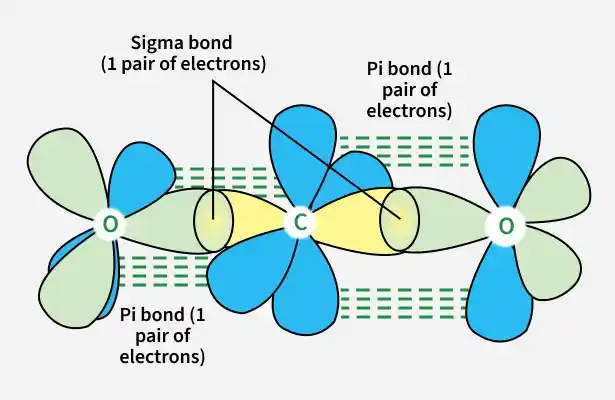
- Overlapping can occur in two ways: head-on overlap (sigma bond) and sideways overlap (pi bond).
Types of Covalent Bonds
Covalent bonds are formed by the overlap of atomic orbitals. Based on the type of overlap, covalent bonds are mainly of two types:
**1. Sigma (σ) bond
- This bond is formed by head-on (direct) overlap of atomic orbitals along the line joining the nuclei of two atoms.
- It is the strongest type of covalent bond because the overlap is maximum.
- Sigma bonds allow free rotation of atoms around the bond.
**Examples:
- Hydrogen molecule (H2) – formed by overlap of two s orbitals
- Methane (CH4) – all bonds are sigma bonds
2. Pi (π) bond
- This bond is formed by sideways (lateral) overlap of p orbitals.
- It is weaker than a sigma bond because the overlap is less.
- Pi bonds do not allow free rotation and are usually formed along with a sigma bond in multiple bonds.
**Examples:
- Ethene (C2H4) – one sigma bond and one pi bond between carbon atoms
- Ethyne (C2H2) – one sigma bond and two pi bonds
Overlapping of Atomic Orbitals
The overlapping of atomic orbitals is the basic concept that explains the formation of covalent bonds. When two atoms come close to each other, their atomic orbitals overlap, and the electrons present in these orbitals are shared between the atoms. This sharing leads to bond formation and increases the stability of the molecule. The greater the extent of overlapping, the stronger is the bond formed between atoms.
Based on the type of orbitals involved in overlapping, it is classified as :
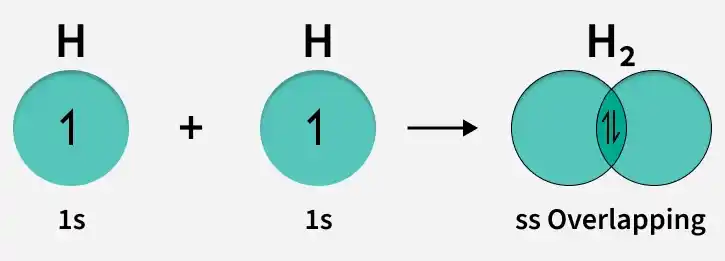
**1. s–s overlap
- This type of overlap occurs between two half-filled s-orbitals of two atoms.
- Since s-orbitals are spherical in shape, the overlap is head-on, resulting in the formation of a sigma (σ) bond.
**Example: Hydrogen molecule (H2)
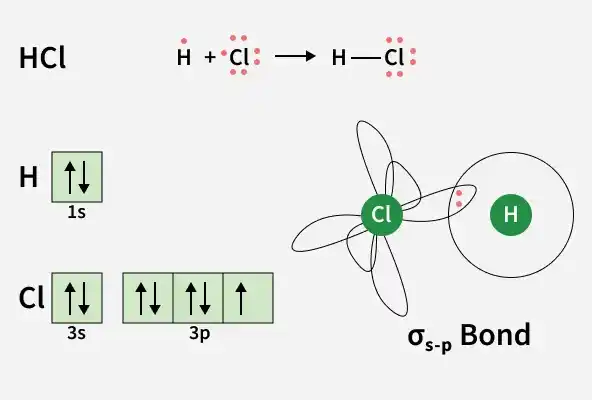
2. s–p overlap
- This overlap takes place between a half-filled s-orbital of one atom and a half-filled p-orbital of another atom.
- The overlap is also head-on, forming a sigma (σ) bond.
**Example: Hydrogen chloride (HCl)
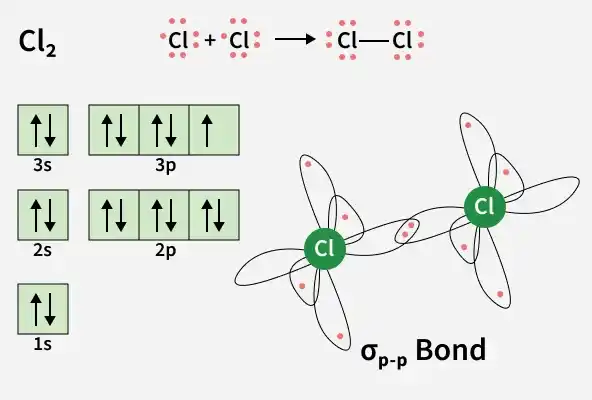
3. p–p overlap
This type of overlap occurs between two half-filled p-orbitals. It can take place in two ways:
- Head-on overlap, forming a sigma (σ) bond
- Sideways overlap, forming a pi (π) bond
**Examples:
- Sigma bond: Chlorine molecule (Cl2)
- Pi bond: Ethene (C2H4)
Hybridization
Hybridization is the process of mixing of atomic orbitals of nearly equal energy to form new equivalent orbitals called hybrid orbitals. These hybrid orbitals help in explaining the geometry and shape of molecules.
Number of Orbitals
It invloves mixing of atomic orbitals to form new hybrid orbitals. An important rule is that the total number of orbitals remains the same before and after hybridization.
This means:
- The number of hybrid orbitals formed = number of atomic orbitals mixed
- Each hybrid orbital can form one sigma bond
- The number of orbitals helps in determining how many bonds an atom can form and also gives an idea about the shape of the molecule.
**Examples:
- 1 s + 1 p → 2 hybrid orbitals (sp)
- 1 s + 2 p → 3 hybrid orbitals (sp2)
- 1 s + 3 p → 4 hybrid orbitals (sp3)
Types of Hybridization
Hybridization is classified based on the number and type of orbitals involved in mixing:
**1. sp hybridization
- Mixing of 1 s and 1 p orbital
- Number of hybrid orbitals: 2
- Geometry: Linear (180°)
**Example: BeCl2
**2. sp² hybridization
- Mixing of 1 s and 2 p orbitals
- Number of hybrid orbitals: 3
- Geometry: Trigonal planar (120°)
**Example: BF3
**3. sp³ hybridization
- Mixing of 1 s and 3 p orbitals
- Number of hybrid orbitals: 4
- Geometry: Tetrahedral (109.5°)
**Example: CH4
**4. sp³d hybridization
- Mixing of 1 s, 3 p, and 1 d orbital
- Number of hybrid orbitals: 5
- Geometry: Trigonal bipyramidal
**Example: PCl5
**5. sp³d² hybridization
- Mixing of 1 s, 3 p, and 2 d orbitals
- Number of hybrid orbitals: 6
- Geometry: Octahedral
**Example: SF6
Limitations of VBT
Although the theory successfully explains the formation and direction of covalent bonds, it has certain limitations.
- It cannot explain the magnetic properties of some molecules, such as oxygen (O₂), which is paramagnetic.
- It does not properly explain the delocalization of electrons in molecules like benzene.
- It fails to give an accurate explanation of bond energies and bond lengths in some cases.
- It assumes that bonds are localized, which is not true for all molecules.
- It cannot explain the colour and spectra of certain compounds, especially coordination compounds.
Applications of VBT
The concept of orbital overlap and hybridization is widely used to understand different aspects of chemical bonding. It has several important applications in chemistry.
- It helps in explaining the formation of covalent bonds between atoms.
- It is used to predict the shape and geometry of molecules with the help of hybridization.
- It explains the directional nature of bonds, which determines molecular structure.
- It helps in understanding the strength of bonds based on the extent of overlapping.
- It is useful in studying chemical reactivity and stability of molecules.
- It plays an important role in organic chemistry, especially in understanding structures of carbon compounds.