VSEPR Theory (original) (raw)
Last Updated : 16 May, 2026
VSEPR theory stands for Valence Shell Electron Pair Repulsion Theory. It is a theory used to predict the shape of molecules. According to this theory, the electron pairs present in the valence shell of the central atom repel each other because they are negatively charged. To reduce this repulsion and achieve maximum stability, these electron pairs arrange themselves as far apart from each other as possible in space. These electron pairs may be bond pairs (shared between atoms) and lone pairs (non-bonding electrons).
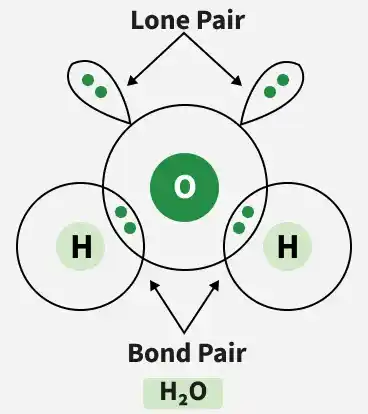
The different shapes that molecules adopt according to VSEPR theory are shown in the illustration below.
| No. of Electron Paper | Electron Pair Geometry | No Lone Pair | 1 Lone Pair | 2 Lone Pairs | 3 Lone Pairs | 4 Lone Pairs |
|---|---|---|---|---|---|---|
| 2 | Linear | Linear | - | - | - | - |
| 3 | Trigonal Planar | Trigonal Planar | Bent | - | - | - |
| 4 | Tetrahedral | Tetrahedral | Trigonal Pyramidal | Bent | - | - |
| 5 | Trigonal Bipyramidal | Trigonal Bipyramidal | See-saw | T-shaped | Linear | - |
| 6 | Octahedral | Octahedral | Square Pyramidal | Square Planar | T-Shaped | Linear |
Postulates of VSEPR Theory
According to this theory, electron pairs repel each other and arrange themselves in such a way that the repulsion between them becomes minimum. This arrangement determines the geometry of the molecule.
The basic rules or assumptions of this theory are called its postulates.
- The shape of a molecule depends on the number of electron pairs (bond pairs and lone pairs) present in the valence shell of the central atom.
- Electron pairs repel each other because they are negatively charged.
- Both bond pairs and lone pairs are counted while determining the geometry.
- The order of repulsion between electron pairs is:
Lone pair – Lone pair > Lone pair – Bond pair > Bond pair – Bond pair
- Lone pairs occupy more space than bond pairs because they are attracted by only one nucleus.
- The actual shape of the molecule depends only on the positions of atoms (bond pairs), not on lone pairs.
Predicting Shapes of Molecules
Predicting the shapes of molecules using the Valence Shell Electron Pair Repulsion (VSEPR) Theory involves a step-by-step approach where the arrangement of electron pairs around a central atom is analyzed to determine the most stable molecular geometry.
**Step 1: Determine the Lewis Structure
- Draw the Lewis structure of the molecule to count the total number of valence electrons.
- Identify bonding pairs (shared electrons) and lone pairs (non-bonded electrons) on the central atom.
**Step 2: Count Electron Pairs Around Central Atom
- Count all electron pairs (bond pairs + lone pairs) around the central atom.
- It is called steric number or VSEPR number.
**Step 3: Determine Electron Pair Geometry
- Electron pairs repel each other and try to stay as far apart as possible.
- The arrangement of electron pairs gives the electron pair geometry.
**Step 4: Determine Molecular Shape
- The actual shape of the molecule depends only on the positions of atoms (bonding pairs), not the lone pairs.
- Lone pairs affect bond angles, causing slight distortions in shape.
**Step 5: Apply the General Rules
- Lone pair – Lone pair repulsion is stronger than Lone pair – Bond pair, which is stronger than Bond pair – Bond pair.
- More lone pairs → smaller bond angles
VSEPR Number
The VSEPR number (also called steric number) is the total number of electron pairs (both bond pairs and lone pairs) around the central atom of a molecule.
**Formula to calculate VSEPR number:
**VSEPR Number = Number of bonded atoms (bond pairs)+Number of lone pairs on central atom
**Example:
In NH3 :
- Bond pairs = 3 (three H atoms)
- Lone pairs = 1 (on N)
- VSEPR number = 3 + 1 = 4
Since the VSEPR number is 4, the electron pair geometry is tetrahedral, but the molecular shape is trigonal pyramidal.
| VSEPR Number | Shape of Molecule |
|---|---|
| 2 | Linear Structure |
| 3 | Trigonal Planar Structure |
| 4 | Tetrahedral Structure |
| 5 | Trigonal Bipyramidal Structure |
| 6 | Octahedral Structure |
| 7 | Pentagonal Bipyramidal Structure |
VSEPR Shapes
Using VSEPR theory, we can predict the shapes of molecules such as linear, bent, trigonal planar, tetrahedral, trigonal pyramidal, trigonal bipyramidal, and octahedral. The theory also explains why some molecules are **symmetrical, while others are distorted due to lone pair repulsions.
**The various shapes of molecules are:
**1. Linear Shape
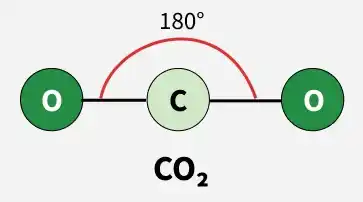
A molecule has a linear shape when the central atom is surrounded by two bond pairs and no lone pairs. Two electron pairs repel each other and arrange themselves as far apart as possible. The maximum distance between two electron pairs is 180°, so the molecule becomes linear.
- Total electron pairs = 2
- Bond pairs = 2
- Lone pairs = 0
- Bond angle = 180°
**Example: CO2
There are only two bonding regions, they arrange at 180°.
So, CO2 has a linear shape.
Structure :
O = C = O
**2. Trigonal Planar
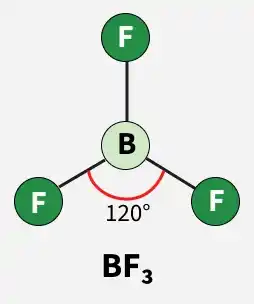
A molecule has a trigonal planar shape when the central atom is surrounded by three bond pairs and no lone pairs. According to VSEPR theory, three electron pairs repel each other and arrange themselves in one plane as far apart as possible. The bond angle formed is 120°.
- Total electron pairs = 3
- Bond pairs = 3
- Lone pairs = 0
- Bond angle = 120°
**Example: BF₃ (Boron trifluoride)
The three bond pairs spread out equally in one plane at 120°.
So, BF₃ has a trigonal planar shape.
**3. Tetrahedral
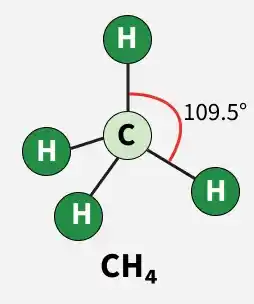
A molecule has a tetrahedral shape when the central atom is surrounded by four bond pairs and no lone pairs. According to VSEPR theory, four electron pairs repel each other and arrange themselves as far apart as possible in three-dimensional space. This arrangement gives a tetrahedral geometry.
- Total electron pairs = 4
- Bond pairs = 4
- Lone pairs = 0
- Bond angle = 109.5°
**Example: CH₄ (Methane)
- Carbon is the central atom.
- It forms four single bonds with hydrogen atoms.
- No lone pairs on carbon.
So, CH₄ has a tetrahedral shape with bond angle 109.5°.
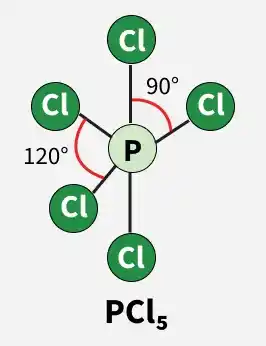
**4. Trigonal Bipyramidal
A molecule has a trigonal bipyramidal shape when the central atom is surrounded by five bond pairs and no lone pairs. Five electron pairs arrange themselves in a way that three lie in one plane (120° apart) and two are above and below the plane.
- Total electron pairs = 5
- Bond pairs = 5
- Lone pairs = 0
- Bond angles = 90° and 120°
**Example: PCl₅ (Phosphorus pentachloride)
- Phosphorus is the central atom.
- It forms five single bonds with chlorine atoms.
- No lone pairs on phosphorus.
So, PCl₅ has a trigonal bipyramidal shape.
**5. Octahedral
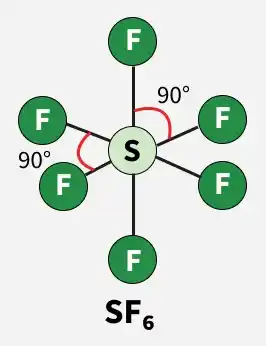
A molecule has an octahedral shape when the central atom is surrounded by six bond pairs and no lone pairs. Six electron pairs arrange themselves symmetrically around the central atom in three-dimensional space.
- Total electron pairs = 6
- Bond pairs = 6
- Lone pairs = 0
- Bond angle = 90°
**Example: SF₆ (Sulphur hexafluoride)
- Sulphur is the central atom.
- It forms six single bonds with fluorine atoms.
- No lone pairs on sulphur.
So, SF₆ has an octahedral shape
Limitations of VSEPR Theory
Although VSEPR theory is very useful in predicting the shapes of simple molecules, it has some limitations. It does not explain all molecular geometries correctly, especially in complex cases.
- It cannot accurately predict the shapes of molecules containing transition metals.
- It does not explain the exact bond angles in many molecules.
- It cannot explain the shape of molecules with delocalized electrons (like in resonance structures).
- It does not explain the difference in bond lengths.
- It works mainly for simple molecules and is less accurate for large or complex molecules.