What is Private Cloud ? (original) (raw)
Last Updated : 7 Mar, 2026
In 2026, the **Private Cloud is no longer just "a server in the basement." It has evolved into a sophisticated, software-defined environment that offers the agility of the public cloud with the physical and logical isolation required by modern enterprises.
The Core Architecture
A private cloud isn't just hardware; it's a stack of technologies working together.
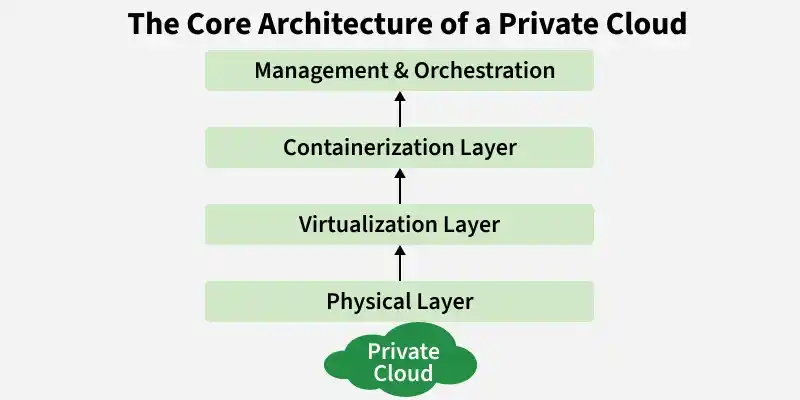
The Infrastructure Layers:
- **Physical Layer: The actual "bare metal" servers, high-speed storage arrays (SAN/NAS), and networking switches.
- **Virtualization Layer (The Hypervisor): This is the heart of the cloud. Tools like VMware ESXi, Microsoft Hyper-V, or KVM abstract the physical hardware into Virtual Machines (VMs).
- **Containerization Layer: Modern private clouds often run Kubernetes (e.g., Red Hat OpenShift) directly on bare metal or VMs to manage microservices.
- **Management & Orchestration: A "Cloud Management Platform" (CMP) provides a self-service portal for users to request resources without needing an IT admin to manually set them up.
Private Cloud Deployment Models and Use Cases
Private cloud computing provides organizations with dedicated resources that are not shared with other tenants offering enhanced control, security and compliance. There are several deployment models for the private clouds primarily distinguished by where the infrastructure is located and how it is managed.
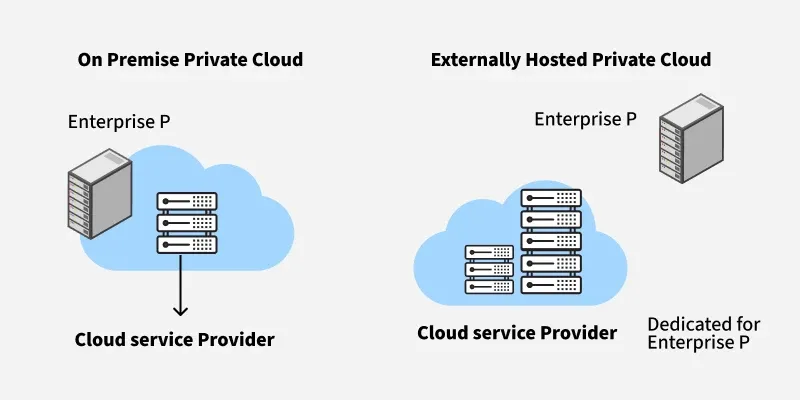
A. On-Premises Private Cloud (Internal)
The organization owns the hardware and houses it in its own data center.
- **Control: Absolute. You decide every hardware spec and security patch.
- **Ideal For: High-security sectors like National Defense or Core Banking Systems.
- **Challenge: High upfront cost (CapEx) and requires a large, skilled IT team
2. Externally Hosted Private Cloud
The Hosted private clouds are provided by third-party vendors who manage the infrastructure while still offering dedicated resources for the single organization. This model allows organizations to leverage the cloud without investing in the physical hardware.
**Use Cases:
- **Control: High. You still own the data and software, but the provider handles the "power and cooling."
- **Ideal For: Healthcare providers needing HIPAA compliance without wanting to manage physical server racks.
Challenges and Considerations in Adopting Private Cloud
While private cloud solutions offer numerous advantages organizations face several challenges when adopting this technology. Addressing these challenges is crucial for the successful implementation.
Common Challenges
- **Cost: The initial investment in infrastructure and ongoing operational costs can be significant for the private cloud deployment.
- **Tip: Conduct a detailed cost-benefit analysis to the understand the long-term savings and ROI. Explore financing options or hybrid models to mitigate upfront costs.
- **Maintenance: The Managing and maintaining the private cloud can require significant IT resources and expertise.
- **Tip: Consider partnering with the managed service providers who can take on maintenance tasks allowing your in-house team to the focus on strategic initiatives.
- **Scalability: The Scaling a private cloud can be more challenging compared to public cloud solutions especially if additional hardware is required.
- **Tip: Implement a hybrid cloud strategy integrating the public cloud resources as needed to the handle spikes in demand without the over-provisioning on-premises resources.
- **Compliance and Security: Ensuring compliance with the industry regulations and maintaining robust security can be complex and time-consuming.
- **Tip: Develop a comprehensive compliance framework and security policies. The Regularly audit your cloud environment to the identify and address potential vulnerabilities.
Private Cloud Deployment Examples
1. On-Premises Private Cloud
- An organization sets up its private cloud infrastructure within its own data center. This allows complete control over hardware, security and data management.
- **Example: A financial institution may deploy an on-premises private cloud to the manage sensitive customer data and comply with the regulatory requirements.
2. Hosted Private Cloud
- A third-party service provider hosts the private cloud infrastructure on behalf of the organization. The provider manages the hardware and underlying the infrastructure while the organization retains control over applications and data.
- **Example: A healthcare organization uses a hosted private cloud to the store patient records securely while leveraging the expertise of the managed service provider.
3. Virtual Private Cloud (VPC)
- A service model where a portion of the public cloud infrastructure is allocated to the single organization. It combines the benefits of the public cloud scalability with the private cloud security.
- **Example: An enterprise using a VPC (Virtual Private Cloud) from the public cloud provider to the run specific applications while maintaining isolation from the other customers.
Differences between Private Cloud, Public Cloud and Hybrid Cloud
| Characteristics | Private Cloud | Public Cloud | Hybrid Cloud |
|---|---|---|---|
| Definition | Cloud infrastructure dedicated to the single organization. | Cloud services offered over the internet to the multiple users. | Combination of both the private and public clouds. |
| Ownership | Owned and managed by the single organization or third party. | Owned and managed by the third-party provider. | Ownership is divided between the public and private cloud providers. |
| Cost Structure | Higher upfront costs due to the infrastructure investment. | Pay-as-you-go model with the lower initial costs. | Costs vary can be a mix of both the models. |
| Scalability | The Limited by the organization’s own resources but can be expanded as needed. | Highly scalable based on the demand resources are virtually unlimited. | Scalable leveraging both the private and public resources. |
| Security | Higher security and privacy due to the exclusive use. | The Less control over security reliant on the service provider’s measures. | The Variable security depending on which cloud resources are used. |
| Compliance | Easier to comply with the regulations due to control over data. | May not meet specific compliance requirements for the sensitive data. | Compliance can be managed, but depends on the resources in use. |
| Management | Requires in-house IT staff or managed services for the maintenance. | Managed entirely byservice provider. | Requires management of both the environments adding the complexity. |
| Use Cases | The Suitable for industries with the strict data privacy requirements. | Ideal for startups and businesses with the variable workloads. | Used when businesses need a balance of control and scalability. |
Security in Private Cloud
In a private cloud, "being behind a firewall" is no longer enough. Modern security follows the Zero Trust Architecture (ZTA):
- **Micro-segmentation: Even inside your private network, different departments (e.g., Finance vs. HR) are isolated so a breach in one cannot spread to the other.
- **Identity & Access Management (IAM): Uses Multi-Factor Authentication (MFA) and "Least Privilege" access users only see what they absolutely need.
- **Encryption Everywhere: Data is encrypted At-Rest (on the disk), In-Transit (moving across the wire), and even In-Use (using Confidential Computing).
- **AI-Driven Threat Detection: Algorithms monitor network patterns 24/7 to spot anomalies that human admins might miss.
Use Cases for Private Cloud
- **Large Enterprises: The Organizations with significant IT demands often opt for the private clouds to the maintain control over their infrastructure while ensuring scalability and flexibility.
- **Regulated Industries: The Sectors such as the finance, healthcare and government benefit from the private clouds due to strict data security and compliance requirements.
- **Data-Intensive Applications: The Applications that require large amounts of the data processing such as the big data analytics or machine learning can benefit from the dedicated resources and performance of the private cloud.
- **Development and Testing Environments: The Private clouds can be used for the creating isolated environments for the application development and testing providing the developers with the resources they need without the impacting production systems.