Basic Geometry for Competitive Programming (original) (raw)
Last Updated : 23 Jul, 2025
Ever wondered how to tackle tricky problems in competitive programming? Well, basic geometry is your secret weapon! In this article, we're diving into the basics **Geometric Algorithms. It's like a power-up for your problem-solving skills, giving you the tools to crack those coding challenges like a pro.
Table of Content
- What are Geometric Algorithms?
- Why to use Geometric Algorithms?
- Vector Addition/Subtraction
- Dot Product and Cross Product
- Distance from a point to a line
- Intersection Point of two lines
- Practice Problems on Basic Geometry for Competitive Programming
What are Geometric Algorithms?
Geometric algorithms are a set of **computational techniques used in Competitive Programming to solve problems related to geometry and spatial relationships. These problems often involve points, lines, polygons, and other geometric objects.
Why to use Geometric Algorithms?
There are several questions which require basic geometric algorithms like:
- Vector Addition/Subtraction
- Dot Product and Cross Product
- Distance of a point from a line
- Intersection of Lines
- Intersection of Planes, etc.
1. Vector Addition/Subtraction:
Operations like **addition and **subtraction of two vectors can be simply done by performing the operation on the individual components of the vectors. Like if we have two vectors ****(x** 1 , y 1 ) and ****(x** 2 , y 2 ), then the sum of the two vectors is ****(x** 1 +x 2 , y 1 +y 2 ) and the difference between them is ****(x** 1 -x 2 , y 1 -y 2 ).
Implementation:
C++ `
#include <bits/stdc++.h> using namespace std;
// Function to perform vector addition vector addVectors(const vector& v1, const vector& v2) { vector result; if (v1.size() != v2.size()) { cerr << "Vectors must be of the same size for " "addition." << endl; return result; // Returning an empty vector // indicating an error }
result.reserve(v1.size());
for (size_t i = 0; i < v1.size(); ++i) {
    result.push_back(v1[i] + v2[i]);
}

return result;
}
// Function to perform vector subtraction vector subtractVectors(const vector& v1, const vector& v2) { vector result; if (v1.size() != v2.size()) { cerr << "Vectors must be of the same size for " "subtraction." << endl; return result; // Returning an empty vector // indicating an error }
result.reserve(v1.size());
for (size_t i = 0; i < v1.size(); ++i) {
    result.push_back(v1[i] - v2[i]);
}

return result;
}
// Driver code int main() {
// Example vectors
vector<int> vector1 = { 1, 2, 3, 4, 5 };
vector<int> vector2 = { 5, 4, 3, 2, 1 };

// Perform vector addition
vector<int> sum = addVectors(vector1, vector2);
cout << "Vector Addition Result: ";
for (int value : sum) {
    cout << value << " ";
}
cout << endl;

// Perform vector subtraction
vector<int> difference
    = subtractVectors(vector1, vector2);
cout << "Vector Subtraction Result: ";
for (int value : difference) {
    cout << value << " ";
}
cout << endl;

return 0;
}
Java
import java.util.Arrays;
public class VectorOperations {
// Function for vector addition
public static int[] addVectors(int[] v1, int[] v2) {
    int[] result = new int[v1.length];

    // Check if vectors are of the same size for addition
    if (v1.length != v2.length) {
        System.out.println("Vectors must be of the same size for addition.");
        // Returning an empty array indicating an error
        return result;
    }

    // Perform vector addition
    for (int i = 0; i < v1.length; i++) {
        result[i] = v1[i] + v2[i];
    }

    return result;
}

// Function for vector subtraction
public static int[] subtractVectors(int[] v1, int[] v2) {
    int[] result = new int[v1.length];

    // Check if vectors are of the same size for subtraction
    if (v1.length != v2.length) {
        System.out.println("Vectors must be of the same size for subtraction.");
        // Returning an empty array indicating an error
        return result;
    }

    // Perform vector subtraction
    for (int i = 0; i < v1.length; i++) {
        result[i] = v1[i] - v2[i];
    }

    return result;
}

public static void main(String[] args) {
    // Example vectors
    int[] vector1 = {1, 2, 3, 4, 5};
    int[] vector2 = {5, 4, 3, 2, 1};

    // Perform vector addition
    int[] sumResult = addVectors(vector1, vector2);
    System.out.println("Vector Addition Result: " + Arrays.toString(sumResult));

    // Perform vector subtraction
    int[] differenceResult = subtractVectors(vector1, vector2);
    System.out.println("Vector Subtraction Result: " + Arrays.toString(differenceResult));
}
}
Python3
def add_vectors(v1, v2): result = [] if len(v1) != len(v2): print("Vectors must be of the same size for addition.") return result # Returning an empty list indicating an error
result = [x + y for x, y in zip(v1, v2)]
return result
def subtract_vectors(v1, v2): result = [] if len(v1) != len(v2): print("Vectors must be of the same size for subtraction.") return result # Returning an empty list indicating an error
result = [x - y for x, y in zip(v1, v2)]
return result
Example vectors
vector1 = [1, 2, 3, 4, 5] vector2 = [5, 4, 3, 2, 1]
Perform vector addition
sum_result = add_vectors(vector1, vector2) print("Vector Addition Result:", *sum_result)
Perform vector subtraction
difference_result = subtract_vectors(vector1, vector2) print("Vector Subtraction Result:", *difference_result)
C#
using System; using System.Collections.Generic;
class Program { // Function to perform vector addition static List AddVectors(List v1, List v2) { List result = new List();
    if (v1.Count != v2.Count)
    {
        Console.WriteLine("Vectors must be of the same size for addition.");
        return result; // Returning an empty list indicating an error
    }

    for (int i = 0; i < v1.Count; ++i)
    {
        result.Add(v1[i] + v2[i]);
    }

    return result;
}

// Function to perform vector subtraction
static List<int> SubtractVectors(List<int> v1, List<int> v2)
{
    List<int> result = new List<int>();

    if (v1.Count != v2.Count)
    {
        Console.WriteLine("Vectors must be of the same size for subtraction.");
        return result; // Returning an empty list indicating an error
    }

    for (int i = 0; i < v1.Count; ++i)
    {
        result.Add(v1[i] - v2[i]);
    }

    return result;
}

// Driver code
static void Main()
{
    // Example lists
    List<int> vector1 = new List<int> { 1, 2, 3, 4, 5 };
    List<int> vector2 = new List<int> { 5, 4, 3, 2, 1 };

    // Perform vector addition
    List<int> sum = AddVectors(vector1, vector2);
    Console.Write("Vector Addition Result: ");
    foreach (int value in sum)
    {
        Console.Write(value + " ");
    }
    Console.WriteLine();

    // Perform vector subtraction
    List<int> difference = SubtractVectors(vector1, vector2);
    Console.Write("Vector Subtraction Result: ");
    foreach (int value in difference)
    {
        Console.Write(value + " ");
    }
    Console.WriteLine();
}
}
JavaScript
// Function for vector addition function addVectors(v1, v2) { let result = new Array(v1.length).fill(0);
// Check if vectors are of the same size for addition
if (v1.length !== v2.length) {
    console.log("Vectors must be of the same size for addition.");
    // Returning an empty array indicating an error
    return result;
}

// Perform vector addition
for (let i = 0; i < v1.length; i++) {
    result[i] = v1[i] + v2[i];
}

return result;
}
// Function for vector subtraction function subtractVectors(v1, v2) { let result = new Array(v1.length).fill(0);
// Check if vectors are of the same size for subtraction
if (v1.length !== v2.length) {
    console.log("Vectors must be of the same size for subtraction.");
    // Returning an empty array indicating an error
    return result;
}

// Perform vector subtraction
for (let i = 0; i < v1.length; i++) {
    result[i] = v1[i] - v2[i];
}

return result;
}
// Example vectors let vector1 = [1, 2, 3, 4, 5]; let vector2 = [5, 4, 3, 2, 1];
// Perform vector addition let sumResult = addVectors(vector1, vector2); console.log("Vector Addition Result: " + sumResult);
// Perform vector subtraction let differenceResult = subtractVectors(vector1, vector2); console.log("Vector Subtraction Result: " + differenceResult);
`
Output
Vector Addition Result: 6 6 6 6 6 Vector Subtraction Result: -4 -2 0 2 4
2. Dot Product and Cross Product:
The dot product of two vectors is simply the **sum of the **products of the corresponding elements. If we have two vectors ****(x** 1 , y 1 ) and ****(x** 2 , y 2 ), then the dot product of the two vectors is ****(x1 * x2) + (y1 * y2)**. The dot product of two vectors is a scalar quantity.
If we have two vectors in **x-y plane ****(x1, y1)** and (x2, y2), then the magnitude of cross product of two vectors is ****(x1 * y2) - (x2 * y1)** and direction is in **±z direction. The cross product of two vectors is a vector quantity. Similarly, the cross product of two 3D vectors ****(x1, y1, z1)** and ****(x2, y2, z2)** is ****(y1*z2 - y2*z1, z1*x2 - z2*x1, x1*y2 - x2*y1)**.
Implementation:
C++ `
#include #include
using namespace std;
// Function to calculate the dot product of two vectors double dotProduct(const vector& vec1, const vector& vec2) { double result = 0; for (int i = 0; i < 3; ++i) { result += vec1[i] * vec2[i]; } return result; }
// Function to calculate the cross product of two vectors vector crossProduct(const vector& vec1, const vector& vec2) { vector result(3, 0); result[0] = vec1[1] * vec2[2] - vec1[2] * vec2[1]; result[1] = vec1[2] * vec2[0] - vec1[0] * vec2[2]; result[2] = vec1[0] * vec2[1] - vec1[1] * vec2[0]; return result; }
int main() { // Example vectors vector vector1 = { 1.0, 2.0, 3.0 }; vector vector2 = { 4.0, 5.0, 6.0 };
// Calculate and display the dot product
double dotResult = dotProduct(vector1, vector2);
cout << "Dot Product: " << dotResult << endl;

// Calculate and display the cross product
vector<double> crossResult
    = crossProduct(vector1, vector2);
cout << "Cross Product: ";
for (double value : crossResult) {
    cout << value << " ";
}
cout << endl;

return 0;
}
Java
import java.util.Arrays; import java.util.List;
public class VectorOperations {
// Function to calculate the dot product of two vectors
public static double dotProduct(List<Double> vec1, List<Double> vec2) {
    double result = 0;
    for (int i = 0; i < 3; ++i) {
        result += vec1.get(i) * vec2.get(i);
    }
    return result;
}

// Function to calculate the cross product of two vectors
public static List<Double> crossProduct(List<Double> vec1, List<Double> vec2) {
    List<Double> result = Arrays.asList(0.0, 0.0, 0.0);
    result.set(0, vec1.get(1) * vec2.get(2) - vec1.get(2) * vec2.get(1));
    result.set(1, vec1.get(2) * vec2.get(0) - vec1.get(0) * vec2.get(2));
    result.set(2, vec1.get(0) * vec2.get(1) - vec1.get(1) * vec2.get(0));
    return result;
}

public static void main(String[] args) {
    // Example vectors
    List<Double> vector1 = Arrays.asList(1.0, 2.0, 3.0);
    List<Double> vector2 = Arrays.asList(4.0, 5.0, 6.0);

    // Calculate and display the dot product
    double dotResult = dotProduct(vector1, vector2);
    System.out.println("Dot Product: " + dotResult);

    // Calculate and display the cross product
    List<Double> crossResult = crossProduct(vector1, vector2);
    System.out.print("Cross Product: ");
    for (double value : crossResult) {
        System.out.print(value + " ");
    }
    System.out.println();
}
}
Python3
class VectorOperations: @staticmethod def dot_product(vec1, vec2): result = 0 for i in range(3): result += vec1[i] * vec2[i] return result
@staticmethod
def cross_product(vec1, vec2):
    result = [0.0, 0.0, 0.0]
    result[0] = vec1[1] * vec2[2] - vec1[2] * vec2[1]
    result[1] = vec1[2] * vec2[0] - vec1[0] * vec2[2]
    result[2] = vec1[0] * vec2[1] - vec1[1] * vec2[0]
    return result
if name == "main": # Example vectors vector1 = [1.0, 2.0, 3.0] vector2 = [4.0, 5.0, 6.0]
# Calculate and display the dot product
dot_result = VectorOperations.dot_product(vector1, vector2)
print("Dot Product:", dot_result)

# Calculate and display the cross product
cross_result = VectorOperations.cross_product(vector1, vector2)
print("Cross Product:", cross_result)
C#
using System; using System.Collections.Generic;
class Program { // Function to calculate the dot product of two vectors static double DotProduct(List vec1, List vec2) { double result = 0; for (int i = 0; i < 3; ++i) { result += vec1[i] * vec2[i]; } return result; }
// Function to calculate the cross product of two vectors
static List<double> CrossProduct(List<double> vec1, List<double> vec2)
{
    List<double> result = new List<double> { 0, 0, 0 };
    result[0] = vec1[1] * vec2[2] - vec1[2] * vec2[1];
    result[1] = vec1[2] * vec2[0] - vec1[0] * vec2[2];
    result[2] = vec1[0] * vec2[1] - vec1[1] * vec2[0];
    return result;
}

static void Main()
{
    // Example vectors
    List<double> vector1 = new List<double> { 1.0, 2.0, 3.0 };
    List<double> vector2 = new List<double> { 4.0, 5.0, 6.0 };

    // Calculate and display the dot product
    double dotResult = DotProduct(vector1, vector2);
    Console.WriteLine("Dot Product: " + dotResult);

    // Calculate and display the cross product
    List<double> crossResult = CrossProduct(vector1, vector2);
    Console.Write("Cross Product: ");
    foreach (double value in crossResult)
    {
        Console.Write(value + " ");
    }
    Console.WriteLine();
}
}
JavaScript
// Function to calculate the dot product of two vectors function dotProduct(vec1, vec2) { let result = 0; for (let i = 0; i < 3; ++i) { result += vec1[i] * vec2[i]; } return result; }
// Function to calculate the cross product of two vectors function crossProduct(vec1, vec2) { let result = [0, 0, 0]; result[0] = vec1[1] * vec2[2] - vec1[2] * vec2[1]; result[1] = vec1[2] * vec2[0] - vec1[0] * vec2[2]; result[2] = vec1[0] * vec2[1] - vec1[1] * vec2[0]; return result; }
// Example vectors const vector1 = [1.0, 2.0, 3.0]; const vector2 = [4.0, 5.0, 6.0];
// Calculate and display the dot product const dotResult = dotProduct(vector1, vector2); console.log("Dot Product: " + dotResult);
// Calculate and display the cross product const crossResult = crossProduct(vector1, vector2); console.log("Cross Product: " + crossResult.join(" "));
`
Output
Dot Product: 32 Cross Product: -3 6 -3
3. Distance from a point to a line:
Suppose we are given point **A and a line **L and we need to calculate the distance between the point and the line (say h), we can simply do it using Cross Product of vectors.
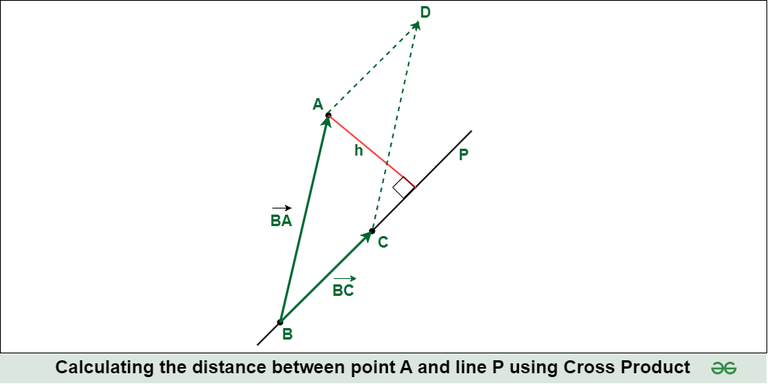
Let's say we take 2 points on the line **L, say **B and **C so the distance between the point and the line would simply be:
h = ( \,|\overrightarrow{\rm BA}| X |\overrightarrow{\rm BC}|) \,/(|\overrightarrow{\rm BC}|)
where the numerator is the magnitude of Cross Product of vector **B to **A and **B to **C and the denominator is the magnitude of vector **B to C.
From the above diagram, we can see that the area of the parallelogram **ABCD =
(|\overrightarrow{\rm BA}| X |\overrightarrow{\rm BC}|)
Also, we know that area of a **parallelogram = base * height = (|\overrightarrow{\rm BC}|) * h
So, using the above two equations, we can calculate the height **h,
h = ( \,|\overrightarrow{\rm BA}| X |\overrightarrow{\rm BC}|) \,/(|\overrightarrow{\rm BC}|)
**Note: We can use the same formula for 3D vectors also.
Implementation:
C++ `
#include <bits/stdc++.h> using namespace std;
// Method to get the magnitude of a vector double getMagnitude(vector& v) { return sqrt(v[0] * v[0] + v[1] * v[1] + v[2] * v[2]); }
// Method to calculate the cross product of two vectors v1 // and v2 void getCrossProduct(vector& v1, vector& v2, vector& crossProduct) { crossProduct[0] = v1[1] * v2[2] - v1[2] * v2[1]; crossProduct[1] = v1[2] * v2[0] - v1[0] * v2[2]; crossProduct[2] = v1[0] * v2[1] - v1[1] * v2[0]; }
int main() { // Point from which we need to calculate the distance vector pointA = { 1, 4, -2 };
// Points on the line P
vector<int> pointB = { 3, 1, -2 };
vector<int> pointC = { 6, -2, 1 };

// vector BA
vector<int> vecBA
    = { pointA[0] - pointB[0], pointA[1] - pointB[1],
        pointA[2] - pointB[2] };
// vector BC
vector<int> vecBC
    = { pointC[0] - pointB[0], pointC[1] - pointB[1],
        pointC[2] - pointB[2] };

// vector to store the cross prduct
vector<int> crossProduct(3);
getCrossProduct(vecBA, vecBC, crossProduct);

// Variable to store the distance of point A from line P
double dist
    = getMagnitude(crossProduct) / getMagnitude(vecBC);

cout << dist;

return 0;
}
Java
import java.util.*;
// Class to hold the methods public class Main {
// Method to get the magnitude of a vector
public static double getMagnitude(int[] v) {
    return Math.sqrt(v[0] * v[0] + v[1] * v[1] + v[2] * v[2]);
}

// Method to calculate the cross product of two vectors v1 and v2
public static int[] getCrossProduct(int[] v1, int[] v2) {
    int[] crossProduct = new int[3];
    crossProduct[0] = v1[1] * v2[2] - v1[2] * v2[1];
    crossProduct[1] = v1[2] * v2[0] - v1[0] * v2[2];
    crossProduct[2] = v1[0] * v2[1] - v1[1] * v2[0];
    return crossProduct;
}

public static void main(String[] args) {
    // Point from which we need to calculate the distance
    int[] pointA = { 1, 4, -2 };

    // Points on the line P
    int[] pointB = { 3, 1, -2 };
    int[] pointC = { 6, -2, 1 };

    // vector BA
    int[] vecBA = { pointA[0] - pointB[0], pointA[1] - pointB[1], pointA[2] - pointB[2] };
    // vector BC
    int[] vecBC = { pointC[0] - pointB[0], pointC[1] - pointB[1], pointC[2] - pointB[2] };

    // vector to store the cross product
    int[] crossProduct = getCrossProduct(vecBA, vecBC);

    // Variable to store the distance of point A from line P
    double dist = getMagnitude(crossProduct) / getMagnitude(vecBC);

    System.out.println(dist);
}
}
Python
import math
Method to get the magnitude of a vector
def get_magnitude(v): return math.sqrt(v[0] * v[0] + v[1] * v[1] + v[2] * v[2])
Method to calculate the cross product of two vectors v1
and v2
def get_cross_product(v1, v2): cross_product = [0, 0, 0] cross_product[0] = v1[1] * v2[2] - v1[2] * v2[1] cross_product[1] = v1[2] * v2[0] - v1[0] * v2[2] cross_product[2] = v1[0] * v2[1] - v1[1] * v2[0] return cross_product
Point from which we need to calculate the distance
pointA = [1, 4, -2]
Points on the line P
pointB = [3, 1, -2] pointC = [6, -2, 1]
vector BA
vecBA = [pointA[0] - pointB[0], pointA[1] - pointB[1], pointA[2] - pointB[2]]
vector BC
vecBC = [pointC[0] - pointB[0], pointC[1] - pointB[1], pointC[2] - pointB[2]]
vector to store the cross product
cross_product = get_cross_product(vecBA, vecBC)
Variable to store the distance of point A from line P
dist = get_magnitude(cross_product) / get_magnitude(vecBC)
print(dist)
C#
using System;
public class MainClass { // Method to calculate the magnitude of a vector static double GetMagnitude(int[] v) { return Math.Sqrt(v[0] * v[0] + v[1] * v[1] + v[2] * v[2]); }
// Method to calculate the cross product of two vectors
// v1 and v2
static void GetCrossProduct(int[] v1, int[] v2,
                            int[] crossProduct)
{
    crossProduct[0] = v1[1] * v2[2] - v1[2] * v2[1];
    crossProduct[1] = v1[2] * v2[0] - v1[0] * v2[2];
    crossProduct[2] = v1[0] * v2[1] - v1[1] * v2[0];
}

public static void Main(string[] args)
{
    // Point from which we need to calculate the
    // distance
    int[] pointA = { 1, 4, -2 };

    // Points on the line P
    int[] pointB = { 3, 1, -2 };
    int[] pointC = { 6, -2, 1 };

    // Vector BA
    int[] vecBA = { pointA[0] - pointB[0],
                    pointA[1] - pointB[1],
                    pointA[2] - pointB[2] };

    // Vector BC
    int[] vecBC = { pointC[0] - pointB[0],
                    pointC[1] - pointB[1],
                    pointC[2] - pointB[2] };

    // Array to store the cross product
    int[] crossProduct = new int[3];

    // Calculate the cross product of vecBA and vecBC
    GetCrossProduct(vecBA, vecBC, crossProduct);

    // Variable to store the distance of point A from
    // line P
    double dist = GetMagnitude(crossProduct)
                  / GetMagnitude(vecBC);

    // Output the distance
    Console.WriteLine(dist);
}
}
JavaScript
// Get the magnitude of a vector const getMagnitude = (v) => { return Math.sqrt(v[0] * v[0] + v[1] * v[1] + v[2] * v[2]); };
// Calculate the cross product of two vectors v1 and v2 const getCrossProduct = (v1, v2, crossProduct) => { crossProduct[0] = v1[1] * v2[2] - v1[2] * v2[1]; crossProduct[1] = v1[2] * v2[0] - v1[0] * v2[2]; crossProduct[2] = v1[0] * v2[1] - v1[1] * v2[0]; };
// Main function const main = () => { // Point from which we need to calculate the distance const pointA = [1, 4, -2];
// Points on the line P const pointB = [3, 1, -2]; const pointC = [6, -2, 1];
// Vector BA const vecBA = [pointA[0] - pointB[0], pointA[1] - pointB[1], pointA[2] - pointB[2]];
// Vector BC const vecBC = [pointC[0] - pointB[0], pointC[1] - pointB[1], pointC[2] - pointB[2]];
// Vector to store the cross product const crossProduct = [0, 0, 0]; getCrossProduct(vecBA, vecBC, crossProduct);
// Distance of point A from line P const dist = getMagnitude(crossProduct) / getMagnitude(vecBC);
console.log(dist); };
main();
`
**Time Complexity: O(1)
**Auxiliary Space: O(1)
4. Intersection Point of two lines:
We can find the intersection point of two lines in 2D using parametric equations. **Parametric equations are a way of representing a curve in terms of one or more parameters. For a line in 2D, we can use the following parametric equation:
**=> r = a + td
where **a is the starting point of the line, t is a real parameter, **d is the direction vector for the line and **r is a point on the line.
So, for the first line the parametric equation will be, **r 1 = a 1 + t 1 d 1 and for the second line the parametric equation will be, **r 2 = a 2 + t 2 d 2. We can further simplify the second equation:
**=> r 2 - a 2 = t 2 d 2
Taking Cross Product with **d2 vector on both sides.
**=> (r 2 - a 2 ) X d 2 = 0
As the lines intersect at any point, the value of r 1and **r 2will be same at that intersection point. So, by substituting the value of **r 1 in the above equation,
=> (a 1 + t 1 d 1 - a 2 ) X d 2 = 0
=> **t 1 = ((a 2 - a 1 ) X d 2 ) / (d 1 X d 2 )
Now, we can find the intersection point by putting the value of **t 1 into **r 1 = a 1 + t 1 d 1
Implementation:
C++ `
#include <bits/stdc++.h> using namespace std;
// Since the product of 2D(x, y) vectors is a vector in z // direction, we simply return the magnitude of the vector double getCrossProduct(vector v1, vector v2) { return v1[0] * v2[1] - v1[1] * v2[0]; }
vector getDifference(vector v1, vector v2) { vector diff(2); diff[0] = v2[0] - v1[0]; diff[1] = v2[1] - v1[1]; return diff; }
vector getSum(vector v1, vector v2) { vector sum(2); sum[0] = v1[0] + v2[0]; sum[1] = v1[1] + v2[1]; return sum; }
int main() { // Points of lines vector pointA = { 1, 1 }; vector pointB = { 4, 4 }; vector pointC = { 1, 8 }; vector pointD = { 2, 4 };
// direction vector d1
vector<double> d1 = getDifference(pointA, pointB);
// direction vector d2
vector<double> d2 = getDifference(pointC, pointD);
double t1
    = getCrossProduct(getDifference(pointA, pointC), d2)
    / (getCrossProduct(d1, d2) * 1.0);
d1[0] *= t1;
d1[1] *= t1;
// Now, we can find the intersection point by putting
// the value of t1 into r1 = A + t1d1
vector<double> intersectionPoint = getSum(pointA, d1);

cout << intersectionPoint[0] << " "
    << intersectionPoint[1];

return 0;
}
Java
import java.util.*;
public class Main { // Since the product of 2D(x, y) vectors is a vector in z // direction, we simply return the magnitude of the vector public static double getCrossProduct(double[] v1, double[] v2) { return v1[0] * v2[1] - v1[1] * v2[0]; }
public static double[] getDifference(double[] v1, double[] v2) {
    double[] diff = new double[2];
    diff[0] = v2[0] - v1[0];
    diff[1] = v2[1] - v1[1];
    return diff;
}

public static double[] getSum(double[] v1, double[] v2) {
    double[] sum = new double[2];
    sum[0] = v1[0] + v2[0];
    sum[1] = v1[1] + v2[1];
    return sum;
}

public static void main(String[] args) {
    // Points of lines
    double[] pointA = { 1, 1 };
    double[] pointB = { 4, 4 };
    double[] pointC = { 1, 8 };
    double[] pointD = { 2, 4 };

    // direction vector d1
    double[] d1 = getDifference(pointA, pointB);
    // direction vector d2
    double[] d2 = getDifference(pointC, pointD);
    double t1 = getCrossProduct(getDifference(pointA, pointC), d2) / getCrossProduct(d1, d2);
    d1[0] *= t1;
    d1[1] *= t1;
    // Now, we can find the intersection point by putting
    // the value of t1 into r1 = A + t1d1
    double[] intersectionPoint = getSum(pointA, d1);

    System.out.println(intersectionPoint[0] + " " + intersectionPoint[1]);
}
}
Python3
from typing import List
Since the product of 2D(x, y) vectors is a vector in z
direction, we simply return the magnitude of the vector
def getCrossProduct(v1: List[float], v2: List[float]) -> float: return v1[0] * v2[1] - v1[1] * v2[0]
def getDifference(v1: List[float], v2: List[float]) -> List[float]: diff = [0.0, 0.0] diff[0] = v2[0] - v1[0] diff[1] = v2[1] - v1[1] return diff
def getSum(v1: List[float], v2: List[float]) -> List[float]: sum = [0.0, 0.0] sum[0] = v1[0] + v2[0] sum[1] = v1[1] + v2[1] return sum
Points of lines
pointA = [1, 1] pointB = [4, 4] pointC = [1, 8] pointD = [2, 4]
direction vector d1
d1 = getDifference(pointA, pointB)
direction vector d2
d2 = getDifference(pointC, pointD) t1 = getCrossProduct(getDifference(pointA, pointC), d2) / getCrossProduct(d1, d2) d1[0] *= t1 d1[1] *= t1
Now, we can find the intersection point by putting
the value of t1 into r1 = A + t1d1
intersectionPoint = getSum(pointA, d1)
print(intersectionPoint[0], intersectionPoint[1])
JavaScript
// Function to calculate the cross product of two 2D vectors function getCrossProduct(v1, v2) { return v1[0] * v2[1] - v1[1] * v2[0]; }
// Function to calculate the difference between two 2D vectors function getDifference(v1, v2) { return [v2[0] - v1[0], v2[1] - v1[1]]; }
// Function to calculate the sum of two 2D vectors function getSum(v1, v2) { return [v1[0] + v2[0], v1[1] + v2[1]]; }
// Main function function main() { // Points of lines const pointA = [1, 1]; const pointB = [4, 4]; const pointC = [1, 8]; const pointD = [2, 4];
// Direction vector d1
const d1 = getDifference(pointA, pointB);
// Direction vector d2
const d2 = getDifference(pointC, pointD);

// Calculate t1
const t1 = getCrossProduct(getDifference(pointA, pointC), d2) / getCrossProduct(d1, d2);

// Calculate the scaled direction vector d1
const scaledD1 = [d1[0] * t1, d1[1] * t1];

// Calculate the intersection point by adding the scaled direction vector to pointA
const intersectionPoint = getSum(pointA, scaledD1);

// Output the intersection point
console.log(intersectionPoint[0] + " " + intersectionPoint[1]);
}
// Invoke the main function main();
`
Click here to know about finding the intersection point using equation of lines.
Practice Problems on Basic Geometry for Competitive Programming:
| Problem | Problem Link |
|---|---|
| Check if two line segments intersect | Practice Now |
| Line Passing through two points | Practice Now |
| Find the missing point of parallelogram | Practice Now |