Fundamentals of Virtual Networking (original) (raw)
Last Updated : 15 Jul, 2025
Computer networks facilitate smooth communication, coordinated operations, and efficient resource sharing. The Internet is a prime example of such a network. When we begin to reflect on the role of computer networking, its significance becomes clear. As technology continues to advance, virtual networking has emerged as a key development.
**Virtual Networking
Virtual networking is a technology that enables the remote control and management of computers or servers over the Internet. It allows communication between two or more virtual machines in a way that mimics traditional networking. However, instead of relying on physical connections, virtual networking uses software and wireless technologies to interconnect devices, servers, and virtual machines within a virtual environment.
- It is based on the principles of physical networking, virtual networking is primarily software-based.
- It allows devices across different locations to communicate and function just like they do in a physical network.
- One of the major advantages of virtual networking is its ability to reduce the cost and complexity involved in managing physical hardware.
- By installing virtual networking software on remote systems, users can access and manage network resources more efficiently.
**Working of Virtual Networking
Virtual networking allows computers, servers, and virtual machines to connect and communicate with each other through software, without needing many physical devices like wires, routers, or switches.
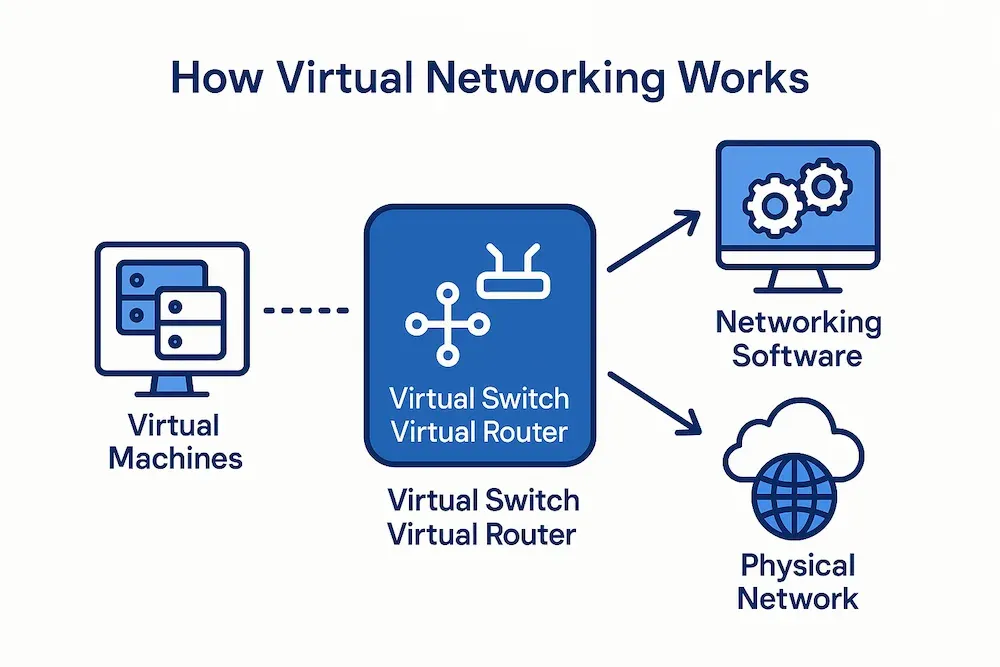
Working of virtual networks
Components involved in the working of the virtual networks:
- **Virtual Network Cards: Each virtual machine or computer gets a virtual version of a network card. This connect to the virtual network just like a real computer connects to a physical network.
- **Virtual Switches and Routers: These are software tools that do the job of physical switches and routers. They help in sending data from one virtual machine to another.
- **Networking Software: Special software is used to create and control the virtual network. It lets us to set up and manage the network from one place without touching any physical devices.
- **Virtual Network Adapter : It creates a gateway between networks means it allows computers and virtual machines to connect to a network. It makes it possible for all the computers in a Local Area Network (LAN) to connect to a larger network.
- **Connecting Different Locations: If virtual machines are in different places, the software creates a kind of tunnel between them so they can still talk to each other like they’re in the same room.
- **Security and Separation: Even if everything runs on the same physical machine, the virtual network can keep different users or departments separate and secure, just like separate rooms in a building.
- **Firewalls and security : It is designed for monitoring and preventing security threats in the virtual network.
- **Mixing with Real Networks: Virtual networks can still connect to real, physical networks, so a virtual machine can talk to a real server or access the Internet if needed.
It is easy to access any parts remotely by virtual networking as it provides more centralized management and simplified network management. Virtual networking is the foundation for Virtualization In Cloud Computing.
**Classes of Virtual Networking
**Virtual Private Network (VPN)
A **Virtual Private Network is an internet-based virtual networking technology that enables secure and private communication between two or more existing physical networks. It acts as a virtual point-to-point connection over the internet, allowing users to access remote private networks securely as if they were directly connected. VPNs are commonly used to protect sensitive data and provide remote access to corporate networks.
**Virtual Local Area Network (VLAN)
A **Virtual Local Area Network logically segments a physical LAN into multiple isolated broadcast domains. By grouping devices based on function or department, VLANs improve security, traffic management, and network efficiency. Each VLAN behaves like an independent LAN, even if devices are on the same physical switch. VLANs reduce broadcast traffic, simplify network administration, and support better scalability in large networks.
**Virtual Extensible LAN (VXLAN)
**Virtual Extensible Local Area Network is an advanced network virtualization technology designed to address the scalability limitations of traditional VLANs. VXLAN extends Layer 2 segments over a Layer 3 infrastructure by encapsulating Ethernet frames within UDP packets. This encapsulation allows networks to scale beyond the 4,096 VLAN limit and span across geographically dispersed data centers, making it ideal for large cloud environments and multi-tenant data centers.
**Benefits of Virtual Networking
- **Flexibility and Scalability
Virtual networks can easily adapt to changes in business needs. Devices and users can be added or removed without major hardware changes, making it easy to scale the network. - **Digital Security
In Digital security, Virtual networking technologies, such as VPNs and VLANs, enhance security by encrypting data, isolating network segments, and controlling access, reducing the risk of cyber threats. - **Low Networking Hardware Investment
Since virtual networks rely more on software and virtualization, there is less need for physical infrastructure, reducing hardware costs significantly. - **Less Overall Traffic
Segmenting networks virtually (e.g., using VLANs) reduces unnecessary broadcast traffic, improving network performance and speed. - **Centralized Network Management
Virtual networks allow for centralized configuration, monitoring, and troubleshooting, simplifying the management of large or distributed networks. - **Easy Address to Issues
In Easy address to issues network issues can be identified and resolved faster with centralized tools and monitoring systems, leading to quicker troubleshooting and recovery. - **Cost Savings
Reduced hardware, maintenance, and management costs lead to significant long-term savings for organizations. - **Remote Work Capabilities
In Remote work capabilities technologies like VPNs enable employees to securely access the company network from anywhere, supporting remote and hybrid work models. - **Improved Productivity
With enhanced connectivity, security, and access to resources, employees can work more efficiently, boosting overall productivity.