Introduction of Mobile Ad hoc Network (MANET) (original) (raw)
Last Updated : 1 Jul, 2024
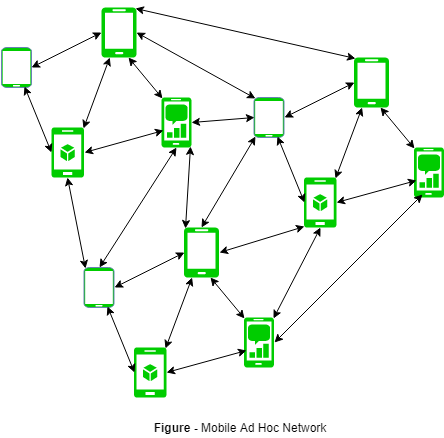
MANET stands for Mobile Adhoc Network also called a wireless adhoc network or Adhoc wireless network that usually has a routable networking environment on top of a Link Layer ad hoc network. They consist of a set of mobile nodes connected wirelessly in a self-configured, self-healing network without having a fixed infrastructure. MANET nodes are free to move randomly as the network topology changes frequently. Each node behaves as a router as it forwards traffic to other specified nodes in the network.
What is MANET?
A MANET is a decentralized wireless network consisting of mobile devices (nodes) that communicate with each other without relying on a fixed infrastructure. MANET forms a highly dynamic autonomous topology with the presence of one or multiple different transceivers between nodes. MANETs consist of a peer-to-peer, self-forming, self-healing network MANETs circa 2000-2015 typically communicate at radio frequencies (30MHz-5GHz). This can be used in road safety, ranging from sensors for the environment, home, health, disaster rescue operations, air/land/navy defense, weapons, robots, etc.
 **Characteristics of MANET
- **Dynamic Topologies: Network topology which is typically multihop may change randomly and rapidly with time, it can form unidirectional or bi-directional links.
- **Bandwidth constrained, variable capacity links: Wireless links usually have lower reliability, efficiency, stability, and capacity as compared to a wired network
- **Autonomous Behavior: Each node can act as a host and router, which shows its autonomous behavior.
- **Energy Constrained Operation: As some or all the nodes rely on batteries or other exhaustible means for their energy. Mobile nodes are characterized by less memory, power, and lightweight features.
- **Limited Security: Wireless networks are more prone to security threats. A centralized firewall is absent due to the distributed nature of the operation for security, routing, and host configuration.
- **Less Human Intervention: They require minimum human intervention to configure the network, therefore they are dynamically autonomous in nature.
Advantages of MANET
- Separation from central network administration.
- Each node can play both the roles ie. of router and host showing autonomous nature.
- Self-configuring and self-healing nodes do not require human intervention.
- Highly scalable and suits the expansion of more network hub.
**Disadvantages of MANET
- Resources are limited due to various constraints like noise, interference conditions, etc.
- Lack of authorization facilities.
- More prone to attacks due to limited physical security.
- High latency i.e. There is a huge delay in the transfer of data between two sleeping nodes.
**Improvement in MANET
- **Quality of Service (QoS): Researchers are working to improve the quality of service of MANET by developing efficient routing protocols that provide better bandwidth, throughput, and latency.
- **Security: To ensure the security of the MANET, researchers are developing efficient security mechanisms that provide encryption, authentication, and authorization facilities.
- **Power management: To enhance the lifetime of MANET nodes, researchers are working on developing efficient power management techniques that reduce the energy consumption of nodes.
- **Multimedia support: Researchers are working to provide multimedia support to MANET by developing efficient routing protocols that can handle multimedia traffic efficiently.
- **Standardization: To ensure the interoperability of different MANET devices, researchers are working on developing standard protocols and interfaces that can be used by different MANET devices.
Applications of MANET
- Military and Defense Operations
- Healthcare
- Sensor Networks
- Wireless Sensor Networks
- Internet of Things (IoT)
Conclusion
Mobile Ad hoc Networks (MANETs) are decentralized, self-configuring, and self-healing wireless networks made up of mobile nodes. They provide flexibility, scalability, and independence from fixed infrastructure, making them ideal for a wide range of applications, including military operations, disaster recovery, healthcare, sensor networks, and the Internet of Things (IoT). With limitations such as limited resources and security concerns, continuous research strives to improve their quality of service, security, power management, and multimedia support, increasing their dependability and efficiency across multiple domains.