OSI Full Form (original) (raw)
Last Updated : 12 Jul, 2025
**OSI stands for **Open Systems Interconnection. It is a model used in computer networking to explain how data moves from one device to another across a network. The OSI model has 7 layers, and each layer has a specific function, from sending raw data to delivering it to the right application. It helps people understand how networks work and troubleshoot problems.
**What is Meant by Open System Interconnection (OSI)?
The OSI Model (Open Systems Interconnection Model) is a framework discovered by ISO (**International Organization for Standardization) in **1984 that helps explain how data moves between devices in a network. It breaks the process into **7 layers, each responsible for different tasks, like sending data, checking for errors, and delivering it to the right application. The OSI model helps people understand and troubleshoot how computers and other devices communicate over networks.
**What are the 7 Layers of Open Systems Interconnection?
The **OSI Model has 7 layers, each with a specific function in the process of sending and receiving data across a network. Here's a simple explanation of each layer:
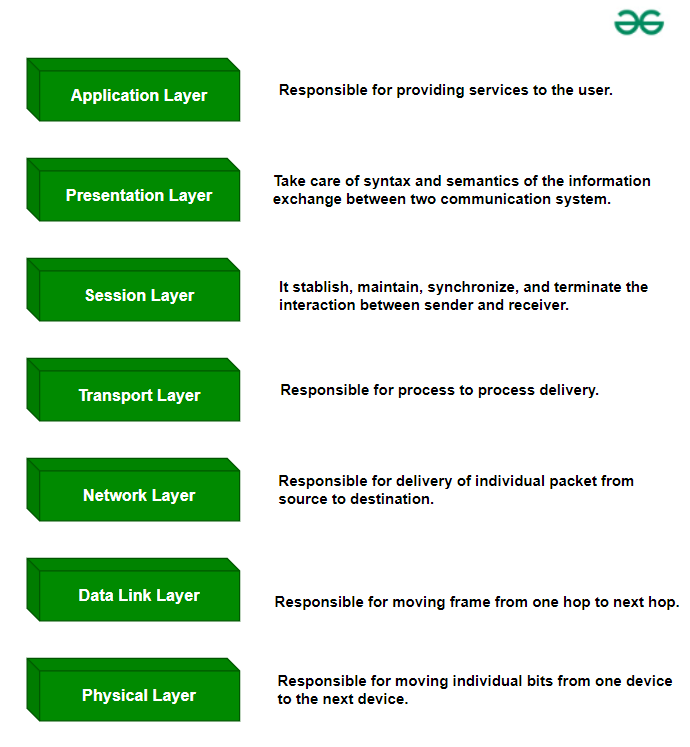
Seven Layers Of OSI Model
1. **Physical Layer
- **Function: Responsible for the physical connection between devices, such as cables, switches, and signals. It transmits raw data (bits) over the network. Example: Ethernet cables, Wi-Fi signals.
2. **Data Link Layer
- **Function: Ensures error-free transfer of data between two directly connected devices. It organizes data into frames and handles physical addressing (MAC addresses). **Example: MAC addresses, switches.
3. **Network Layer
- **Function: Responsible for routing data between different networks. It assigns IP addresses and ensures that data reaches the correct destination. Example: IP addresses, routers.
4. **Transport Layer
- **Function: Ensures reliable data transfer between devices. It manages error detection, flow control, and data segmentation. Protocols like TCP and UDP operate here. Example: TCP (Transmission Control Protocol), UDP (User Datagram Protocol).
5. **Session Layer
- **Function: Manages and controls the connections, sessions between computers. It establishes, maintains, and terminates sessions between applications. Example: Managing login sessions for remote servers.
6. **Presentation Layer
- **Function: Translates data between the application layer and the network. It handles data encryption, compression, and formatting. Example: Data encryption (SSL), data compression (JPEG).
7. **Application Layer
- **Function: The layer that interacts with the user directly. It provides network services to applications such as email, file transfer, and web browsing. Example: Web browsers (HTTP), email (SMTP), file transfer (FTP).
**How Data Flows Through the OSI Model?
In the OSI model, data flows through seven layers, starting from the top and moving down. Here's how it works:
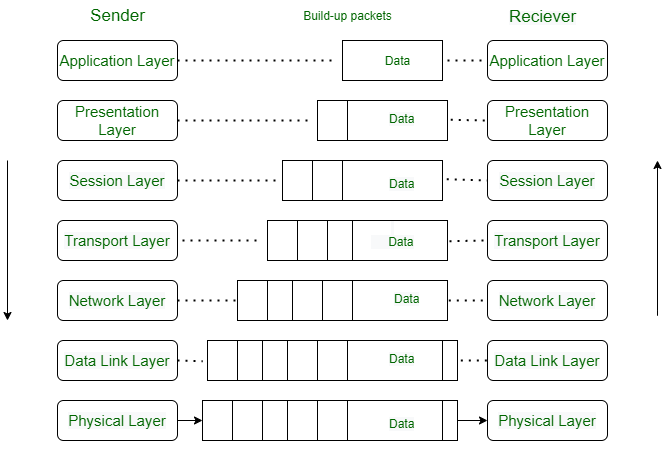
Data Flow in OSI Model
- **Application Layer: At the Application layer user interacts with software, for example sending emails or going to any website.
- **Presentation Layer: The presentation layer formats and translates data received from the application layer, ensuring it is in the right format like text, images, etc.
- **Session Layer: The session layer manages the connection between sender and receiver ensuring they stay connected during data transfer.
- **Transport Layer: The transport layer breaks data into smaller chunks called packets and ensures they are sent and received reliably.
- **Network Layer: The network layer decides the best path or root for transferring the data.
- **Data Link Layer: It organizes the data into frames and makes sure it’s error-free before sending it to the physical network.
- **Physical Layer: This is where the data gets transmitted as electrical signals or bits through cables or wireless connections.
**Characteristics of the OSI Model
- The OSI model has a layered architecture in which each layer offers certain services to the layer below it and there is abstraction present between layers.
- Each layer passes data and information to the layer below it to the lowest layer where actual communication takes place.
- The function of each layer varies which helps in reducing the complexity.
- Protocols, services, and interfaces form the basis of the model. Where protocols are the rules that layers have to follow while exchanging information, services are the set of actions provided by the layers and interfaces are the medium that layers use to communicate with other layers.
**Advantages of OSI Model
- OSI model supports layered architecture.
- Both connection-oriented and connectionless services are supported by OSI model.
- It implements abstraction between the layers such that, the changes made by the above layer do not affect the layer below it.
- It provides flexibility to adapt to new protocols with technological advancements.
- It reduces complexity as the services are divided into 7 layers.
**Disadvantages of the OSI Model
- OSI is a reference model. Thus, its practical application is restricted.
- Duplication of some services in layers is observed such as both the transport layer and data link layer have error control mechanism.
- The layers cannot work in parallel as each layer has to wait in order to receive data from the layer above it.
- The protocols in some of the layers were never fully defined such as the presentation and session layer.
- When OSI model was introduced, TCP/IP was already in place and thus changing it would require a lot of time and money and mainly because a lot of time and money had been spent on developing TCP/IP.
Conclusion
In conclusion, the **OSI (Open Systems Interconnection) model is a key framework for understanding how data moves through a network, broken down into 7 layers. It helps organize and explain the communication process between devices, making it easier to manage and troubleshoot networks. While the OSI model is mostly used for learning, its concepts are still important in networking today.