Types of Internet Security Protocols (original) (raw)
Last Updated : 4 May, 2026
Data transfer over the internet continues to grow, ensuring its security has become essential.
- Internet security protocols help in the security and integrity of data over the Internet.
- Many protocols exist and help in the security of data over the internet, such as SSL and TLS.
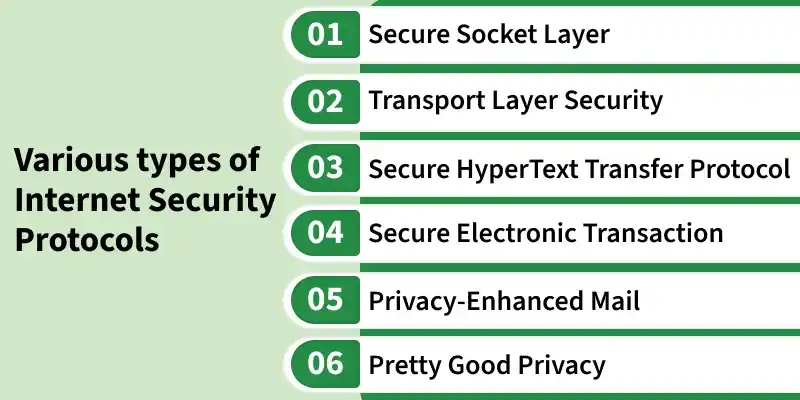
Types of Internet Security Protocols
1. SSL Protocol
Secure Sockets Layer and it is an encryption-based Internet security protocol that protects the confidentiality and integrity of data.
- Ensures privacy and authenticity of data exchanged over the internet.
- Operates between the application layer and the transport layer in the network stack.
- Acts as the predecessor of modern TLS encryption protocols.
- Early versions of SSL had security flaws, leading to the adoption of TLS as its replacement.
2. TLS Protocol
Transport Layer Security is a standardized security protocol developed to safeguard digital communication by creating an encrypted channel between two systems.
- Developed as an improved and more secure replacement for SSL.
- Relies on a pseudo-random function to generate a master secret during session establishment.
- The master secret is further used to derive encryption and authentication keys.
- Supports secure communication between clients and servers, such as browsers and web applications.
3. S-HTTP
Secure HyperText Transfer Protocol is an extension of the HTTP protocol designed to provide secure communication over the web.
- Works at the application layer, making it closely integrated with HTTP operations.
- Protects web-based transactions such as online forms, database submissions, and internet communications.
- Provides authentication to verify the identity of communicating parties.
- Encrypts HTTP traffic to maintain confidentiality of transmitted data.
- Ensures message integrity through digital signing mechanisms.
- Operates on a message-by-message basis instead of securing the full session.
4. SET Protocol
Secure Electronic Transaction is a security protocol developed to protect electronic payments made through credit cards over the internet. It was designed to ensure confidentiality, authentication, and integrity during online financial transactions.
- Creates a protected communication channel between transaction participants.
- Ensures confidentiality so that sensitive payment details are disclosed only when required.
- Supports authentication to confirm the identities of all involved parties.
- Maintains data integrity to prevent unauthorized modification of transaction information.
- Operates as a transaction protocol, not as an independent payment mechanism.
Participants in the SET Protocol
- **Cardholder: the customer using the credit card for purchase.
- **Merchant: the seller providing goods or services.
- **Issuer: the financial institution that issues the credit card.
- **Acquirer: the bank that processes payments for the merchant.
- **Payment Gateway: the system that authorizes and routes payment requests.
- C**ertification Authority: the trusted entity that issues digital certificates for authentication.
5. PEM Protocol
Privacy-Enhanced Mail is an email security protocol developed to provide secure communication over the internet.
- Primarily used for securing email transmission across networks.
- Supports encryption to keep message contents confidential.
- Provides nonrepudiation, ensuring that the sender cannot deny sending the message.
- Maintains message integrity by detecting unauthorized changes.
- Uses cryptographic methods to strengthen trust in email communication.
- Defined and standardized through four key RFC documents are RFC 1421, RFC 1422, RFC 1423 and RFC 1424.
6. PGP Protocol
Pretty Good Privacy is a widely used cryptographic protocol designed to secure digital communication and data storage. It provides strong privacy protection through encryption and supports authentication mechanisms that verify the sender’s identity.
- Easy to use and widely adopted for personal and professional security needs.
- Provides source code documentation, supporting transparency and trust.
- Meets essential cryptographic requirements for secure communication.
- Offers encryption to protect sensitive information from unauthorized access.
- Supports non-repudiation through digital signatures.
- Ensures message integrity by detecting alterations in transmitted data.
- More widely adopted and popular than the PEM protocol in practical use.