What is HTTP/3? How it is Different From HTTP/2? (original) (raw)
Last Updated : 23 Jul, 2025
Web protocols are essential for transmitting data between clients and servers over the internet. Over time, these protocols have evolved to address limitations in performance, reliability, and security. This article explores HTTP evolution through HTTP/2 and the latest advancement HTTP/3 with a comparative perspective.
HTTP (Hypertext Transfer Protocol) is the foundation of data communication on the World Wide Web. It allows users to fetch and interact with resources like text, images, and videos through their browsers.
HTTP/3
HTTP/3 is the third major version of the Hypertext Transfer Protocol (HTTP), which is the foundation of data communication on the web. Unlike its predecessors (HTTP/1.1 and HTTP/2) that use TCP as their transport layer protocol, HTTP/3 is built on QUIC a new protocol that runs over UDP (User Datagram Protocol). QUIC is a modern transport protocol developed to improve the speed and reliability of internet connections. It replaces the traditional TCP three-way handshake with faster connection setups using 0-RTT and 1-RTT handshakes.
**HTTP/3 for CDN : CDN stands for Content Delivery Network, it plays an important role in delivering content of web to users across the world effectively. With the release of HTTP/3, CDNs can further enhance their performance, reliability, and security capabilities.
Key Features of HTTP/3
- **Uses QUIC protocol: Replaces TCP with QUIC, improving speed and reliability.
- **Faster connection setup: QUIC uses 0-RTT and 1-RTT handshakes, reducing delay.
- **No Head-of-Line (HOL) blocking at transport layer: Unlike HTTP/2, packet loss affects only individual streams, not all of them.
- **Built-in encryption: QUIC includes TLS 1.3 encryption as part of its core design.
- **Better performance : It provides better performance on mobile and high-latency networks.
HTTP/2
HTTP/2, released in 2015, was designed to overcome many limitations of HTTP/1.1, particularly **Head-of-Line blocking at the application layer. It retains compatibility with existing web applications while offering enhanced performance.
**Key Features of HTTP/2
- **Multiplexing: Multiple requests/responses can be handled simultaneously on a single connection.
- **Binary protocol: More efficient than the text-based HTTP/1.1.
- **Header compression: Reduces overhead with HPACK compression.
- **Server Push: Allows the server to preemptively send resources to the client.
- Reduced latency and fewer RTTs (Round Trip Times).
- Prioritization of requests for better resource management.
- Enhanced support for **TLS (Transport Layer Security).
**Problems with HTTP/2
- More complex implementation due to advanced features.
- TLS dependency can introduce extra latency.
- Still suffers from HOL blocking at the transport layer (TCP).
- Strict TCP dependency can cause interoperability issues in certain networks.
The problems which occurred in HTTP/2 , to overcome these problems HTTP/3 is used.
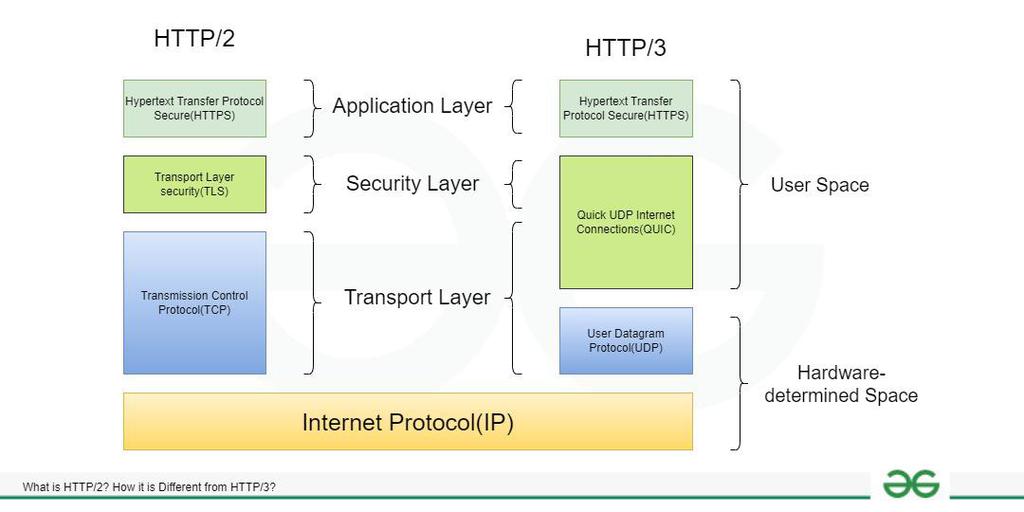
HTTP/2 vs HTTP/3
**Benefits of HTTP/3 Over HTTP/2
- **Faster Start Time
HTTP/3 makes website connections start up to 80-90% faster than HTTP/2. That means pages begin loading almost instantly. - **No Waiting in Line
In older versions, if one part of the website had a delay, everything else had to wait. HTTP/3 fixes this with independent streams, so delays in one part don’t block the rest. - **Handles Bad Connections Better
HTTP/3 is smarter at dealing with weak or unstable internet, such as mobile or public Wi-Fi. It can recover from lost data more smoothly. - **Works Well with Modern Networks
HTTP/3 uses **UDP on port 443, which is already commonly used. This makes it more compatible with today’s internet systems. - **Supported by Major Browsers
We don’t need to install anything special browsers like Chrome, Firefox, Safari, and others already support it.
**Challenges in Using HTTP/3
- **More Complicated Technology
HTTP/3 uses a new system called **QUIC, which is more complex than older methods. That means it's harder to build and maintain. - **Needs New Equipment
To use HTTP/3, companies may need to upgrade their servers, routers, or load balancers. - **Not Always Compatible with Old Systems
Older or large networks might have trouble supporting HTTP/3 without major changes. - **Harder for Firewalls to See What's Inside
HTTP/3 encrypts everything even small pieces of data. That’s great for privacy, but it can make it harder for firewalls to check for threats. - **Skilled People Needed
Setting up and managing HTTP/3 properly requires experienced engineers who understand how it works.
Comparison Table Between HTTP/2 and HTTP/3
| **Feature | **HTTP/2 | **HTTP/3 |
|---|---|---|
| **Protocol Used | Uses TCP (Transmission Control Protocol). | Uses QUIC, which runs over UDP (User Datagram Protocol). |
| **Head-of-Line Blocking | Suffers from HOL blocking at the transport layer. | Eliminates HOL blocking with independent streams. |
| **TLS Encryption | TLS is optional. | TLS is mandatory and built into QUIC. |
| **RFC Standard | Defined in RFC 9113. | Defined in RFC 9114. |
| **Performance | Limited performance compared to HTTP/3. | Offers higher performance, especially on modern networks. |
| **Error Handling | Less error-handling capability. | Enhanced error detection and recovery with QUIC. |
| **Connection Migration | Not supported. | Supports connection migration (useful for mobile networks). |
| **Congestion Control | Based on TCP mechanisms. | Uses QUIC’s advanced congestion control. |
| **Use Case | Widely used by existing browsers and servers. | Gaining popularity as the future web standard. |