How to Design a Database for SaaS Applications? (original) (raw)
Last Updated : 23 Jul, 2025
Database design is an important component of **Software as a Service (SaaS) applications. It provides the foundation for data **storage, **retrieval, and management in a cloud-based environment.
Designing a database for SaaS applications involves considerations such as **scalability, **multi-tenancy, **data security, and performance optimization.
In this article, we'll explore the essential principles of designing databases specifically for SaaS applications, ensuring reliability, efficiency, and seamless user experiences.
Database Design for SaaS Applications
Designing a database for SaaS applications requires careful planning to accommodate the unique requirements of serving multiple customers (tenants) on a shared platform. The database must be **scalable, **secure, and capable of handling varying data volumes and user interactions across different tenant environments.
Features of Databases for SaaS Applications
Databases for SaaS applications offer a range of features designed to support **multi-tenancy, **data isolation, customization, and seamless integration with application workflows. These features typically include
- **Multi-Tenancy Support: Providing logical and data isolation for multiple tenants sharing the same application instance.
- **Data Partitioning: Partitioning data to ensure tenant-specific data segregation and performance optimization.
- **Customization and Configuration: Allowing tenants to customize application settings, workflows, and data models.
- **Scalability and Performance: Designing the database to scale horizontally and vertically to handle varying loads and data volumes.
- **Data Security and Compliance: Implementing robust security measures to protect tenant data and ensure regulatory compliance.
- **Backup and Disaster Recovery: Implementing data backup and recovery procedures to ensure data integrity and business continuity.
Entities and Attributes in Databases for SaaS Applications
Entities in a SaaS application database represent various aspects of tenant data, user interactions, application settings, and system configurations, while attributes describe their characteristics. Common entities and their attributes may include:
Tenant Table
- TenantID (Primary Key): Unique identifier for each tenant.
- TenantName, Domain: Tenant-specific information (e.g., company name, domain).
- SubscriptionPlan: Details of the tenant's subscription plan and usage limits.
- StorageQuota: Allocated storage quota for the tenant's data.
User Table
- **UserID (Primary Key): Unique identifier for each user.
- **Username, Email: User's login credentials and contact information.
- **TenantID: Identifier for the tenant associated with the user.
- **Role: User role or permissions within the SaaS application.
Configuration Table
- **ConfigID (Primary Key): Unique identifier for each configuration setting.
- **SettingName, SettingValue: Customizable settings and configurations for each tenant.
Relationships Between Entities
Based on the entities and their attributes provided, relationships between them can be defined to establish data flows and dependencies within the SaaS application database. Common relationships may include:
One-to-Many Relationship between Tenant and User
- One tenant can have multiple users with varying roles and permissions.
- Each user is associated with one tenant.
- Therefore, the relationship between Tenant and User is one-to-many.
Many-to-One Relationship between Tenant and Configuration
- One tenant can have multiple configuration settings.
- Each configuration setting is associated with one tenant.
- Therefore, the relationship between Tenant and Configuration is many-to-one.
Entity Structures in SQL Format
Here’s how the entities mentioned above can be structured in SQL format:
-- Tenant Table
CREATE TABLE Tenant (
TenantID INT PRIMARY KEY,
TenantName VARCHAR(255),
Domain VARCHAR(255),
SubscriptionPlan VARCHAR(255),
StorageQuota INT,
PaymentStatus VARCHAR(50),
BillingAddress VARCHAR(255),
ContactPerson VARCHAR(100)
);
-- User Table
CREATE TABLE User (
UserID INT PRIMARY KEY,
Username VARCHAR(255),
Email VARCHAR(255),
TenantID INT,
Role VARCHAR(50),
LastLogin TIMESTAMP,
IsActive BOOLEAN,
ProfilePictureURL VARCHAR(255),
FOREIGN KEY (TenantID) REFERENCES Tenant(TenantID)
);
-- Product Table
CREATE TABLE Product (
ProductID INT PRIMARY KEY,
ProductName VARCHAR(255),
Description TEXT,
PricingModel VARCHAR(50),
Active BOOLEAN,
ReleaseDate DATE,
EndOfLifeDate DATE
);
-- Subscription Table
CREATE TABLE Subscription (
SubscriptionID INT PRIMARY KEY,
UserID INT,
ProductID INT,
StartDate DATE,
EndDate DATE,
Status VARCHAR(50),
RenewalDate DATE,
FOREIGN KEY (UserID) REFERENCES User(UserID),
FOREIGN KEY (ProductID) REFERENCES Product(ProductID)
);
-- Payment Table
CREATE TABLE Payment (
PaymentID INT PRIMARY KEY,
SubscriptionID INT,
Amount DECIMAL(10, 2),
PaymentDate DATE,
PaymentMethod VARCHAR(50),
Status VARCHAR(50),
InvoiceID INT,
FOREIGN KEY (SubscriptionID) REFERENCES Subscription(SubscriptionID)
);
-- Invoice Table
CREATE TABLE Invoice (
InvoiceID INT PRIMARY KEY,
SubscriptionID INT,
AmountDue DECIMAL(10, 2),
DueDate DATE,
IssuedDate DATE,
Status VARCHAR(50),
FOREIGN KEY (SubscriptionID) REFERENCES Subscription(SubscriptionID)
);
-- Usage Log Table
CREATE TABLE UsageLog (
LogID INT PRIMARY KEY,
UserID INT,
Action VARCHAR(255),
Timestamp TIMESTAMP,
IP_Address VARCHAR(50),
DeviceInfo VARCHAR(255),
FOREIGN KEY (UserID) REFERENCES User(UserID)
);
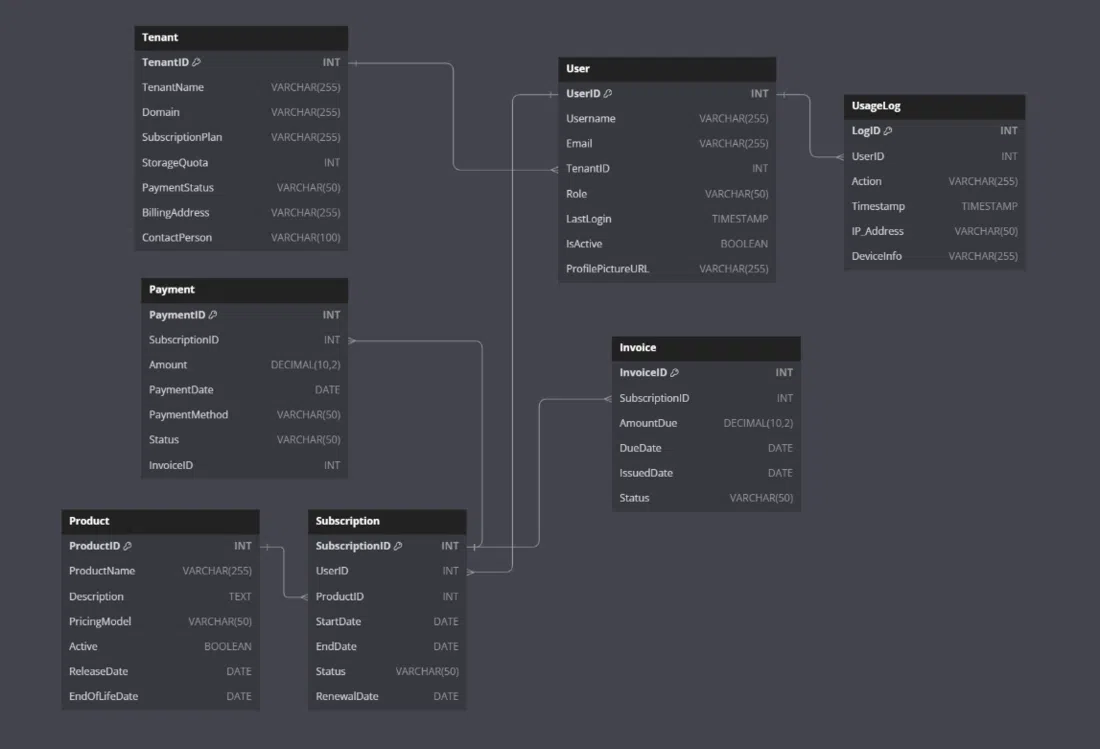
Database Model for SaaS Applications
The database model for SaaS applications revolves around efficiently managing tenant data, user interactions, configurations, and system settings to provide a customizable and scalable platform for multiple customers.
Tips & Best Practices for Enhanced Database Design
- **Schema Design: Use schema-based multi-tenancy to isolate tenant data logically and physically.
- **Indexing and Partitioning: Implement indexing and data partitioning strategies to optimize performance and scalability.
- **Data Encryption: Encrypt sensitive data at rest and in transit to ensure data security.
- **Tenant Isolation: Implement strict data isolation measures to prevent unauthorized access to tenant data.
- **Monitoring and Logging: Implement monitoring and logging mechanisms to track performance metrics, usage patterns, and security events.
Conclusion
Designing a database for SaaS applications requires careful consideration of multi-tenancy, data isolation, customization, and scalability to meet the evolving needs of multiple customers on a shared platform. By following best practices in database design and leveraging cloud-native technologies, SaaS applications can deliver reliable, efficient, and secure services to customers while supporting business growth and innovation.
A well-designed database architecture tailored to the unique requirements of SaaS applications enables organizations to effectively manage tenant data, user interactions, configurations, and system settings, ultimately providing a robust and scalable platform for delivering software services in a cloud-based environment.