Scalability in System Design (original) (raw)
Last Updated : 9 Jun, 2026
Scalability refers to a system’s ability to handle increasing workloads, users, or data without affecting performance.. A scalable system can expand resources such as servers, storage, or processing power when needed.
- When a system's workload or scope rises, it should be able to maintain or even improve its performance, efficiency, and dependability. This is known as scalability.
- A system must be scalable in order to accommodate growing user traffic, data volumes, or computing demands without suffering a major performance hit or necessitating a total redesign.
**Example: A video streaming platform that automatically adds more servers when millions of users start watching content at the same time.
Real-World Examples of Scalable Systems
There are many real-world examples of scalable systems that demonstrate the importance and impact of scalability in modern technology.
- **Google: Uses a highly scalable distributed system (Bigtable, MapReduce, Spanner) to handle billions of searches globally.
- **AWS: Offers scalable cloud services that let businesses easily scale compute, storage, and databases on demand.
- **Netflix: Relies on cloud infrastructure, microservices, and caching to stream content to millions of users at once.
These examples highlight how scalability helps companies deliver reliable performance, handle traffic spikes, and grow rapidly without infrastructure limitations.
Ways to Achieve Scalability
These are common approaches used to handle increasing load and improve system performance efficiently.
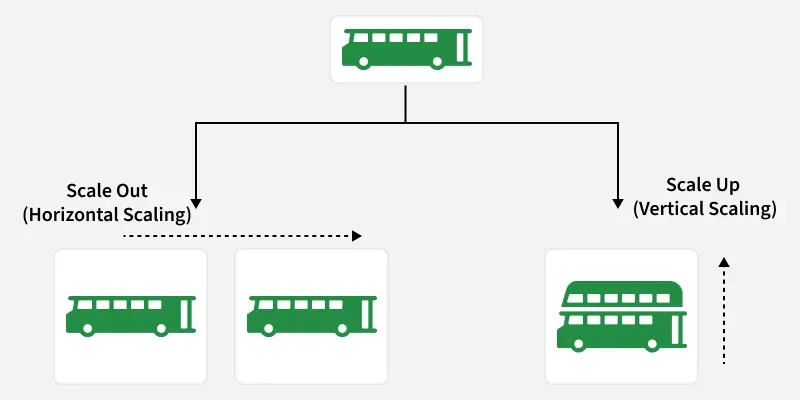
1. Make It Bigger
Vertical Scaling, Like upgrading a car with a bigger engine for more power.
- Upgrading a system by adding more CPU, memory, or storage to a single server, similar to increasing a car’s engine power.
- Suitable for small applications and quick scaling, but limited by hardware constraints and cannot scale indefinitely.
2. Get More Cars
Horizontal Scaling, Like using multiple cars to share the workload.
- Scaling by adding multiple servers or instances to share the workload, similar to using multiple cars instead of one.
- Distributes traffic across resources efficiently, making it ideal for large-scale applications with high user demand.
3. Divide and Conquer
Microservices, Treats the app as small, independent services.
- Breaks the application into small, independent services that handle specific functionalities.
- Allows scaling of only required parts, improving flexibility and efficient resource utilization.
4. No Servers, No Problems
Serverless, Removes the need to manage servers.
- Automatically scales based on demand without requiring manual server management.
- Cost-efficient for variable workloads, with services like AWS Lambda handling execution and scaling.
Factors Affecting Scalability
The factors that affects the scalability with their explanation are:
1. Performance Bottlenecks
Performance bottlenecks are components or processes in a system that limit overall performance and slow down operations.
- Performance bottlenecks are parts of a system that slow down overall performance.
- They are often caused by slow databases, inefficient code, or limited resources.
2. Resource Utilization
Efficient use of system resources is important to maintain performance and support system scalability.
- Efficiently using resources such as CPU, memory, and disk space is essential for scalability.
- Inefficient resource utilization can lead to bottlenecks and limit the system's ability to scale.
3. Network Latency
Network latency refers to the delay that occurs when data travels between systems or network nodes.
- Network latency is the delay in data transmission.
- High latency slows node communication and affects scalability.
4. Data Storage and Access
The way data is stored and accessed plays a major role in determining how well a system can scale.
- Data storage and access patterns affect scalability.
- Distributed databases and caching help systems scale better.
5. Concurrency and Parallelism
Concurrency and parallelism allow systems to process multiple tasks at the same time to improve performance.
- Enables handling of multiple tasks simultaneously, improving scalability and system efficiency.
- Increases throughput by processing more requests, but may introduce latency due to synchronization and overhead if not managed properly.
6. System Architecture
System architecture determines how components are structured and how easily the system can scale.
- System architecture defines how easily a system can scale, with modular and loosely coupled components improving flexibility.
- Supports both horizontal scaling (adding instances) and vertical scaling (upgrading resources) for better performance.
Components that help to increase Scalability
Some of the main components that help to increase the scalability are:
- **Load Balancer: A load balancer distributes incoming traffic across multiple servers to avoid overload and improve performance and availability.
- **Caching: Caching stores frequently accessed data temporarily to reduce latency and backend load.
- **Database Replication: Database replication creates multiple copies of data (often asynchronously) to improve availability and read performance, with trade-offs in consistency.
- **Database Sharding: Database sharding splits data into smaller shards to scale databases across multiple instances.
- **Microservices Architecture: Microservices architecture divides applications into independent services that can scale separately.
- **Data Partitioning: Data partitioning divides data based on criteria like user or region to improve scalability.
- **Content Delivery Networks (CDNs): CDNs deliver cached content from locations closer to users, reducing latency.
- **Queueing Systems: Queueing systems handle requests asynchronously to manage traffic spikes and prevent overload.
Challenges and Trade-offs in Scalability
Challenges and trade-offs include:
- **Cost Vs Scalability: Scaling improves performance and availability but often increases infrastructure and operational costs.
- **Complexity: As systems scale, they become harder to manage, maintain, and debug, raising operational overhead.
- **Latency Vs Throughput: There is often a trade-off between latency and throughput. Optimizing for low latency may reduce throughput, and vice versa.
- **Data Partitioning Trade-offs: Partitioning boosts scalability but requires careful balance of partition size, data movement, and data locality.