Relational Database Management Systems(RDBMS) (original) (raw)
Last Updated : 11 Mar, 2026
RDBMS stands for Relational Database Management Systems. A database is an organized collection of data stored in a computer system and usually controlled by a database management system (DBMS). It is a program that allows us to create, delete, and update a relational database.
- Data is organized in a structured, tabular format
- Tables are related to each other using keys
- Supports easy and powerful query execution
- Can handle large volumes of data efficiently
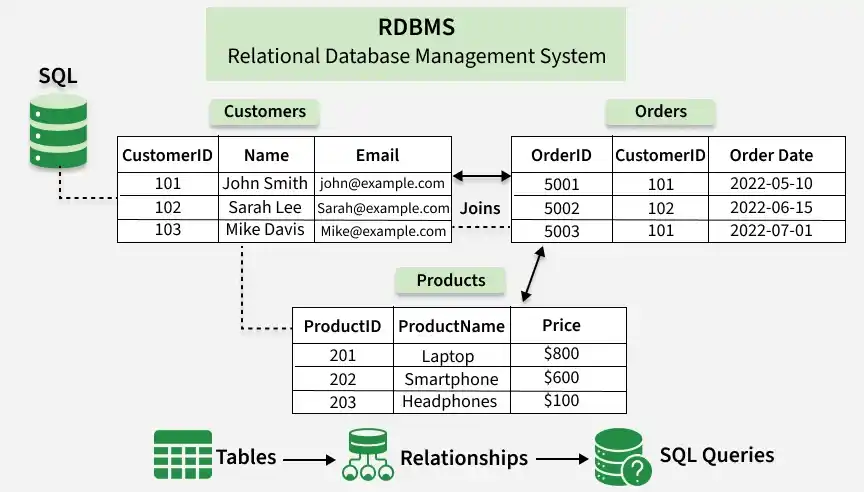
Relational Database Management Systems maintain data integrity by simulating the following features:
- **Entity Integrity: No two records of the database table can be completely duplicates.
- **Referential Integrity: Only the rows of those tables can be deleted which are not used by other tables. Otherwise, it may lead to data inconsistency.
- **User-defined Integrity: Rules defined by the users based on confidentiality and access.
- **Domain integrity: The columns of the database tables are enclosed within some structured limits, based on default values, type of data or ranges.
Database Table
A table is a collection of related data in an organized manner in the form of rows and columns. Here is the pictorial representation of the table and its different components containing the data about different students that is ID, name, Age, and course.
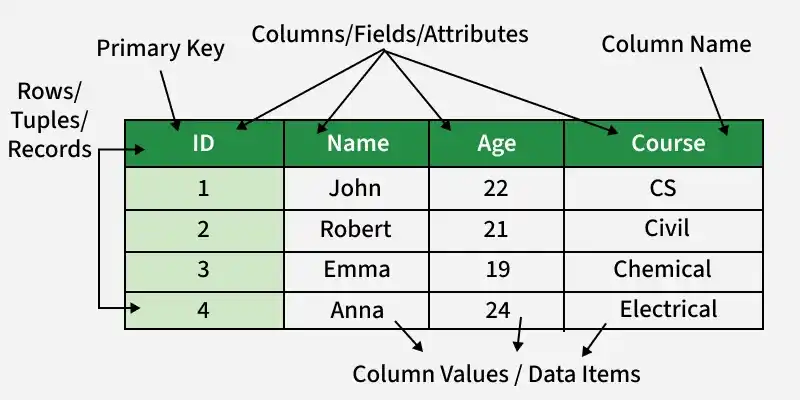
Database Table
Features of RDBMS
- Data must be stored in tabular form in DB file and it should be organized in the form of rows and columns.
- Each row of table is called record/tuple . Collection of such records is known as the cardinality of the table.
- Each column of the table is called an attribute/field. Collection of such columns is called the arity of the table.
- No two records of the DB table can be same. Data duplicity is therefore avoided by using a candidate key. Candidate Key is a minimum set of attributes required to identify each record uniquely.
- Tables are related to each other with the help for foreign keys.
- Database tables also allow NULL values, that is if the values of any of the element of the table are not filled or are missing, it becomes a NULL value. (NOTE: Primary key cannot have a NULL value).
Working of Relational Database Model
The relational database enables any table to be associated to another table by means of a common attribute. A change to a data model where data is stored, accessed, and related in tables without restructuring the tables that hold them in place of hierarchical structures.
- Each spreadsheet in the relational database model is a table that contains data, which is shown as rows (tuples) and columns (attributes).
- A data type is specified by an attribute (column), and the value of that particular data type is contained in each record (or row).
- A primary key is an attribute found in all tables in a relational database that serves as a unique row identifier.
| Roll number | Name | Section |
|---|---|---|
| 1 | Sophia | A |
| 2 | Jack | B |
| 3 | David | A |
| 4 | Olivia | C |
Uses of RDBMS
- Customer Relationship Management.
- Online Retail Platforms.
- Hospital Management Systems.
- Business Intelligence.
- Data Warehousing
SQL Query in RDBMS
1. Creating a Table
**Syntax:
CREATE TABLE table_name (
column1_name datatype constraint,
column2_name datatype constraint,
);
**Example:
CREATE TABLE Employees (
EmployeeID INT PRIMARY KEY,
FirstName VARCHAR(50),
LastName VARCHAR(50),
BirthDate DATE,
Salary DECIMAL(10, 2)
);
**2. Inserting Data into a Table
**Syntax:
INSERT INTO table_name (column1_name, column2_name, ...)
VALUES (value1, value2, ...);
**Example:
INSERT INTO Employees (EmployeeID, FirstName, LastName, BirthDate, Salary)
VALUES (1, 'John', 'Doe', '1985-06-15', 55000.00);
**3. Querying Data (SELECT)
**Syntax:
SELECT column1_name, column2_name, ...
FROM table_name
WHERE condition;
**Example:
SELECT FirstName, LastName, Salary
FROM Employees
WHERE Salary > 50000;
**4. Deleting Data from a Table
**Syntax:
DELETE FROM table_name
WHERE condition;
**Example:
DELETE FROM Employees
WHERE EmployeeID = 1;
**5. Dropping a Table
**Syntax:
DROP TABLE table_name;
**Example:
DROP TABLE Employees;
Advantages of RDBMS
- **Easy to Manage: Each table can be independently manipulated without affecting others.
- **Security: It is more secure consisting of multiple levels of security. Access of data shared can be limited.
- **Flexible: Updating of data can be done at a single point without making amendments at multiple files.
- **Users: RDBMS supports client-side architecture storing multiple users together. Facilitates storage and retrieval of large amount of data.
- **Fault Tolerance: Replication of databases provides simultaneous access and helps the system recover in case of disasters, such as power failures .
- Data consistency is ensured as RDBMS is based on ACID properties for data transactions.
Disadvantages of RDBMS
- **High Cost and Extensive Hardware : Huge costs and setups are required to make these systems functional.
- **Scalability: In case of addition of more data, servers along with additional power, and memory are required.
- **Complexity: Voluminous data creates complexity in understanding of relations and may lower down the performance.
- **Structured Limits: The fields or columns of a relational database system is enclosed within various limits, which may lead to loss of data.
DBMS vs RDBMS
| DBMS | RDBMS |
|---|---|
| DBMS stores data as file. | RDBMS stores data in tabular form. |
| Data elements need to access individually. | Multiple data elements can be accessed at the same time |
| No relationship between data. | Data is stored in the form of tables which are related to each other. |
| Normalization is not present. | Normalization is present. |
| DBMS does not support distributed database. | RDBMS supports distributed database. |
| It deals with small quantity of data. | It deals with large amount of data. |
| Not all Codd rules are satisfied. | All 12 Codd rules are satisfied. |
| Security is less | More security measures provided. |
| Data fetching is slower for the large amount of data. | Data fetching is fast because of relational approach. |