Categorical CrossEntropy in MultiClass Classification (original) (raw)
Categorical Cross-Entropy in Multi-Class Classification
Last Updated : 25 Nov, 2025
Categorical Cross-Entropy is widely used as a loss function to measure how well a model predicts the correct class in multi-class classification problems. It measures the difference between the predicted probability distribution and the true one-hot encoded labels, guiding the model to assign higher probabilities to the correct class.
- It is used when there are more than two classes.
- Works with softmax outputs where probabilities sum to 1.
- Higher loss means the prediction is far from the true class, lower loss means the model is performing well.
- Commonly used in image classification, text classification and speech recognition tasks.
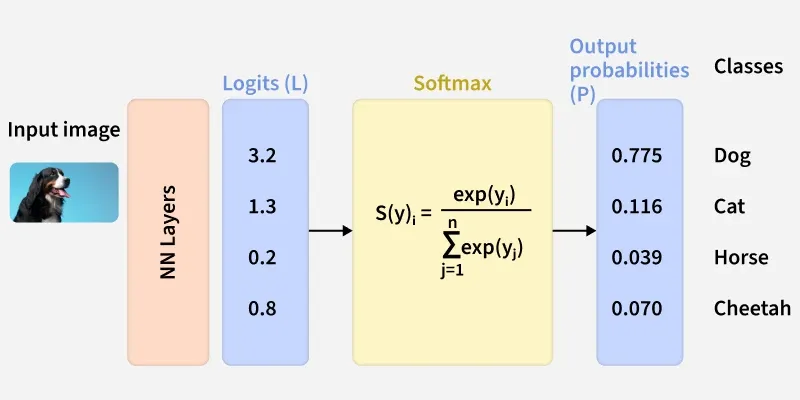
Categorical Cross-Entropy
Here we see how neural networks are converted into Softmax probabilities and used in Categorical Cross-Entropy (CCE) to compute loss for the true class.
How Categorical Cross-Entropy Works
Categorical Cross-Entropy measures the difference between the true labels and the predicted probabilities of a model. It penalizes the model when it assigns low confidence to the correct class. Formula is:
L(y, \hat{y}) = - \sum_{i=1}^{c} y_i \log(\hat{y}_i)
where
- L(y, \hat{y}) : Categorical Cross-Entropy loss
- y_i: True label for class i
- \hat{y}_i: Predicted probability for class i
- C: Number of classes
Categorical Cross-Entropy works through the following steps
- **Prediction of Probabilities: The model uses a Softmax layer to convert raw logits into probabilities for each class.
- **Comparison with True Class: Predicted probabilities are matched with one-hot encoded labels to determine the correct class.
- **Calculation of Loss: CCE calculates the negative log of the predicted probability for the true class, giving lower loss for higher confidence and higher penalty for low confidence.
Step-By-Step Implementation
Here in this code we will train a neural network on the MNIST dataset using Categorical Cross-Entropy loss for multi-class classification. It allows predicting any test image and displays the probability of each class along with the predicted label.
Step 1: Import Libraries & Load Dataset
Here we will use numpy, tenserflow and matplotlib.
Python `
import numpy as np import tensorflow as tf from tensorflow.keras.datasets import mnist from tensorflow.keras.models import Sequential from tensorflow.keras.layers import Dense, Flatten from tensorflow.keras.utils import to_categorical from tensorflow.keras.losses import CategoricalCrossentropy import matplotlib.pyplot as plt
(X_train, y_train), (X_test, y_test) = mnist.load_data()
`
Step 2: Preprocess Data
- **Normalization****:** Scale pixel values to [0,1] for faster training
- **One-hot encoding****:** Convert integer labels to categorical format
- **Categorical labels: Required for multi-class classification Python `
X_train = X_train.astype('float32') / 255.0 X_test = X_test.astype('float32') / 255.0 y_train_encoded = to_categorical(y_train, num_classes=10) y_test_encoded = to_categorical(y_test, num_classes=10)
`
Step 3: Build and Compile Model
- Use a Sequential model with Dense layers and ReLU activation.
- Flatten input images before feeding into Dense layers.
- Use Softmax activation in output layer for 10 classes.
- Compile the model with Adam optimizer and Categorical Cross-Entropy (CCE) loss. Python `
model = Sequential([ Flatten(input_shape=(28,28)), Dense(128, activation='relu'), Dense(64, activation='relu'), Dense(10, activation='softmax') ])
model.compile(optimizer='adam', loss=CategoricalCrossentropy(), metrics=['accuracy'])
`
Step 4: Train the Model
- **Epoch: One complete pass over the training data
- **Batch size: Number of samples per gradient update
- **Validation split: 20% of training data used to check model performance
- **Categorical Crossentropy (CCE) loss: Guides the model to improve predictions
- **Training loss and accuracy: Metrics to monitor learning progress Python `
history = model.fit(X_train, y_train_encoded, epochs=10, batch_size=64, validation_split=0.2)
`
Step 5: Predict and Display Probabilities
- **Softmax probabilities: Model outputs probability distribution over classes
- **Predicted class: Class with highest probability
- **Visualization: Display the test image and prediction
- **Categorical Cross-Entropy: Loss used during training Python `
def predict_digit(index): img = X_test[index] plt.imshow(img, cmap='gray') plt.title(f"True Label: {y_test[index]}") plt.axis('off') plt.show()
pred_prob = model.predict(img.reshape(1,28,28))[0]
for i, prob in enumerate(pred_prob):
    print(f"Class {i}: {prob:.4f}")
predicted_class = np.argmax(pred_prob)
print(f"\nPredicted Class: {predicted_class}")
`
**Output:
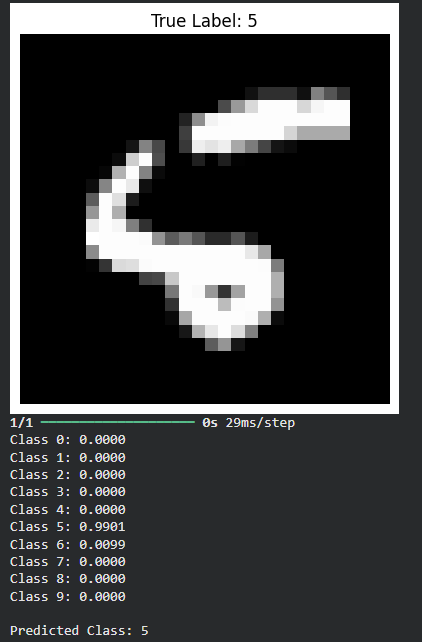
Output
You can download full code from here.
Categorical Cross-Entropy vs Binary Cross-Entropy
Here we see the difference between Categorical Cross-Entropy and Binary Cross-Entropy:
| Parameters | Categorical Cross-Entropy | Binary Cross-Entropy |
|---|---|---|
| Use Case | Multi-class classification | Binary classification |
| Label Format | One-hot encoded vector | Single label |
| Interpretation | Penalizes wrong predictions across all classes | Penalizes wrong prediction for the single class |
| Activation Function | Softmax | Sigmoid |
| Output | Probability distribution across multiple classes | Single probability for positive class |
Applications
- **Handwritten Digit Recognition: Classifying digits 0 to 9 in apps like postal mail sorting.
- **Email Classification: Categorizing emails into multiple folders like Inbox, Promotions Social, etc.
- **Sentiment Analysis: Determining if a review is Positive, Negative or Neutral.
- **Medical Imaging: Detecting types of diseases from X-rays or MRI scans.
- **Speech Recognition: Recognizing different words or commands in voice assistants.
Advantages
- **Effective for Multi-Class Problems: Perfectly suited for tasks with more than two classes.
- **Probabilistic Interpretation: Works naturally with Softmax outputs to produce meaningful probabilities.
- **Sensitive to Incorrect Predictions: Penalizes wrong predictions more helping models learn better.
- **Smooth Gradient: Provides continuous and differentiable loss ideal for gradient-based optimization.
Limitations
- **Requires One-Hot Labels: Needs proper encoding of true labels, not suitable for raw class integers.
- **Overconfidence Risk: Models can become overconfident in predictions if not regularized.
- **Not for Multi-Label Problems: Works for single-class predictions per sample, not multi-label classification.
- **Sensitive to Class Imbalance: Can give biased training if classes are unevenly distributed.