OpenShift Architecture (original) (raw)
Last Updated : 23 Jul, 2025
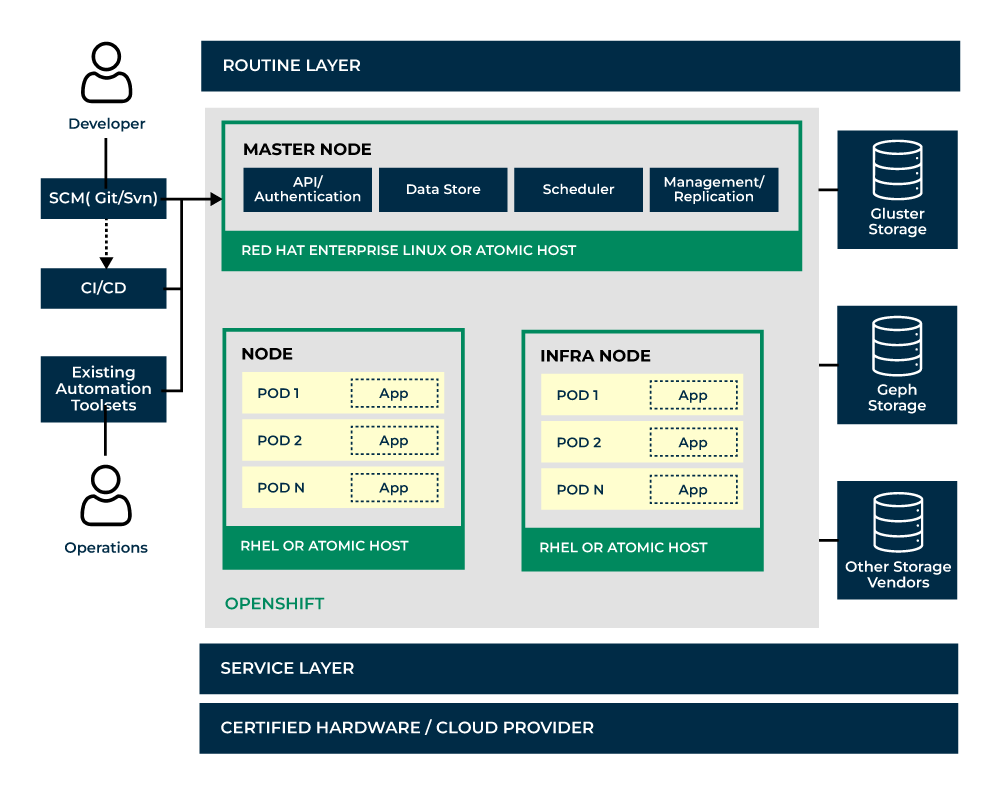
OpenShift, created by Red Hat, is a powerful and adaptable platform for managing containers. It is based on Kubernetes and offers a wide range of tools and features for deploying, scaling, and managing containerized applications. The architecture of OpenShift is crucial in ensuring efficient and secure delivery of these capabilities.
What Is OpenShift?
Open-shift, a widely adopted containerization and container orchestration platform, has been developed by Red Hat, a prominent open-source software enterprise. This platform is constructed on the foundation of Kubernetes, an open-source container orchestration platform, and offers supplementary functionalities and resources to streamline the process of deploying, scaling, and administering containerized applications.
Components of OpenShift Architecture
1. Nodes
- **Master Node: The master node assumes the role of overseeing the cluster and determining the optimal deployment locations for containers.
- **Worker Node: Worker nodes are tasked with executing containers and overseeing their lifecycle.
2. **Pods
- A pod represents the most compact and deployable entity within the OpenShift and Kubernetes platforms. It has the capability to encompass multiple containers that operate within a shared network namespace and storage volume.
3. **Services
- Services are responsible for defining a collection of pods and establishing the means to access them. They offer a network abstraction layer and implement load balancing mechanisms to evenly distribute incoming traffic among the pods.
4. **Routes (Ingress)
- Routes enable external traffic to reach services within the OpenShift cluster. They serve the purpose of exposing applications to the internet and managing the routing of HTTP and HTTPS traffic.
5. Deployment Configurations
- Deployment Configurations specify the manner in which an application is to be deployed and updated.
6.**Persistent Storage
- OpenShift offers various tools and features to effectively handle the storage needs of applications. These encompass network-attached storage, storage classes, and Persistent Volume Claims (PVCs).
7. I**mage Registry
- OpenShift incorporates a built-in container image registry, typically leveraging Docker, for the purpose of storing and overseeing container images.
8. **Operators
- Operators serve as an augmentation to Kubernetes and OpenShift, facilitating the automated administration of intricate applications and services.
9. **Authentication and Authorization
- OpenShift incorporates authentication and authorization mechanisms that effectively regulate access to the cluster.
10. **Monitoring and Logging
- OpenShift offers a comprehensive suite of tools and integrations designed to facilitate the monitoring and assessment of application and infrastructure health and performance.
11. **Networking
- OpenShift is responsible for the management of network configurations, which encompasses overlay networks utilized for container communication, services, and routing.
12. **Security
- OpenShift places a strong emphasis on security and incorporates various features such as Security Context Constraints (SCCs), pod security policies, and container scanning to guarantee the security of applications that are containerized.
How OpenShift Works?
Here are some points on working of OpenShift:
- OpenShift simplifies the procedure of deploying applications that are containerized.
- Developers encapsulate their code and associated dependencies within containers.
- The aforementioned containers are stored either in the integrated container registry or in an external registry.
- Deployment configurations specify the manner in which applications are to be deployed, while services guarantee their accessibility.
- OpenShift is responsible for the orchestration of pod scheduling on worker nodes, the management of scaling operations, the routing of external traffic, the monitoring of application health, the enforcement of security policies, and the automation of various tasks through operators.
- Furthermore, it provides support for CI/CD integration, facilitates rolling updates, and enables high availability configurations, thereby establishing itself as a versatile platform for contemporary software development.
Benefits of OpenShift Architecture
- **Container Orchestration: OpenShift leverages Kubernetes to automate the process of deploying, scaling, and managing containerized applications. This guarantees that your applications are always accessible and can easily adapt to increasing demand.
- **Multi-Tenancy: OpenShift enables multi-tenancy, enabling multiple teams or projects to utilize the same cluster while ensuring separation. This is accomplished by utilizing namespaces, role-based access control (RBAC), and network policies.
- Scalability: OpenShift has the capability to effortlessly expand applications horizontally by adding or removing containers as required. It also provides support for automatic scaling based on metrics such as CPU and memory utilization.
- **Service Discovery and Load Balancing: OpenShift comes with integrated service discovery and load balancing features, simplifying the process of applications finding and interacting with each other. This promotes the development of robust and highly accessible architectures.
- **Security: OpenShift offers strong security capabilities such as role-based access control (RBAC), pod security policies, network policies, and automated vulnerability scanning for containers.
- **High Availability: OpenShift offers high availability configurations to guarantee that your applications can withstand node failures and other infrastructure problems.
- **Community and Ecosystem: The OpenShift platform has a lively community of open-source contributors and a expanding range of third-party tools and extensions. This enables organizations to make use of established solutions and industry standards.
- **Customization and Extensibility: OpenShift offers a great deal of flexibility and adaptability. It allows you to tailor and expand its functionalities according to your applications and organization's unique requirements. This can be achieved through the creation of personalized templates, operators, and configurations.
- **Regulatory Compliance: OpenShift provides functionalities that assist organizations in fulfilling regulatory compliance obligations, including encryption of data, access management, and auditing capabilities.
- **Cost Efficiency: OpenShift can lower operational expenses related to containerized applications by enhancing resource utilization, automating management tasks, and offering a scalable platform.To know the difference between kubernetes and AWS refer to Difference Between Kubernetes and OpenShift.
Conclusion
The architectural design of OpenShift, which is based on Kubernetes, is a comprehensive and meticulously planned framework that effectively manages containers and facilitates the efficient, secure, and scalable delivery of applications.