Combinational Circuit vs Sequential Circuit (original) (raw)
Last Updated : 24 Mar, 2026
In digital electronics, circuits are classified into two primary categories: The combinational circuits and the sequential circuits. Where the outputs depend on the current inputs are called combination circuits; combinational circuits are simple and effective for functions like addition, subtraction, and logical works. Combinational circuits are used for basic operations, whereas sequential circuits are used for tasks involving sequences.
Combinational Circuit
A combinational circuit is a kind of digital electronic circuit whose outputs depend on the present inputs and have no connections to the past inputs. These circuits do such tasks as additions, subtractions, and logical AND, OR, and NOR circuits. The key characteristics of combinational circuits include:
- **No Memory Elements: The output is dependent solely on the current policy inputs.
- **Immediate Response: Good input differs from its output, and bad input differs from its output.
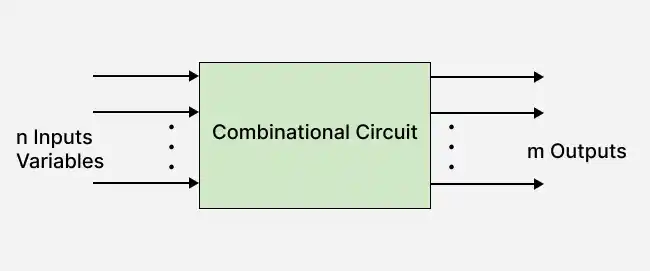
Combinational Circuit
Advantages
- **Simplicity: It is easier to design and implement more so because it lacks memory elements mainly.
- **Speed: Operational at a faster rate as the output automatically adjusts with the changes in inputs.
- **Resource Efficiency: Generally it needs far fewer components as compared to its equivalent sequential circuits.
Disadvantages
- **Limited Functionality: Is not able to perform operations that need historical information or sequence details.
- **Complexity with Increased Inputs: It becomes difficult to design combinational circuits when there are many inputs.
Sequential Circuit
Sequential circuits are quite different from combinational circuits in the sense that they employ memory components. A sequential circuit provides output based on current inputs as well as prior inputs; therefore, it is more functional.
- **Memory Elements: These circuits have flip-flop or latch to store past state information.
- **Time Dependency: Current input values as well as the previous input states have an impact on the output.
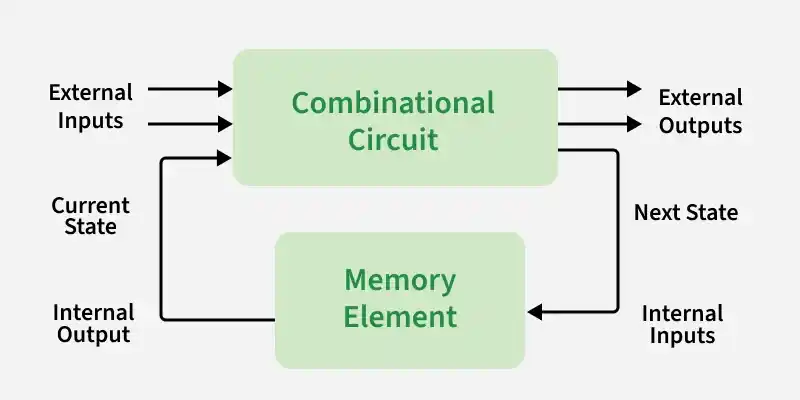
Sequential Circuit
Advantages
- **Memory Utilization: Able to store the previous states in order to perform the operations.
- **Functional Versatility: It is used for those tasks which need a series of operations, state machines, and counters.
Disadvantages
- **Complexity: More difficult to design compared to counter-propagators due to the use of memory elements.
- **Slower Operation: Output changes may represent a delay because often they require data processing from the past.
Combinational Circuit vs Sequential Circuit
| Combinational Circuit | Sequential Circuit |
|---|---|
| Output depends only on the current inputs. | Output depends on both current inputs and past states (memory). |
| Does not require memory elements. | Requires memory elements like flip-flops or latches. |
| Output is immediate, based on input changes. | Output is dependent on clock pulses and previous states. |
| No clock signal required. | Requires a clock signal to synchronize state changes. |
| Simpler design without the need for memory. | More complex due to memory and clock management. |
| Faster, as outputs change instantly with inputs. | Slower due to dependency on clock cycles and past states. |
| Performs basic logical operations without sequence dependency. | Performs operations that require sequences or timed events. |
| Adders, Subtractors, Multiplexers, Encoders. | Counters, Shift Registers, Flip-Flops, State Machines. |
| Generally lower power consumption. | Higher power consumption due to memory and clock circuitry. |
| Used in tasks requiring direct logical operations (e.g., arithmetic). | Used in applications involving sequential operations (e.g., counters, registers). |