Multiplexers (original) (raw)
Last Updated : 8 Oct, 2025
A multiplexer is a combinational circuit that has many data inputs and a single output, depending on control or select inputs. For N input lines, log2(N) selection lines are required, or equivalently, for 2n input lines, n selection lines are needed.
- Multiplexers are also known as "N-to-1 selectors," parallel-to-serial converters, many-to-one circuits, and universal logic circuits.
- They are mainly used to increase the amount of data that can be sent over a network within a certain amount of time and bandwidth.

Multiplexer
Types of Mux
The Mux can be of different types based on input but in this article, we will go through two major types of mux, which are
- **2x1 Mux
- **4x1 Mux
2x1 Multiplexer
The 2x1 is a fundamental circuit which is also known 2-to-1 multiplexer that are used to choose one signal from two inputs and transmits it to the output. The 2x1 mux has two input lines, one output line, and a single selection line. It has various applications in digital systems such as in microprocessor it is used to select between two different data sources or between two different instructions.
Block Diagram of 2:1 Multiplexer with Truth Table
Given Below is the Block Diagram and Truth Table of 2:1 Mux. In this Block Diagram where I0 and I1 are the input lines, Y is the output line and S0 is a single select line.
.png)
Block Diagram of 2:1 Multiplexer with Truth Table
The output of the 2x1 Mux will depend on the selection line S0,
- When S is 0(low), the I0 is selected
- when S0 is 1(High), I1 is selected
Logical Expression of 2x1 Mux
Using the Truth Table ,the Logical Expression for Mux can be determined as
Y=\overline{S_0}.I_0+S_0.I_1
Circuit Diagram of 2x1 Multiplexers
Using truth table the circuit diagram can be given as
.webp)
Circuit Diagram of 2x1 Mux
4×1 Multiplexer
The 4x1 Multiplexer which is also known as the 4-to-1 multiplexer. It is a multiplexer that has 4 inputs and a single output. The Output is selected as one of the 4 inputs which is based on the selection inputs. The number of the Selection lines will depend on the number of the input which is determined by the equation log_2n ,In 4x1 Mux the selection lines can be determined as log_4=2 ,slo two selections are needed.
Block Diagram of 4×1 Multiplexer
In the Given Block Diagram I0, I1, I2, and I3 are the 4 inputs and Y is the Single output which is based on Select lines S0 and S1.
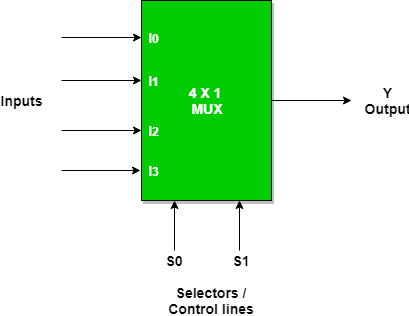 The output of the multiplexer is determined by the binary value of the selection lines
- When S1S0=00, the input I0 is selected.
- When S1S0=01, the input I1 is selected.
- When S1S0=10, the input I2 is selected.
- When S1S0=11, the input I3 is selected.
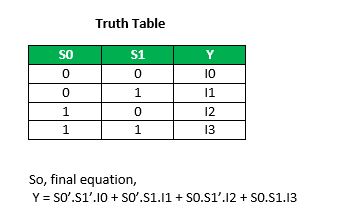
Truth Table of 4×1 Multiplexer
Given Below is the Truth Table of 4x1 Multiplexer
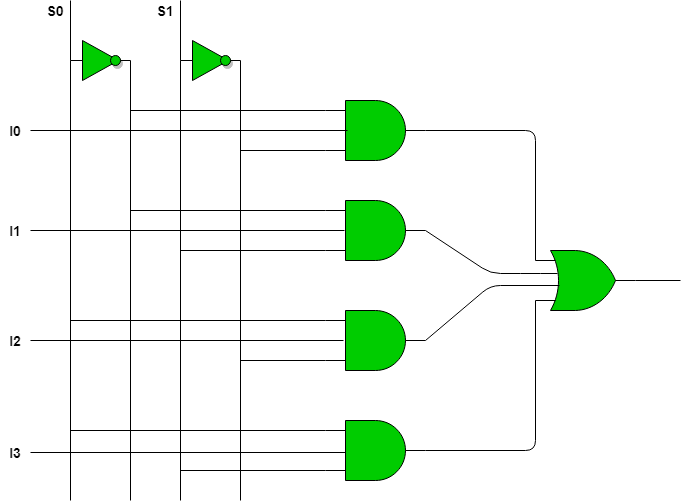
Circuit Diagram of 4x1 Multiplexers
Using truth table the circuit diagram can be given as
Multiplexer can act as universal combinational circuit. All the standard logic gates can be implemented with multiplexers.
Implementation of Different Gates with 2:1 Mux
Given below are the Implementation of Different gate using 2:1 Mux
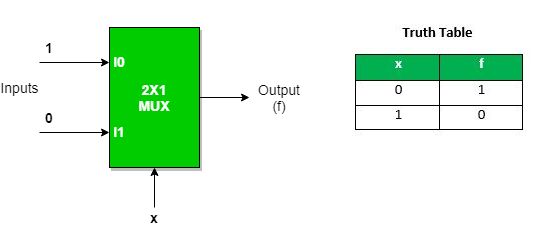
Implementation of NOT gate using 2 : 1 Mux
The Not gate from 2:1 Mux can be obtained by
- Connect the input signal to one of the data input lines(I0).
- Then connect a line (0 or 1) to the other data input line(I1)
- Connect the same input line Select line S0 which is connected to D0.
Given Below is the Diagram for the Logical Representation of NOT gate using 2 : 1 Mux
Implementation of AND gate using 2 : 1 Mux
The And gate from 2:1 Mux can be obtained by
- Connect the input Y to I1.
- Connect the input X to the selection line S0.
- Connect a line(0) to I0.
Given Below is the Diagram for the Logical Representation of AND gate **using 2 : 1 Mux
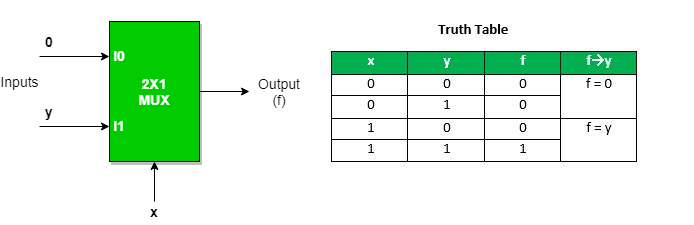
For further more on the **Implementation of AND gate using 2 : 1 Mux
Implementation of OR gate using 2 : 1 Mux
The OR gate from 2:1 Mux can be obtained by
- Connect input X to the selection line S0.
- Connect input Y to I1.
- Connect Line(1) to I1.
Given Below is the Diagram for the Logical Representation of OR gate using 2 : 1 Mux
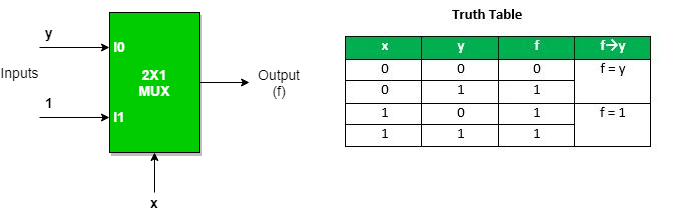
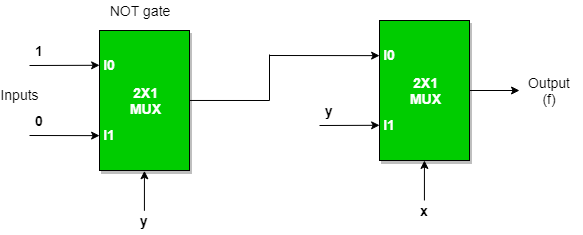
Implementation of NAND, NOR, XOR and XNOR gates requires two 2:1 Mux. First multiplexer will act as NOT gate which will provide complemented input to the second multiplexer.
Implementation of NAND gate using 2 : 1 Mux
The NAND gate from 2:1 Mux can be obtained by
- In first mux take inputs and 1 and 0 and y as selection line.
- In Second MUX the Output from mux is connected to I1.
- line(1) is given to the I0.
- x is given as selection line for the second Mux.
Given Below is the Diagram for the Logical Representation of NAND gate using 2 : 1 Mux
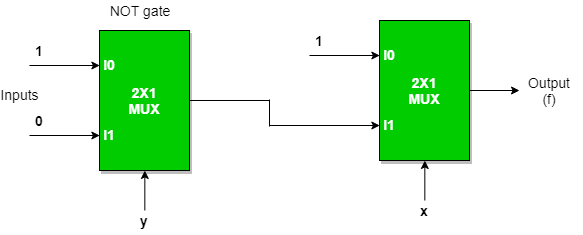
For further more on the Implementation of NAND gate using 2 : 1 Mux
Implementation of NOR gate using 2 : 1 Mux
The Nor gate from 2:1 Mux can be obtained by
- In first mux take inputs and 1 and 0 and y as selection line.
- In Second MUX the Output from mux is connected to I0.
- line(0) is given to the I1.
- x is given as selection line for the second Mux.
Given Below is the Diagram for the Logical Representation of NOR gate using 2 : 1 Mux

For further more on the Implementation of NOR gate using 2 : 1 Mux
Implementation of EX-OR gate using 2 : 1 Mux
The Nor gate from 2:1 Mux can be obtained by
- In first mux take inputs and 1 and 0 and y as selection line.
- In Second MUX the Output from mux is connected to I1.
- y is given to the I0.
- x is given as selection line for the second Mux.
Given Below is the Diagram for the Logical Representation of EX-OR gate using 2 : 1 Mux
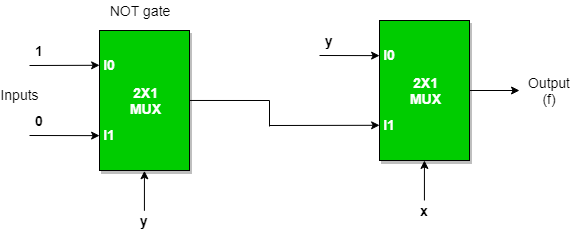
Implementation of EX-NOR gate using 2 : 1 Mux
Given Below is the Diagram for the Logical Representation of EX-OR gate using 2 : 1 Mux
The Nor gate from 2:1 Mux can be obtained by
- In first mux take inputs and 1 and 0 and y as selection line.
- In Second MUX the Output from mux is connected to I0.
- y is given to the I1.
- x is given as selection line for the second Mux.
Implementation of Higher Order MUX using Lower Order MUX
Given Below are the Implementation of Higher Order MUX Using Lower Order MUX
4 : 1 MUX using 2 : 1 MUX
Three 2: 1 MUX are required to implement 4 : 1 MUX.
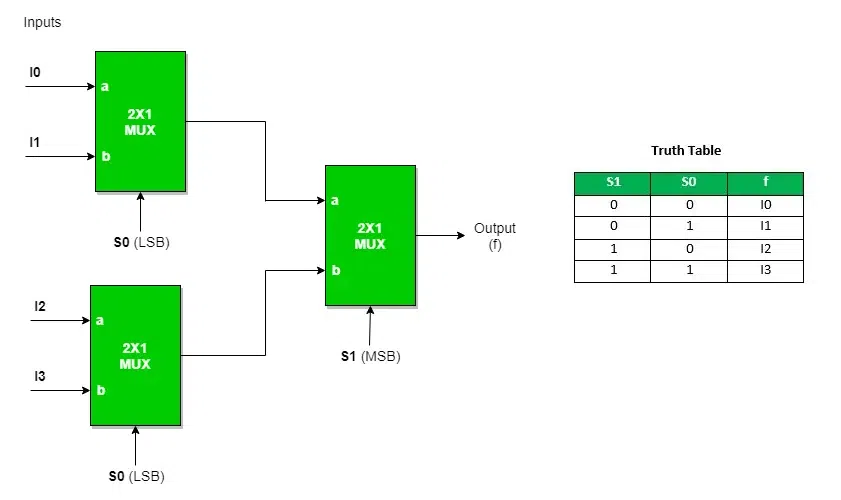
4 : 1 MUX using 2 : 1 MUX
Similarly,
While an 8:1 MUX requires seven (7) 2:1 MUX, a 16:1 MUX requires fifteen (15) 2:1 MUX, and a 64:1 MUX requires sixty-three (63) 2:1 MUX. Hence, we can draw the conclusion that an
2^n:1
MUX requires sixty-three (63) 2:1 MUX. Hence, we can draw the conclusion that an 2 n :1 MUX requires (2n−1)2:1 MUX (2 n −1)2:1 MUX.
16 : 1 MUX using 4 : 1 MUX
Given Below is the logical Diagram of 16:1 Mux Using 4:1 Mux
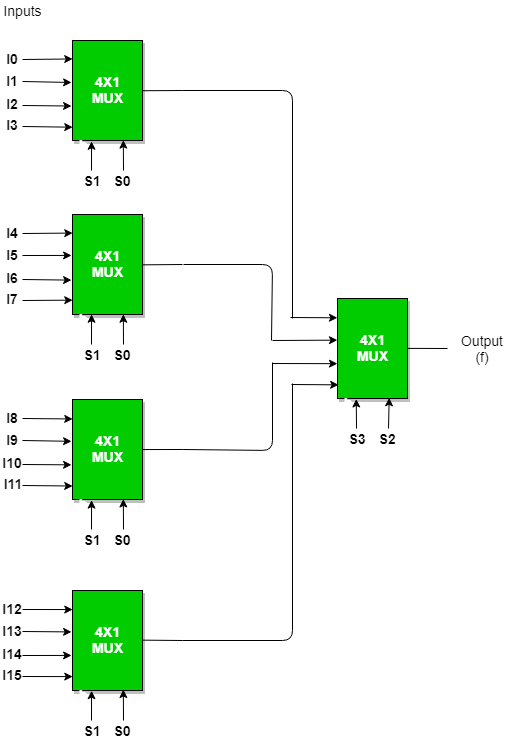
In general, to implement B : 1 MUX using A : 1 MUX , one formula is used to implement the same.
B / A = K1,
K1/ A = K2,
K2/ A = K3
KN-1 / A = KN = 1 (till we obtain 1 count of MUX).
And then add all the numbers of MUXes = K1 + K2 + K3 + .... + K N .
To implement 64 : 1 MUX using 4 : 1 MUX
Using the above formula, we can obtain the same.
64 / 4 = 16
16 / 4 = 4
4 / 4 = 1 (till we obtain 1 count of MUX)
Hence, total number of 4 : 1 MUX are required to implement 64 : 1 MUX = 16 + 4 + 1 = 21.
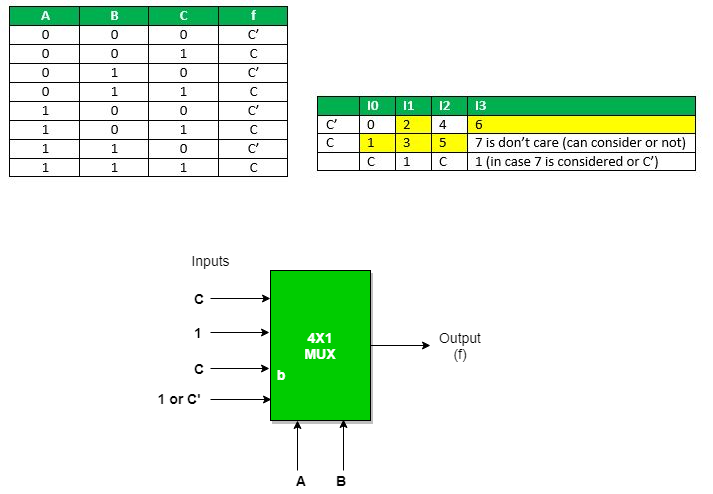
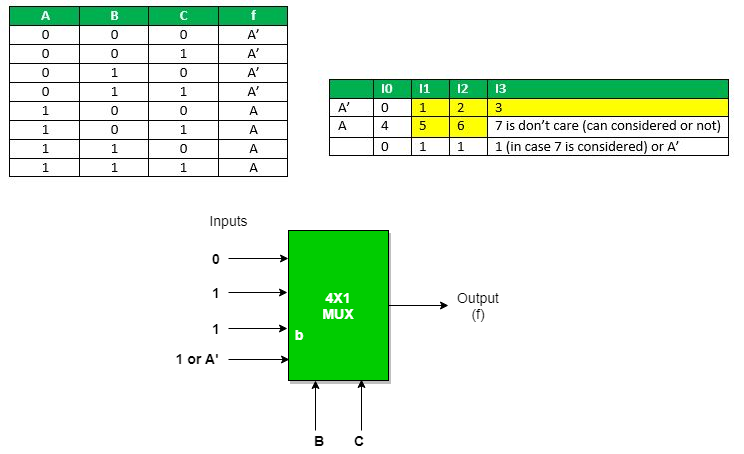
f(A, B, C) =
\sum
(1, 2, 3, 5, 6) with don't care (7)
Using A and B as the select lines for 4 : 1 MUX,
AB as select: Expanding the minterms to its boolean form and will see its 0 or 1 value in Cth place so that they can be placed in that manner.
**AC as select : Expanding the minterms to its Boolean form and will see its 0 or 1 value in Bth place so that they can be place in that manner.
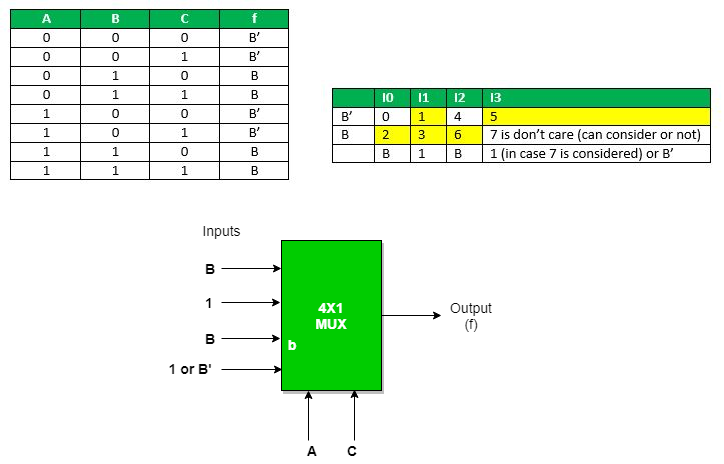 **BC as select: Expanding the minterms to its boolean form and will see its 0 or 1 value in A th place so that they can be place in that manner.
Applications of MUX
- **Data Routing : The Mux is used for data routing in the digital system where they select one of the several data lines and re-route it the output.
- **Data Selection : The Mux is used for data selection where they select data source according to the select lines.
- **Analog-to-Digital Conversion : The Mux are used in ADC to select different analog input channels.
- **Address Decoding : The Mux are used in Microprocessors or memory for address decoding.
- **Logic Function Implementation : Mux can be used to implement various logic functions.
**➣ **Also Check - Demultiplexer(DEMUX)