Synchronous vs. Asynchronous Counter (original) (raw)
Last Updated : 9 Oct, 2025
Counters are essential components in digital electronics used for counting events or time.
- They are widely used in digital systems for tasks like frequency division, event counting, and time measurement.
- Their design and operation play a crucial role in determining the accuracy and efficiency of digital circuits.
Synchronous Counter
A Synchronous Counter is a counter where all flip-flops are triggered simultaneously by a single common clock signal, ensuring synchronized state changes.
- A universal clock controls all flip-flops at once.
- All flip-flops change state together for precise timing.
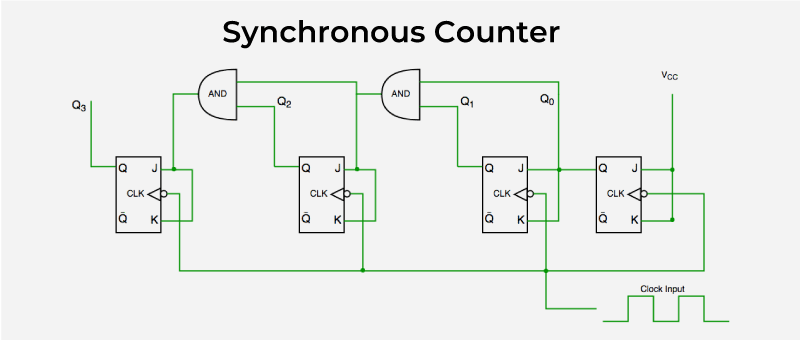
Synchronous Counter
**Advantages of Synchronous Counters:
- **Faster Operation: All flip-flops trigger simultaneously for quicker response.
- **Precise Timing: Synchronized operation reduces timing errors.
- **Low Propagation Delay: No ripple effect between flip-flops.
- **High Reliability: Stable and error-resistant performance.
- **Ideal for High-Speed Use: Suitable for fast timers and processors.
- **Simplified Control: Single clock source makes timing easier to manage.
**Disadvantages of Synchronous Counters:
- **Complex Design: Requires additional control logic and synchronization circuits.
- **Higher Power Consumption: All flip-flops switching simultaneously increases power usage.
- **More Components Needed: Needs extra hardware like clock drivers and buffers.
Asynchronous Counter
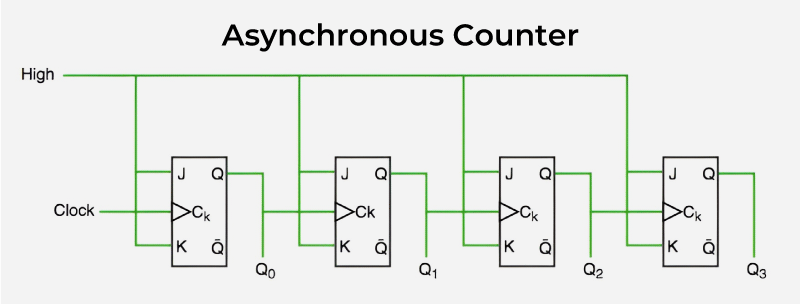
An Asynchronous Counter, or Ripple Counter, is a counter where only the first flip-flop receives the main clock signal, and each subsequent flip-flop is triggered by the output of the previous one.
- Flip-flops change state one after another, causing a ripple effect.
- Only the first flip-flop gets the external clock; others rely on preceding outputs.
**Advantages of Asynchronous Counters:
- **Simple Design: Each flip-flop triggers the next, no common clock needed.
- **Lower Power Consumption: Flip-flops change one at a time, saving power.
- **Cost-Effective: Fewer components make it cheaper to build.
- **Good for Low-Speed Use: Suitable for basic timers and event counters.
- **Flexible: Works well when precise synchronization isn’t required.
**Disadvantages of Asynchronous Counters:
- **Slower Operation: Sequential triggering causes delays.
- **Timing Issues: Ripple effect can lead to errors at high speeds.
- **Less Accurate: Propagation delays reduce precision.
- **Limited Speed: Not suitable for fast applications.
- **Reduced Reliability: More prone to glitches as flip-flops increase.
**Synchronous vs. Asynchronous Counter
| Synchronous Counter | Asynchronous Counter |
|---|---|
| In synchronous counter we use a universal clock that is common to all flip flops through out the circuit. | In asynchronous counter main clock is only applied to the first flip flop and then for rest of flip flops the output of previous flip flop is taken as a clock. |
| Synchronous Counter is faster in operation as compared to Asynchronous Counter. | Asynchronous Counter is slower as compared to synchronous counter in operation. |
| Synchronous Counter does not produce any decoding errors. | Asynchronous Counter produces decoding error. |
| Synchronous Counter is also called Parallel Counter. | Asynchronous Counter is also called Serial Counter. |
| Synchronous Counter designing as well implementation are complex due to increasing the number of states. | Asynchronous Counter designing as well as implementation is very easy. |
| Synchronous Counter will operate in any desired count sequence. | Asynchronous Counter will operate only in fixed count sequence (UP/DOWN). |
| Synchronous Counter examples are: Ring counter, Johnson counter. | Asynchronous Counter examples are: Ripple UP counter, Ripple DOWN counter. |
| In synchronous counter, propagation delay is less. | In asynchronous counter, there is high propagation delay. |