Arithmetic Sequence Formula (original) (raw)
Last Updated : 23 Jul, 2025
An **Arithmetic Sequence is a sequence of numbers in which the difference between consecutive terms is constant. This constant is called the **common difference (d).
**Example:
**Sequence: 2, 5, 8, 11, 14,…
**Common Difference: d = 5 − 2 = 3
The following are the key formulas associated with **arithmetic sequences, including ways to find the **n-th term, the **sum of terms, the **common difference, and the **number of terms in a sequence. Each formula is explained with its purpose and usage.
Table of Content
- Formula 1: General Formula for the nth Term
- Formula 2: Sum of the First n Terms (Arithmetic Series)
- Formula 3: Common Difference
- Formula 4: Finding the Number of Terms
- Applications of Arithmetic Sequences Formula
- Solved Examples of Arithmetic Sequence
Formula 1: General Formula for the nth Term
The arithmetic sequence formula is a way to describe the n-th term of an arithmetic sequence. If we know the first term of the sequence (denoted by '**a') and the common difference ('**d'), we can determine any term in the sequence using this formula.
The general formula for the nth term (an) of an arithmetic sequence is given by:
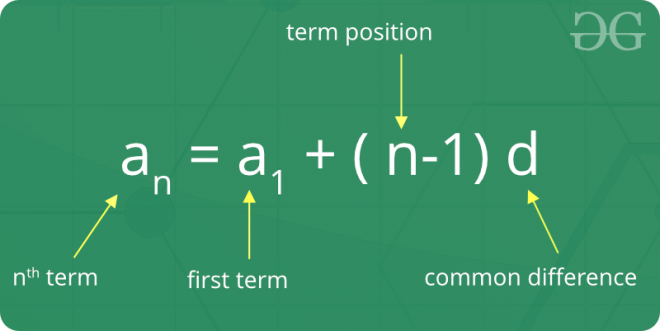
Where,
- **First Term (a 1 ): This is the starting point of the sequence. It represents the initial value from which the sequence begins.
- **Common Difference (d): This is the consistent difference between any two successive terms in the sequence. If the sequence is increasing, d is positive. If the sequence is decreasing, d is negative.
- **Position of the Term (n): This represents the term number we are interested in finding.
Formula 2: Sum of the First n Terms (Arithmetic Series)
These formulas help you calculate the total of the first **n terms in the sequence.
When you know the first term and the **common difference, the sum of the first n terms (**S n) of an arithmetic sequence can be calculated using the formula:
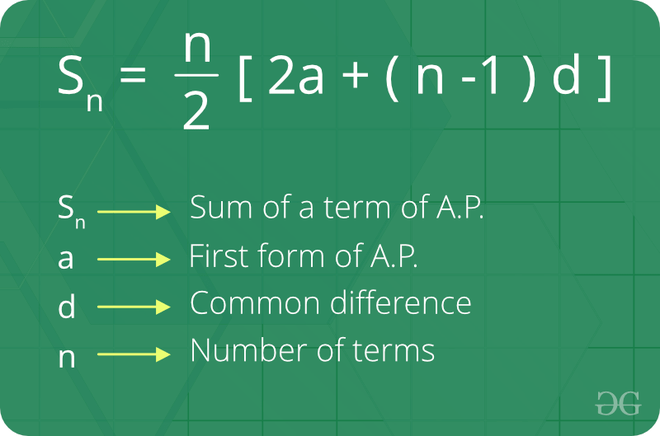
**Alternatively, when you know the first term and the **last term, the sum of the first n terms (**S n) of an arithmetic sequence can be calculated using the formula:
**S n **= (n/2) [a 1 + T n ]
Where,
- **S n = sum of the first n terms
- **a = first term
- **n = number of terms
- **d = common difference
- **T n = nth term
Formula 3: Common Difference
This formula helps determine the consistent interval between terms in the sequence. If you need to find the common difference (d) when you know two terms in the sequence, use:
**d = T n - T n - 1
where,
- **d = Common Difference
- **T n = nth term
- T n - 1 = (n - 1)th term
Formula 4: Finding the Number of Terms
This formula is useful for determining how many terms exist in a given range of an arithmetic sequence. To find the number of terms (n) in an arithmetic sequence between two given terms, you can rearrange the general formula:
**n = (T n - a)/d + 1
Where,
- **T n = last term in the sequence
- **a = first term
- **d = common difference
Applications of Arithmetic Sequences Formula
Arithmetic sequences are not just theoretical constructs but have practical applications in various fields. Here are some key areas where arithmetic sequence formulas are commonly used:
- **Loan Repayment Schedules: The total amount to be repaid on a loan can be calculated using arithmetic sequences.
- **Data Structures: Arithmetic sequences are used in algorithms that require uniform increments or decrements, such as iterating through arrays or lists.
- **Motion Analysis: In kinematics, uniform acceleration problems often lead to arithmetic sequences. For example, the displacement of an object under uniform acceleration can be analyzed using these sequences.
- **Grading Systems: Some grading systems use arithmetic sequences to assign grades based on uniform score increments.
- **Economic Predictions: Predicting future values of economic indicators that change uniformly over time, such as monthly sales increases or production quantities.
**Read More,
Solved Examples of Arithmetic Sequence
**Example 1: Find the 10 th term of an arithmetic sequence where the first term a 1 is 5 and the common difference d is 3.
**Solution:
The formula for the nth term of an arithmetic sequence is:
an = a**1 + (n - 1) · d
Here, a1 = 5, d = 3, and n = 10.
a10 = 5 + (10 - 1) · 3
⇒ a10 = 5 + 9 · 3
⇒ a10 = 5 + 27
⇒ a10 = 32So, the 10th term is 32.
**Example 2: Find the sum of the first 15 terms of an arithmetic sequence where the first term a 1 is 7 and the common difference d is 4.
**Solution:
The formula for the sum of the first n terms Sn of an arithmetic sequence is:
Sn = (n/2) · (2a**1 + (n - 1) · d)
Here, a1 = 7, d = 4, and n = 15.
S15 = (15/2) · (2 · 7 + (15 - 1) · 4)
⇒ S15 = (15/2) · (14 + 14 · 4)
⇒ S15 = (15/2) · (14 + 56)
⇒ S15 = (15/2) · 70
⇒ S15 = 15 · 35
⇒ S15 = 525So, the sum of the first 15 terms is 525.
**Example 3: Find the common difference of an arithmetic sequence where the 3 rd term is 11 and the 7 th term is 23.
**Solution:
The formula for the nth term of an arithmetic sequence is: an = a1 + (n - 1) · d
Let a3 = 11 and a7 = 23.
From the formula for the n**th term, we have two equations:
- a3 = a1 + 2d
- a7 = a1 + 6d
Subtracting the first equation from the second:
a7 - a3 = (a1 + 6d) - (a1 + 2d)
⇒ 23 - 11 = 4d
⇒ 12 = 4d
⇒ d = 3So, the common difference is 3.
**Example 4: Find the sum of the terms from the 4 th term to the 10 th term of an arithmetic sequence where the first term a 1 is 2 and the common difference d is 5.
**Solution:
First, find the 4th and 10th terms using the nth term formula:
For the 4**th term:
a4 = a1 + (4 - 1) · d
⇒ a4 = 2 + 3 · 5
⇒ a4 = 2 + 15
⇒ a4 = 17For the 10th term:
a10 = a1 + (10 - 1) · d
a10 = 2 + 9 · 5
a10 = 2 + 45
a10 = 47Now, find the sum of the terms from the 4**th to the 10th term using the sum formula:
The number of terms from the 4th to the 10th term is 10 - 4 + 1 = 7.
The sum of these terms is:
S7 = 7/2 · (a4 + a10)
S7 = 7/2 · (17 + 47)
S7 = 7/2 · 64
S7 = 7 · 32 = 224So, the sum of the terms from the 4th to the 10th term is 224.