Diagonal Matrix (original) (raw)
Last Updated : 21 Aug, 2025
A **diagonal matrix is a square matrix in which all of the elements except the principal diagonal elements are zero. It is both upper and lower triangular, as all the elements except the main diagonal elements are zeros. This structure simplifies many operations like multiplication and raising matrices to powers.
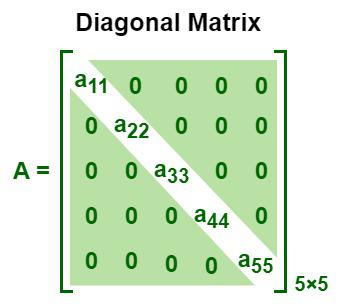
A square matrix "A = [aij]" is said to be a diagonal matrix if a ij = 0 when i ≠ j.
The matrix given below represents a diagonal matrix of order "5 × 5."
Examples of a Diagonal Matrix
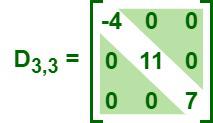
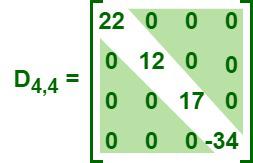
Some common examples of diagonal matrices of different orders are given below:
Diagonal Matrix of order (3 × 3)
Diagonal Matrix of order (4 × 4)
Properties of a Diagonal Matrix
The following are the properties of the Diagonal Matrix:
- Every diagonal matrix is a square matrix, i.e., a matrix that has an equal number of rows and columns.
- Scalar matrices, identity matrices, and null matrices are examples of diagonal matrices, as their non-principal diagonal elements are zeros.
- The resultant matrix of the sum of two diagonal matrices is also diagonal.
- The resultant matrix of the product of diagonal matrices is also a diagonal matrix, where the main diagonal elements of the resultant matrix are products of the corresponding elements of the original matrices.
If A = \left[\begin{array}{cc} -3 & 0\\ 0 & -3 \end{array}\right] and B = \left[\begin{array}{cc} 8 & 0\\ 0 & 5 \end{array}\right] , then AB = \left[\begin{array}{cc} -24 & 0\\ 0 & -15 \end{array}\right] .
- A diagonal matrix is a symmetric matrix, as the transpose of a diagonal matrix is the same matrix itself.
If D = \left[\begin{array}{cc} 6 & 0\\ 0 & 7 \end{array}\right] is a diagonal matrix, then D^{T} = \left[\begin{array}{cc} 6 & 0\\ 0 & 7 \end{array}\right] , i.e., D = DT.
- The sum of two diagonal matrices is also a diagonal matrix.
If A = \left[\begin{array}{cc} -5 & 0\\ 0 & 11 \end{array}\right] and B = \left[\begin{array}{cc} 7 & 0\\ 0 & -13 \end{array}\right] are two diagonal matrices, then
A + B = B + A = \left[\begin{array}{cc} 2 & 0\\ 0 & -2 \end{array}\right]
AB = BA = \left[\begin{array}{cc} -35 & 0\\ 0 & -143 \end{array}\right]
Block Diagonal Matrix
The term "block matrix" refers to a matrix that is divided into blocks. In such matrices, the non-diagonal blocks are zero matrices, whereas the main diagonal blocks are diagonal matrices. A matrix "A = [aij]" is called a block **diagonal matrix when aij = 0, for i ≠ j, i.e., when the non-diagonal blocks are zero.
A = \left[\begin{array}{cccccc} a_{11} & 0 & 0 & . & . & 0\\ 0 & a_{22} & 0 & . & . & 0\\ 0 & 0 & a_{33} & . & . & 0\\ . & . & . & . & . & .\\ . & . & . & . & . & .\\ 0 & 0 & 0 & . & . & a_{nn} \end{array}\right]_{n\times n}
Determinant of a Diagonal Matrix
The determinant of a diagonal matrix is equal to the product of its principal diagonal elements.
If,
D = \left[\begin{array}{ccc} a_{11} & 0 & 0\\ 0 & a_{22} & 0\\ 0 & 0 & a_{33} \end{array}\right]
|D| = a11 × a22 × a33.
Inverse of Diagonal Matrix
The inverse of a diagonal matrix is also a diagonal matrix with the principal diagonal's elements being the reciprocals of the corresponding elements of the original matrix.
If D = \left[\begin{array}{ccc} a_{11} & 0 & 0\\ 0 & a_{22} & 0\\ 0 & 0 & a_{33} \end{array}\right] , then D^{-1} = \left[\begin{array}{ccc} \frac{1}{a_{11}} & 0 & 0\\ 0 & \frac{1}{a_{22}} & 0\\ 0 & 0 & \frac{1}{a_{33}} \end{array}\right] .
Anti-Diagonal Matrix
An anti-diagonal matrix, or non-diagonal matrix, is said to be the mirror image of a diagonal matrix concerning the placement of the elements. In an anti-diagonal matrix, all elements are zero except the diagonal (not the principal diagonal) elements from the upper right edge to the lower left edge. The matrix given below is an anti-diagonal matrix of order "3 × 3."
A = \left[\begin{array}{ccc} 0 & 0 & a_{11}\\ 0 & a_{22} & 0\\ a_{33} & 0 & 0 \end{array}\right]
Identity vs Diagonal Matrix
The difference between a diagonal matrix and an identity matrix is outlined below:
| Identity Matrix | Diagonal Matrix |
|---|---|
| A special diagonal matrix where all diagonal entries are **1. | A square matrix where all off-diagonal elements are zero. |
| All diagonal entries are **1. | Can be any numbers (zero, positive, negative, fractions). |
| Example: A = \left[\begin{array}{ccc} 1 & 0 & 0\\ 0 & 1 & 0\\ 0 & 0 & 1 \end{array}\right] | Example: A = \left[\begin{array}{ccc} 4 & 0 & 0\\ 0 & 5 & 0\\ 0 & 0 & 6 \end{array}\right] |
| Acts as the "do nothing" matrix: AI = IA = A. | Scales rows/columns by the diagonal entries. |
**Related Articles
Solved Examples of Diagonal Matrix
**Example 1: If A = \left[\begin{array}{ccc} -4 & 0 & 0\\ 0 & 11 & 0\\ 0 & 0 & 7 \end{array}\right], then prove that A = AT.
**Solution:
Given matrix, A = \left[\begin{array}{ccc} -4 & 0 & 0\\ 0 & 11 & 0\\ 0 & 0 & 7 \end{array}\right]
A^{T} = \left[\begin{array}{ccc} -4 & 0 & 0\\ 0 & 11 & 0\\ 0 & 0 & 7 \end{array}\right] = A
So, A = AT
Hence proved.
**Example 2: Find the determinant of the matrix given below.
D = \left[\begin{array}{ccc} -5 & 0 & 0\\ 0 & 0 & 0\\ 0 & 0 & 14 \end{array}\right]
**Solution:
Given matrix, D = \left[\begin{array}{ccc} -5 & 0 & 0\\ 0 & 0 & 0\\ 0 & 0 & 14 \end{array}\right]
We can notice that the given matrix is a diagonal matrix. We know that the determinant of a diagonal matrix is equal to the product of its principal diagonal elements.
So, |D| = -5 × 0 × 14 = 0
Hence, the determinant of the given matrix is 0.
**Example 3: Find the inverse of the matrix given below.
B = \left[\begin{array}{cc} 11 & 0\\ 0 & 17 \end{array}\right]
**Solution:
We can notice that the given matrix is a diagonal matrix. We know that the inverse of a diagonal matrix is obtained by replacing the principal diagonal's elements with the reciprocals of the corresponding elements of the original matrix, while the rest of the elements remain the same.
So, B^{-1} = \left[\begin{array}{cc} \frac{1}{11} & 0\\ 0 & \frac{1}{17} \end{array}\right] .
**Example 4: Prove that A + B = B + A, if A = \left[\begin{array}{cc} 6 & 0\\ 0 & 7 \end{array}\right] and B = \left[\begin{array}{cc} -10 & 0\\ 0 & 13 \end{array}\right].
**Solution:
Given matrices,
A = \left[\begin{array}{cc} 6 & 0\\ 0 & 7 \end{array}\right] and B = \left[\begin{array}{cc} -10 & 0\\ 0 & 13 \end{array}\right]
A + B = \left[\begin{array}{cc} -4 & 0\\ 0 & 20 \end{array}\right]
B + A = \left[\begin{array}{cc} -4 & 0\\ 0 & 20 \end{array}\right]
So, A + B = B + A
Hence, proved.
Diagonal Matrix Practice Worksheet
**Problem 1: Identify whether the following matrix is diagonal:
\begin{pmatrix} 5 & 0 & 0 \\ 0 & 3 & 0 \\ 0 & 0 & 7 \end{pmatrix}
**Problem 2: Identify whether the following matrix is diagonal:
\begin{pmatrix} 1 & 2 & 0 \\ 0 & 4 & 0 \\ 0 & 0 & 6 \end{pmatrix}
**Problem 3: Multiply the following diagonal matrices:
\begin{pmatrix} 2 & 0 \\ 0 & 3 \end{pmatrix} \times \begin{pmatrix} 4 & 0 \\ 0 & 5 \end{pmatrix}
**Problem 4: Multiply the following diagonal matrices:
\begin{pmatrix} 7 & 0 & 0 \\ 0 & 1 & 0 \\ 0 & 0 & 9 \end{pmatrix} \times \begin{pmatrix} 3 & 0 & 0 \\ 0 & 6 & 0 \\ 0 & 0 & 2 \end{pmatrix}
**Problem 5: Add the following diagonal matrices:
\begin{pmatrix} 1 & 0 \\ 0 & 1 \end{pmatrix} + \begin{pmatrix} 2 & 0 \\ 0 & 2 \end{pmatrix}
**Problem 6: Add the following diagonal matrices:
\begin{pmatrix} 5 & 0 & 0 \\ 0 & 8 & 0 \\ 0 & 0 & 3 \end{pmatrix} + \begin{pmatrix} 7 & 0 & 0 \\ 0 & 1 & 0 \\ 0 & 0 & 6 \end{pmatrix}
**Problem 7: Find the inverse of the following diagonal matrix:
\begin{pmatrix} 3 & 0 \\ 0 & 4 \end{pmatrix}
**Problem 8: Find the inverse of the following diagonal matrix:
\begin{pmatrix} 2 & 0 & 0 \\ 0 & 5 & 0 \\ 0 & 0 & 7 \end{pmatrix}
**Problem 9: Find the determinant of the following diagonal matrix:
\begin{pmatrix} 4 & 0 \\ 0 & 5 \end{pmatrix}
**Problem 10: Find the determinant of the following diagonal matrix:
\begin{pmatrix} 3 & 0 & 0 \\ 0 & 6 & 0 \\ 0 & 0 & 2 \end{pmatrix}