Square Matrix (original) (raw)
Last Updated : 21 Aug, 2025
In mathematics and computer science, matrices are powerful tools for representing and processing data. They can model complex systems, perform transformations in graphics, and solve real-world problems across various domains.
Among the many types of matrices, one special category stands out for its wide range of applications — the **square matrix.
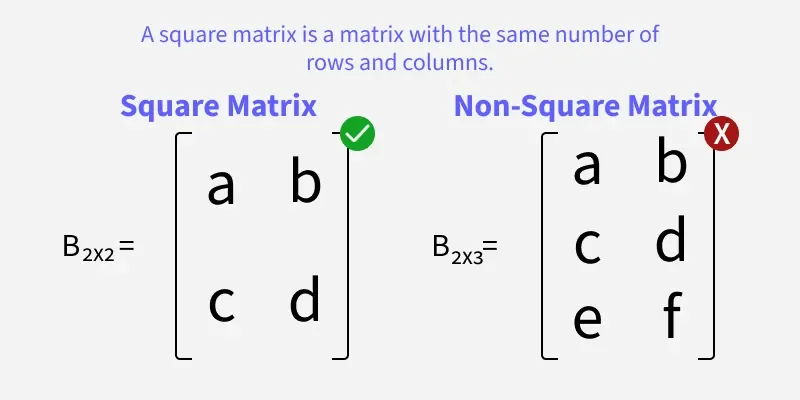
With the same number of rows and columns, square matrices have unique properties such as determinants, inverses, and traces, making them essential in areas like cryptography, engineering, and machine learning.
For example, consider the square matrix X given by
X = \begin{bmatrix}2 & -7 & 7 \\2 & 5 & 6 \\5 & 4 & 3\end{bmatrix}
Square Matrix Examples
Some common examples of square matrices of different orders are given below:
- The following matrix is a square matrix of order "2 × 2," i.e., the given matrix has two rows and two columns.
A_{2\times2} = \left[\begin{array}{cc} p & q\\ r & s \end{array}\right]
- The following matrix is a square matrix of order "3 × 3," i.e., the given matrix has three rows and three columns.
B_{3\times3} = \left[\begin{array}{ccc} 1 & 2 & 3\\ 4 & 5 & 6\\ 7 & 8 & 9 \end{array}\right]
- The following matrix is a square matrix of order "n × n," i.e., the given matrix has "n" rows and "n" columns.
A_{n\times n} = \left[\begin{array}{cccccc} a_{11} & a_{12} & a_{13} & . & . & a_{1n}\\ a_{21} & a_{22} & a_{23} & . & . & a_{2n}\\ a_{31} & a_{32} & a_{33} & . & . & a_{3n}\\ . & . & . & . & . & .\\ . & . & . & . & . & .\\ a_{n1} & a_{n2} & a_{n3} & . & . & a_{nn} \end{array}\right]
Properties of a Square Matrix
The following are some important properties of a square matrix:
- In every square matrix, the number of rows and columns is equal.
- The sum of all principal diagonal elements in a square matrix is defined as the trace of a matrix.
- The determinant value can be determined only for square matrices.
- If the determinant of a square matrix is zero, then the matrix is called a singular matrix, whereas it is said to be non-singular if its determinant is not equal to zero.
- If the principal diagonal elements in a square matrix are ones and the rest of the elements are zeros, then the matrix is called an identity matrix.
- The order of a square matrix and its transpose are the same.
- We can perform various operations on a square matrix, such as addition, multiplication, inverse, etc.
Types of Square Matrix
We have various types of square matrices, such as identity matrices, singular matrices, non-singular matrices, symmetric matrices, etc.
- **Singular Matrix****:** If the determinant of a square matrix is zero, then the matrix is called a singular matrix.
"A" is a square matrix of order "n × n" and is said to be a singular matrix if ****|A| = 0.**
- **Scalar Matrix****:** A scalar matrix is a square matrix whose principal diagonal elements are equal and the rest of the elements are zeros.
- **Identity Matrix****:** An identity matrix is a square matrix whose principal diagonal elements are ones and the rest of the elements are zeros.
- **Symmetric Matrix****:** A symmetric matrix is a square matrix whose transpose is the same as the original matrix.
"A" is a square matrix of order "n × n" and is said to be a symmetric matrix if **A T = A.
- **Skew-Symmetric Matrix****:** A skew-symmetric matrix is a square matrix whose transpose is equal to the negative of the original matrix.
"A" is a square matrix of order "n × n" and is said to be a symmetric matrix if **A T = −A.
- **Orthogonal Matrix****:** An orthogonal matrix is a square matrix whose inverse is equal to the transpose of the matrix.
"A" is a square matrix of order "n × n" and is said to be an orthogonal matrix if **A -1 = A T .
Addition and Subtraction of Square Matrices
We can perform various mathematical operations on a square matrix, such as addition, multiplication, etc. When two square matrices of the same order are added or subtracted, the resultant matrix is obtained when corresponding elements are added or subtracted.
If A = \left[\begin{array}{cc} a & b\\ c & d \end{array}\right] and \ B = \left[\begin{array}{cc} p & q\\ r & s \end{array}\right] are two square matrices of order "2 × 2," then A\pm B = \left[\begin{array}{cc} a\pm p & b\pm q\\ c\pm r & d\pm s \end{array}\right] .
- If A and B are two square matrices of the same order, then A + B = B + A.
Multiplication of Square Matrices
If are A = \left[\begin{array}{cc} a & b\\ c & d \end{array}\right] and B = \left[\begin{array}{cc} p & q\\ r & s \end{array}\right] are two square matrices of order "2 × 2," then
A\times B = \left[\begin{array}{cc} a & b\\ c & d \end{array}\right] \times \left[\begin{array}{cc} p & q\\ r & s \end{array}\right]
A\times B = \left[\begin{array}{cc} (a\times p)+(b\times q) & (a\times r)+(b\times s)\\ (c\times p)+(d\times q) & (c\times r)+(d\times s) \end{array}\right] .
Determinant of a Square Matrix
The determinant of a square matrix is a scalar value or a summary value that represents the entire set of elements in the matrix. The determinant of a "2 × 2" square matrix can be easily determined using the formula, which is the difference of the product of the matrix's principal diagonal elements.
If A = \left[\begin{array}{cc} a & b\\ c & d \end{array}\right] is a square matrix of order "2 × 2," then the formula to calculate its determinant is given as follows:
|A| or det A = [ad – bc]
Inverse of a Square Matrix
The inverse operation can be performed on the square matrix. Division of a matrix can be achieved using the inverse of a Matrix. The inverse of a matrix is found after the determinant of the Square Matrix is calculated. After that Adjoint of the Square matrix is found. Then the Inverse is calculated as,
**A -1 = adj. A / |A|
**Related Articles
Solved Examples on Square Matrix
**Example 1: Calculate the determinant of the square matrix given below.
P = \left[\begin{array}{cc} -3 & 5\\ -2 & 0 \end{array}\right]
**Solution:
Given matrix, P = \left[\begin{array}{cc} -3 & 5\\ -2 & 0 \end{array}\right]
|P| = (-3 × 0) – (–2 × 5)
|P| = 0 – (–10) = 10
Hence, the determinant of the given matrix is 10.
**Example 2: Find whether the matrix given below is a singular matrix or not.
B = \left[\begin{array}{cc} 0 & 4\\ 4 & 0 \end{array}\right]
**Solution:
To find whether the matrix given below is singular or not, we have to calculate its determinant.
|B| = (4 × 4) – (0 × 0) = 16 ≠ 0
As the determinant of the given matrix is not equal to zero, the given matrix is non-singular.
**Example 3: Determine the inverse of the matrix given below.
A = \left[\begin{array}{cc} 1 & -2\\ 6 & 7 \end{array}\right]
**Solution:
If A = \left[\begin{array}{cc} a & b\\ c & d \end{array}\right] , then
A^{-1} = \frac{1}{ad-bc} \left[\begin{array}{cc} d & -b\\ -c & a \end{array}\right]
A^{-1} = \frac{1}{7+12} \left[\begin{array}{cc} 7 & 2\\ -6 & 1 \end{array}\right]
A^{-1} = \frac{1}{19}\left[\begin{array}{cc} 7 & 2\\ -6 & 1 \end{array}\right]
A^{-1}= \left[\begin{array}{cc} \frac{7}{19} & \frac{2}{19}\\ \frac{-6}{19} & \frac{1}{19} \end{array}\right]
**Example 4: Find whether the matrix given below is symmetric or not.
A = \left[\begin{array}{ccc} 2 & 0 & 6\\ 5 & 4 & 9\\ 1 & 3 & -5 \end{array}\right]
**Solution:
"A" is a square matrix of order "n × n" and is said to be a symmetric matrix if AT = A.
The given matrix, A = \left[\begin{array}{ccc} 2 & 0 & 6\\ 5 & 4 & 9\\ 1 & 3 & -5 \end{array}\right]
A^{T} = \left[\begin{array}{ccc} 2 & 5 & 1\\ 0 & 4 & 3\\ 6 & 9 & -5 \end{array}\right] ≠ A
Since, AT ≠ A, the given square matrix is not symmetric.
Unsolved Questions on Square Matrix
**Question 1: If A = \begin{bmatrix} 3 & 2 \\ 5 & 4 \end{bmatrix} find:
a) The determinant of A
b) AT (transpose of A)
**Question 2: Determine whether A is symmetric, skew-symmetric, or neither
A = \left[\begin{array}{ccc} 1 & 2 & 3\\ 2 & 4 & 5\\ 3 & 5 & 6 \end{array}\right]
**Question 3: Determine the inverse of the following matrix (if it exists):
A = \begin{bmatrix} 1 & 0 & 5 \\ 2 & 1 & 6 \\ 3 & 4 & 0 \end{bmatrix}
**Question 4: Determine whether the following matrix is **singular or **non-singular:
A = \begin{bmatrix} 2 & 0 & 5 \\ 4 & 3 & 2 \\ 1 & -1 & 0 \end{bmatrix}