Even and Odd Functions | Definition, Graph and Examples (original) (raw)
Last Updated : 25 Sep, 2025
Functions can be categorized into two categories based on their symmetry along the axes.
- **Even Functions: An even function remains unchanged when its input is negated (same output for x and -x), reflecting symmetry about the y-axis.
- **Odd Functions: An odd function transforms into its negative when its input is negated, displaying symmetry about the origin. In other words, negating the input results in the negation of the output.
**Conditions for even/odd function:
- **For Even: f(-x) = f(x), for all x in the domain of f, if this condition holds true, the function is considered even.
- **For Odd: f(-x) = -f(x), for all x in the domain of f, if this condition holds true, the function is considered odd.
How to Determine Even and Odd Functions
A real-valued function is regarded as an even or odd function if that is symmetrical. Plugging (-x) in place of x in the function f(x) allows us to detect if a function is an even or odd function. Therefore, we may determine the type of function by looking at the output value of f(-x).
So, let's see the following definitions that are given below:
Even Function
When all values of x and −x in the domain of f satisfy the following equation, the function "f" is considered even:
**f(-x) = f(x)
Here, "Even" is symmetric about the y-axis indicating the graphical Function that would stay unmodified if you were to represent it across the y-axis.
**Examples of even functions:
- cos x
- x2, x4, x6, x8,…, i.e. xn is an even function when n is an even integer
- |x|
- cos2x
- sin2x
**Odd Function
When all values of x and −x in the domain of f satisfy the following equation, the function "f" is considered odd:
**f(-x) = -f(x)
Here, "Odd" is symmetric in that the graphical function would remain unchanged if it were rotated 180 degrees around the origin.
**Examples of odd functions:
- sin x
- x3, x5, x7, x9,…, i.e. xn is an odd function when n is an odd integer
- x
Graphing Even and Odd Functions
Let's explore the graphical behavior of even and odd functions. An even function's graph is symmetric around the y-axis, meaning it looks the same when reflected across the y-axis. For any pair of opposite x-values, the function's y-values are identical along the curve.
On the other hand, an odd function's graph is symmetric with respect to the origin. This means the graph is equidistant from the origin but in opposite directions. For any pair of opposite x-values, the function's y-values are also opposite. Here are some examples of even and odd functions.
Even Functions Graph
An even function's graph is symmetric about the y-axis and stays unchanged after reflection of the y-axis. Along the whole curve, the function value will not change for any two opposing input values of x.
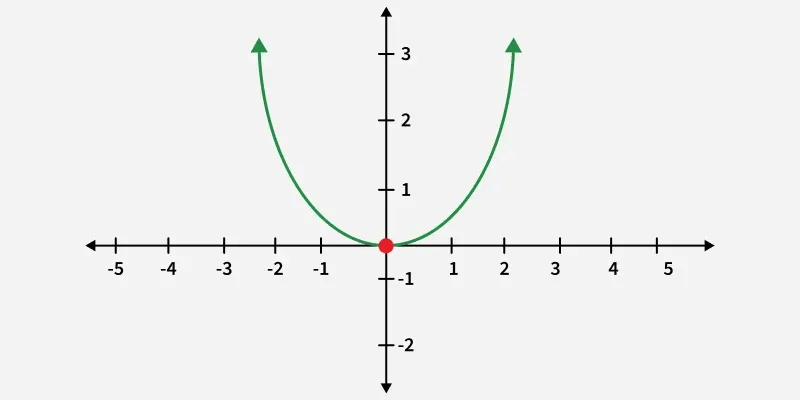
Graph of a Square Function
Odd Functions Graph
An Odd function's graph is symmetric concerning the origin that lies at the same distance from the origin but faces different directions. Whereas the function has opposite y values for any two opposite input values of x.
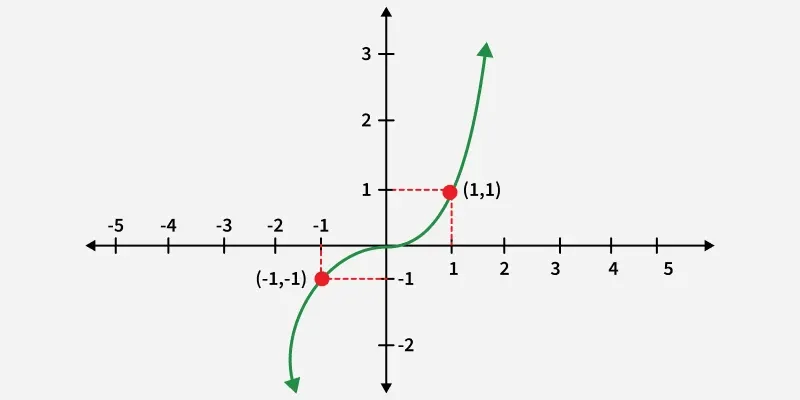
Graph of a Cubic Function
Neither Odd Nor Even Function
If a real-valued function f(x) does not fulfill f(-x) = f(x) and f(-x) = -f(x) for at least one value of x in the function's domain, it is considered to be neither even nor odd (x). Suppose
f(x) = 2x5 + 3x2 + 1
f(-x) = 2(-x)5 + 3(-x)2 + 1
f(-x) = -2x5- 3x2 + 1
(Both conditions failed)
Therefore, f(x) = 2x5 + 3x2 + 1 is neither "Even" nor "Odd" Function.
Its graph lacks reflective symmetry and rotational symmetry, meaning the function does not satisfy either condition
f(-x) \ne f(x) \ and \ f(-x) \ne -f(x)
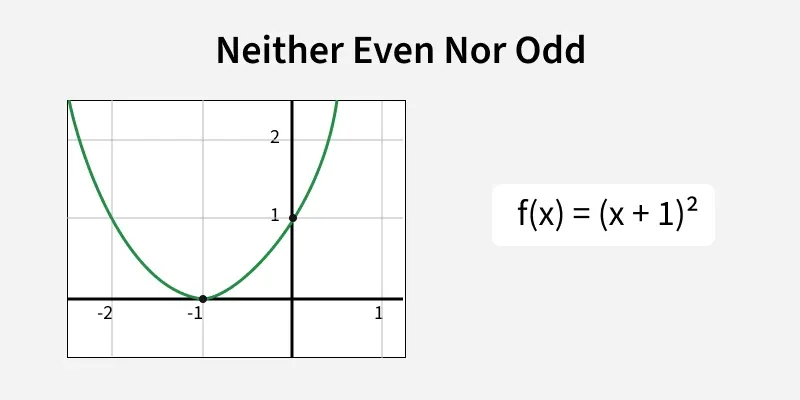
Graph of Neither Even nor Odd Function
**Even and Odd Trigonometric Functions
In trigonometry, the concepts of even and odd functions play a crucial role in understanding the behavior and properties of the trigonometric functions. The classification of trigonometric functions as even and odd functions helps in simplifying problems and deriving identities.
**Even Trigonometric Functions
An even trigonometric function satisfies the property f(−x) = f(x). This means the trigonometric function is symmetric about the y-axis. In trigonometry, the cosine function (cos x) and the secant function (sec x) are examples of even trigonometric functions.
- **Cosine Function (cos x): For the cosine function, cos (-x) = cos x. This symmetry about the y-axis indicates that the cosine values remain the same if the angle is negated.
- **Secant Function (sec x): The secant function, being the reciprocal of the cosine function, also exhibits even symmetry. Thus, sec (-x) = sec x.
**Odd Trigonometric Functions
An odd trigonometric function satisfies the property f(−x) = −f(x). This means the trigonometric function is symmetric about the origin. In trigonometry, the sine function (sin x), the tangent function (tan x), the cosecant function (csc x), and the cotangent function (cot x) are examples of odd trigonometric functions.
- **Sine Function (sin x): For the sine function, sin(−_x) = −sin _x. This indicates that the sine function is symmetric concerning the origin.
- **Tangent Function (tan x): The tangent function satisfies tan(−_x) = −tan _x which reflects its odd symmetry.
- **Cosecant Function (csc x): Since the cosecant function is the reciprocal of the sine function, it follows the odd function property, csc(−_x) = −csc _x.
- **Cotangent Function (cot x): The cotangent function, being the reciprocal of the tangent function, is also odd, so cot(−_x) = −cot _x.
Properties of Even and Odd Functions
Some of the properties of Even and Odd Functions are given below.
- **Zero Function: The only function that is both even and odd is the zero function, f(x) = 0.
- **Addition and Subtraction:
- **Even Functions: The sum or difference of two even functions is even.
- **Odd Functions: The sum or difference of two odd functions is odd.
- **Multiplication:
- **Even Functions: The product of two even functions is even.
- **Odd Functions: The product of two odd functions is even.
- **Quotient:
- **Even Functions: The quotient of two even functions is even, provided the denominator is not zero.
- **Odd Functions: The quotient of two odd functions is even, provided the denominator is not zero.
- **Mixing Even and Odd Functions:
- The sum of an even and an odd function is neither even nor odd unless one of the functions is zero.
- The product of even and odd functions is an odd function.
Integral Properties of Even and Odd Functions
Integrals over symmetric intervals can be made simpler by using the distinct integral features of even and odd functions. These are as follows:
**Even Functions
When f(x) is an even function, its integral over the symmetric interval [−a, a] can be reduced as follows:
**∫ a -a **f(x) dx = 2 ∫ a 0 **f(x) dx
Due to its symmetry about the y-axis, the graph of an even function has this property. Integrating over a symmetric interval effectively doubles the area under the curve on one side, so we only need to compute half of it.
**Odd Functions
When f(x) is an odd function, its integral over the symmetric interval [−a, a] can be reduced as follows:
∫ a -a f(x) dx = 0
The rotational symmetry of the odd function's graph origin gives birth to this characteristic. The net area is zero when the integration across a symmetric interval eliminates the positive and negative regions.
**Related Articles
Solved Examples of Even and Odd Functions
**Example 1: Using the notion of even and odd functions, ascertain if the function f(x) = Cos(x) is even or not.
**Solution:
Given Function: f(x) = Cos(x)
f(x) = f(-x) for all x in its domain
Cos(x) = Cos(-x)
Cos(x), satisfies the condition f(x) = f(-x)So, therefore, Cos(x) is an even function
**Example 2: Identify whether the function f(x) = x4 + 2x2 - 3 is even, odd, or neither.
**Solution:
For even function
Let's take f(-x)
f(-x) = (-x)4 + 2(-x)2 - 3
f(-x) = x4 + 2x2 - 3Since, f(x) = f(-x),
Therefore, function f(x) is even.
Practice Questions on Even and Odd Functions
**Question 1: Determine if the function g(x) = 1/x2 is even, odd, or neither.
**Question 2: Identify whether the function f(x) = x3+ x is even, or odd or neither.
**Question 3: Identify if the function m(x) = ex + e-x is even, odd, or neither.
**Question 4: Determine whether the function g(x) = 1/tan x, is even, odd, or neither.
**Question 5: Determine whether the function h(x) = sin x - cos x, is even, odd, or neither.