Fractional Exponents (original) (raw)
Last Updated : 23 Apr, 2026
Fractional exponents, also known as rational exponents (radicals), are used to represent powers and roots together in a single expression. In an exponential expression of the form aᵇ, where a is the base and b is the exponent, if b is a fraction (m/n), it is called a fractional exponent.
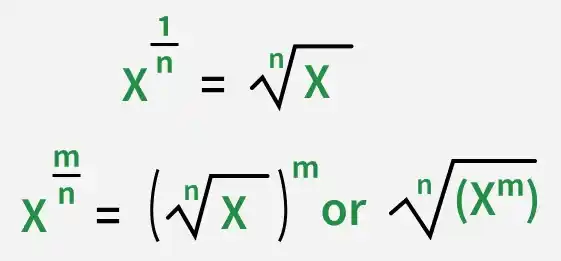
In a fractional exponent, the numerator (m) represents the power, and the denominator (n) represents the root.
**Here are some common examples of fractional exponents:
| Exponent | Name of the exponent | Indication |
|---|---|---|
| 1/2 | Square root | a^{\frac{1}{2}} = \sqrt{a} |
| 1/3 | Cube root | a^{\frac{1}{3}} = \sqrt[3]{a} |
| 1/4 | Fourth root | a^{\frac{1}{4}} = \sqrt[4]{a} |
Rules of Fractional Exponents
**Rule 1: When multiplying powers with the same base, add the exponents: a^{\frac{1}{m}} \times a^{\frac{1}{n}} = a^{\frac{1}{m} + \frac{1}{n}}
**Rule 2: When dividing powers with the same base, subtract the exponents: a^{\frac{1}{m}} \div a^{\frac{1}{n}} = a^{\frac{1}{m} - \frac{1}{n}}
**Rule 3: When multiplying different bases with the same exponent, multiply the bases: a^{\frac{1}{m}} \times b^{\frac{1}{m}} = (ab)^{\frac{1}{m}}
**Rule 4: When dividing different bases with the same exponent, divide the bases: a^{\frac{1}{m}} \div b^{\frac{1}{m}} = \left(\frac{a}{b}\right)^{\frac{1}{m}}
**Rule 5: A negative exponent means taking the reciprocal: a^{-\frac{m}{n}} = \frac{1}{a^{\frac{m}{n}}}
**Example: Simplify (64/125)²⁄³
**Solution:
64 = 4³ and 125 = 5³
So, (64/125)²⁄³ = (4³/5³)²⁄³
= ((4/5)³)²⁄³ _(using law of exponents: (aᵐ)ⁿ = aᵐⁿ)
= (4/5)² _(since 3 × 2/3 = 2)
= 16/25
Fractional Exponents vs Integer Exponents
The following table shows the difference between fractional and integer exponents:
| Fractional Exponents | Integer Exponents |
|---|---|
| Used when the power is not an integer. | Used when the powers are whole numbers. |
| They are written in the form x a/b. | They are written in the form x a |
| Allows us to express roots and other non- integer powers. | Positive integer exponents indicate repeated multiplication, and negative integer exponents indicate repeated division. |
| Ex: 41/2=2 | Ex: 42 = 16 and 4-2 = 1/16 |
**Example: Solve 161/4
**Solution:
We know that 16 can be expressed 2x2x2x2.
16 = 24
So, we get, (24)1/4 = 2
The product of the exponents gives 4×1/4=1. ∴ 4√16=161/4=2.
**Example: Solve 22/3 * 23/4
**Solution:
Multiply fractional exponents with same base
Sum of exponents = 2/3 +3/4 = (8+9)/12 = 17/12
So, 22/3 x 23/4 = 217/12
**Example: Simplify 43/4 ÷ 45/8
**Solution:
In this case we express it as a1/m ÷ a1/n = a(1/m - 1/n).
= 4 (3/4-5/8) = 4 (1/8)
**Example: Simplify 163/5 ÷ 43/5
**Solution:
Using a1/m ÷ b1/m = (a ÷ b)1/m
So, (16/4)(3/5) = 43/5
**Example: Simplify 49-1/2
**Solution:
The base is 49 and the exponent is −1/2.
First, remove the negative sign by taking the reciprocal of the base:
49⁻¹ᐟ² = (1/49)¹ᐟ²Now, the exponent 1/2 means square root:
(1/49)¹ᐟ² = 1/√49Since √49 = 7, we get:
1/√49 = 1/7
Related Articles
Solved Examples
**1. Simplify (27/125)2/3
**Solution:
Here both the base and the exponent are in fractional form. 27 can be expressed as a cube of 3 and 125 can be expressed as a cube of 5.
so, 27=33 and 125=53.
We get, (33/53)2/3 here 3 is a common power for both the numbers, So, ((3/5)3)2/3, which is equal to (3/5)2 as 3×2/3=2.
Now, we have (3/5)2, which is equal to 9/25.
**2. Simplify 81-1/4
**Solution:
Here the base is 81 and the power is -1/4. The first step is to take the reciprocal of the base, which is 1/81, and remove the negative sign from the power.
We get (1/81)1/4. As we know that is the fourth power of 3 is 34 = 81, we can re-write the expression as 1/(34)1/4. Since 4 and 1/4 cancel each other, so we get 1/3.
**3. Evaluate 81/2 ÷ 21/2
**Solution:
In this case the powers are the same but the bases are different.
Hence, we can solve this problem as, 81/2 ÷ 21/2 = (8/2)1/2 = 41/2 = 2.
**4. Solve the given expression involving the multiplication of terms with fractional exponents.
31/2 × 31/4 × 31/8
**Solution:
The given expression can be re-written as,
31/2 × 31/4 × 31/8
Multiplication of fractional exponents with the same base is done by adding the powers and writing the sum on the common base.
⇒ 3(1/2 + 1/4 + 1/8)
⇒ 37/8
Practice Problems
**Problem 1: Simplify:
- 163/2
- 1251/3
- 813/4
- 642/3
- √(x3)
**Problem 2: Evaluate:
- 1/82/3
- (91/2)3/2
- (163/4)2/3
- (272/3)1/3
**Problem 3: Calculate:
- a2/5 × a3/5
- 33/4 × 31/4
- x1/4 × x-1/4
- 22/5 × 2-3/5