Identity Matrix (original) (raw)
Last Updated : 21 Aug, 2025
An identity Matrix is a square matrix whose all diagonal elements are equal to 1 and the rest of the elements are zero****.**
- The identity Matrix is also known as the Unit Matrix.
- The main condition for the Identity matrix is that it should be a square matrix, i.e., the number of rows should be equal to the number of columns.
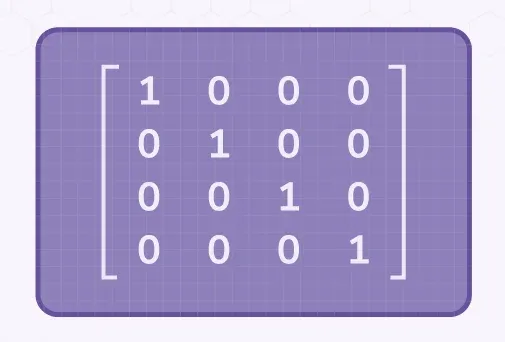
A (4×4) unit matrix
Representation of Identity Matrix
An identity matrix or unit matrix is always a square matrix and is expressed as "𝑰." For example, "𝑰n" is the identity matrix of order n, i.e., it has "n" rows and columns.
It is a scalar matrix as the diagonal elements are the same. When the product of any two square matrices is an identity matrix, then the matrices are said to be inverses of each other. The rank of an identity matrix of order "n × n" is n, as it has "n" linearly independent rows (or columns). The matrix given below represents an identity matrix of order "n by n."
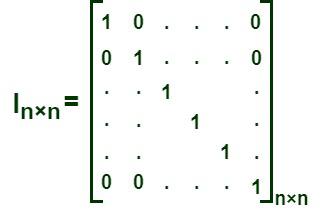
Unit matrix of order (n × n)
Examples of Identity Matrix
A square matrix P = [aij] is said to be an identity matrix when aij = 1 for i = j and aij = 0 for i ≠ j.
⇒ The matrix given below is an identity matrix of order "2 × 2."
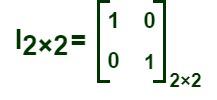
Unit matrix of order 2× 2
⇒ The matrix given below is an identity matrix of order "3 × 3."
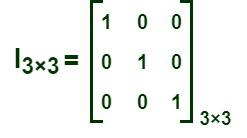
Unit matrix of order 3 × 3
Properties of an Identity Matrix
The properties mentioned below are some important properties of an Identity Matrix:
- An identity matrix is always a square matrix, i.e., a matrix that has an equal number of rows and columns.
- The determinant of an identity matrix or unit matrix is always equal to 1, i.e., |𝑰| = 1.
|𝑰| = 1
- The inverse of an identity matrix or unit matrix is the identity matrix itself.
𝑰**-1 = I
- If an identity matrix of order "n" is multiplied by itself n times, then the resultant matrix will also be a unit matrix of order n.
𝑰**n = I
- If any matrix A is multiplied by an identity matrix, then the resultant matrix is A.
A𝑰 = 𝑰**A = A**
- The product of two inverse matrices is an identity matrix.
**AA -1 = A -1 A = 𝑰
Solved Examples on Identity Matrix
**Example 1: Determine whether the given matrices are identity matrices or not.
**a) A = \left[\begin{array}{cc} 1 & 1\\ 1 & 1 \end{array}\right]
**b) B= \left[\begin{array}{ccc} 1 & 0 & 0\\ 0 & 1 & 0\\ 0 & 0 & 1 \end{array}\right]
**Solution:
**a) In matrix A, all the principal diagonal elements are ones, and the rest of the elements are also equal to 1. We know that a unit matrix, or identity matrix, is a square matrix whose all elements are zeros except the main diagonal elements, which are ones. Hence, matrix A is not an identity matrix.
**b) In matrix B, all the principal diagonal elements are ones, and the rest of the elements are zeros. So, from the definition of an identity matrix, the given matrix B is an identity matrix.
**Example 2: Give an example of an identity matrix that has four rows and four columns.
**Solution:
The order of an identity matrix that has four rows and four columns is "4 × 4." The matrix given below represents an identity matrix of order "4 × 4," where all the principal diagonal elements are ones, and the rest of the elements are zeros.
𝑰4×4 = \left[\begin{array}{cccc} 1 & 0 & 0 & 0\\ 0 & 1 & 0 & 0\\ 0 & 0 & 1 & 0\\ 0 & 0 & 0 & 1 \end{array}\right]
**Example 3: Find the value of (p − q + r) if the matrix given below is an identity matrix.
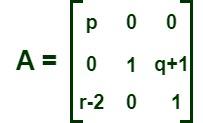
**Solution:
If the given matrix is an identity matrix, then all its principal diagonal elements are ones, and the rest of the elements are zeros.
So, p = 1
q + 1 = 0 ⇒ q = -1
r - 2 = 0 ⇒ r = 2
Now, p − q + r = 1 −(−1) + 2
= 1 + 1 + 2 = 4
Hence, the value of (p − q + r) is 4 if matrix A is an identity matrix.
**Example 4: Prove that the inverse of the identity matrix is the identity matrix itself.
**Solution:
Let's consider an identity matrix of order "2 × 2" to prove that the inverse of the identity matrix is the identity matrix itself.
𝑰2 × 2 = \left[\begin{array}{cc} 1 & 0\\ 0 & 1 \end{array}\right]
We know that the inverse of a matrix A \left[\begin{array}{cc} a & b\\ c & d \end{array}\right] = Adj A/ (ad - bc)
where Adj A = \left[\begin{array}{cc} d & -b\\ -c & a \end{array}\right]
𝑰-1 = 1/ (1 - 0) \left[\begin{array}{cc} 1 & 0\\ 0 & 1 \end{array}\right]
𝑰-1 = \left[\begin{array}{cc} 1 & 0\\ 0 & 1 \end{array}\right] = 𝑰
Hence proved.
**Example 5: For a given matrix A, prove that A𝑰 = A.
**Solution:
Let's consider a square matrix A = \left[\begin{array}{cc} a & b\\ c & d \end{array}\right] to prove that A𝑰 = A.
A𝑰 = \left[\begin{array}{cc} a & b\\ c & d \end{array}\right] \left[\begin{array}{cc} 1 & 0\\ 0 & 1 \end{array}\right]
= \left[\begin{array}{cc} (a\times1+b\times0) & (0\times a+b\times1)\\ (c\times1+d\times0) & (0\times c+d\times1) \end{array}\right]
= \left[\begin{array}{cc} (a+0) & (0+b)\\ (c+0) & (0+d) \end{array}\right]of
= \left[\begin{array}{cc} a & b\\ c & d \end{array}\right] = A
Hence, proved.