Scalar Matrix (original) (raw)
Last Updated : 21 Aug, 2025
A scalar matrix is a square matrix in which all principal diagonal elements are equal and the remaining elements are zero. It is a special case of a **diagonal matrix and can be obtained when an **identity matrix is multiplied by a constant value.
The matrix given below is a scalar matrix of order "4 × 4." We can observe that all its main diagonal elements are the same, while the rest of the elements are zeros.
A =\left[\begin{array}{cccc} 5 & 0 & 0 & 0\\ 0 & 5 & 0 & 0\\ 0 & 0 & 5 & 0\\ 0 & 0 & 0 & 5 \end{array}\right]
A scalar matrix can be obtained when an identity matrix is multiplied by a constant value. In the image given below, we can observe that when an identity matrix is multiplied by a constant "k," a scalar matrix is obtained.
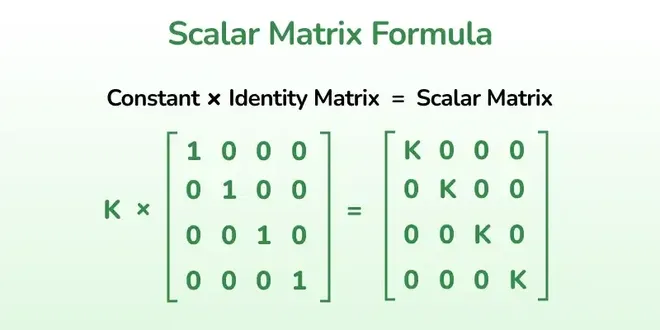
Scalar Matrix
**Scalar Matrix = k × Identity Matrix
**Condition for a Scalar Matrix
Consider a square matrix A that has "i" rows and "j" columns, and let "aij" be an element of the matrix at row number "i" and column number "j."
The following two requirements must be satisfied for matrix A to be a scalar matrix:
- **Diagonal elements are equal to a constant k:
- aij = k for i = j and k ≠ 0, where i = j = 0, 1, 2, ……., n.
- **Non-diagonal elements must be zero:
- aij = 0 for i ≠ j, where i = j = 0, 1, 2, ……., n.
Examples of Scalar Matrix
- The matrix given below is a scalar matrix of order "2 × 2"
A = \left[\begin{array}{cc} -6 & 0\\ 0 & -6 \end{array}\right]
- The matrix given below is a scalar matrix of order "3 × 3"
P = \left[\begin{array}{ccc} k & 0 & 0\\ 0 & k & 0\\ 0 & 0 & k \end{array}\right]
Properties of a Scalar Matrix
Following are the properties of the scalar matrix
- As the transpose of a scalar matrix is equal to the matrix itself, it is a symmetric matrix.
- As the entries above and below the principal diagonal are zero in a scalar matrix, it is both an upper triangular matrix and a lower triangular matrix.
- An identity matrix or a unit matrix is a scalar matrix.
- Any scalar matrix can be obtained when an identity matrix is multiplied by a constant numeric value.
- The determinant of a scalar matrix of any order is equal to the product of the principal diagonal elements.
- The inverse of a scalar matrix is also a scalar matrix whose principal diagonal elements are the reciprocals of the numbers of the original matrix. Remember that the inverse of a scalar matrix exists only if all the principal diagonal elements are not equal to zero.
If A = \left[\begin{array}{cc} k & 0\\ 0 & k \end{array}\right], then A-1 = \left[\begin{array}{cc} \frac{1}{k} & 0\\ 0 & \frac{1}{k} \end{array}\right] (for k ≠ 0).
Scalar vs Diagonal vs Identity Matrix
All these matrix seems similar but there is a slight difference between each of them below is the table showing the difference between them:
| Scalar Matrix | Identity Matrix | Diagonal Matrix |
|---|---|---|
| Diagonal elements equal to a constant k (k≠0). | Diagonal elements equal to 1. | Diagonal elements can have any value. |
| All off-diagonal elements are 0. | All off-diagonal elements are 0. | All off-diagonal elements are 0. |
| Special type of diagonal matrix and includes the identity matrix if k = 1. | A special case of both scalar and diagonal matrices where k = 1. | A diagonal matrix is the most general form. |
| \left[\begin{array}{ccc} k & 0 & 0\\ 0 & k & 0\\ 0 & 0 & k \end{array}\right] | \left[\begin{array}{ccc} 1 & 0 & 0\\ 0 & 1 & 0\\ 0 & 0 & 1 \end{array}\right] | \left[\begin{array}{ccc} 1 & 0 & 0\\ 0 & 9 & 0\\ 0 & 0 & 2 \end{array}\right] |
| The uniform diagonal value makes it "scalar". | Multiplying any matrix by an identity matrix leaves the matrix unchanged. | General diagonal elements without uniformity or restrictions. |
**Related Articles
Operation on Scaler Matrix
For any two matrices of the order m × n, let us say, A = [aij] and B = [bij] and take two scalers 'a' and 'b' Then the scalar multiplication is:
- a(A + B) = aA + aB
- (a + b)A = a A + b A
The multiplication of a scalar matrix (say A) with another matrix (say B) is equal to the multiplication of the constant element of the scalar matrix (A) with all the elements of the matrix (B).
**Also Check
Solved Examples on Scalar Matrix
**Example 1: Calculate the determinant of a scalar matrix given below.
A = \left[\begin{array}{ccc} -3 & 0 & 0\\ 0 & -3 & 0\\ 0 & 0 & -3 \end{array}\right]
**Solution:
Given matrix A = \left[\begin{array}{ccc} -3 & 0 & 0\\ 0 & -3 & 0\\ 0 & 0 & -3 \end{array}\right]
|A| = −3[(−3 × −3) − 0] − 0 + 0
|A| = −3(9) = −27Hence, the determinant of the given scalar matrix is −27.
**Example 2: Give an example of a scalar matrix that has three rows and three columns.
**Solution:
The order of a scalar matrix that has three rows and three columns is "3 × 3." The matrix given below represents a scalar matrix of order "3 × 3," where all the principal diagonal elements are equal, and the rest of the elements are zeros.
B = \left[\begin{array}{ccc} 6 & 0 & 0\\ 0 & 6 & 0\\ 0 & 0 & 6 \end{array}\right]
**Example 3: Determine the inverse of the scalar matrix given below.
P = \left[\begin{array}{cc} \frac{1}{2} & 0\\ 0 & \frac{1}{2} \end{array}\right]
**Solution:
The given matrix P = \left[\begin{array}{cc} \frac{1}{2} & 0\\ 0 & \frac{1}{2} \end{array}\right]
Now, P-1 = Adj P/|P|
|P| = 1/2(1/2 − 0) − 0 = 1/4
P-1 = \left[\begin{array}{cc} \frac{1}{2} & 0\\ 0 & \frac{1}{2} \end{array}\right] / (1/1/4)
P-1 = 4 × \left[\begin{array}{cc} \frac{1}{2} & 0\\ 0 & \frac{1}{2} \end{array}\right]
P-1 = \left[\begin{array}{cc} 2 & 0\\ 0 & 2 \end{array}\right]
**Example 4: Find the value of (a + b + c) if the matrix given below is a scalar matrix.
C = \left[\begin{array}{ccc} a & 0 & 0\\ 0 & -2 & b+3\\ c-5 & 0 & -2 \end{array}\right]
**Solution:
If the given matrix is a scalar matrix, then all its principal diagonal elements are equal, and the rest of the elements are zeros.
So, a = −2
b + 1 = 0 q = −3
c − 2 = 0 c = 5Now, a + b + c = −2 + (−3) + 5
= −5 + 5 = 0Hence, the value of (a + b + c) is 0 if matrix A is a scalar matrix.