Introduction to Linear Equations (original) (raw)
Last Updated : 21 Apr, 2026
A linear equation is an equation in which the highest power (degree) of the variable is 1.
- It represents a straight line when graphed.
- It can have one, two, or more variables, but they do not include exponents or higher powers.
- The linear equation in one variable represents a straight line parallel to either axis.
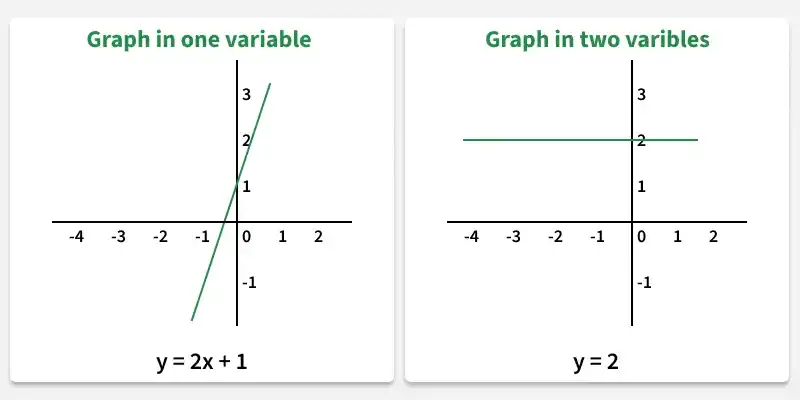
Examples of linear graphs
**General Forms:
- One variable: ax + b = 0 (a ≠ 0)
- Two variables: Ax + By + C = 0
Here, a, b, c are constants and x, y are variables.
**Examples of Linear Equations
**1. One Variable: A linear equation involving one variable has the form ax + b = 0. It can be solved using a single equation. Example: x + 4 = 6
**2. Two Variables: A linear equation involving two variables has the form ax + by = c. A single equation represents a line and has infinitely many solutions; two such equations are required to get a unique solution. Example: x + y = 6
**3. Three Variables: A linear equation involving three variables has the form ax + by + cz = d. A single equation represents a plane and has infinitely many solutions; three independent equations are required to get a unique solution.
Example : x + y + z = 6
Representations or Different Forms
There are various ways to represent the linear equations, such as
- Standard Form: ax + by = c. Example, 2x + 3y = 6
- Slope-Intercept Form: y = mx + b. Example, y = 2x + 3
- Point-Slope Form: y - y₁ = m(x - x₁). Example, y - 4 = 3(x - 2)
- Intercept Form: x/a + y/b = 1, Example, x/2 + y/3 = 1
Graphing Linear Equations
This linear equation in one variable represents a straight line passing through the point (-7, 0) and parallel to the y-axis. Similarly, linear equations in two variables also represent a straight line, and its graph can be plotted by following the steps discussed below.
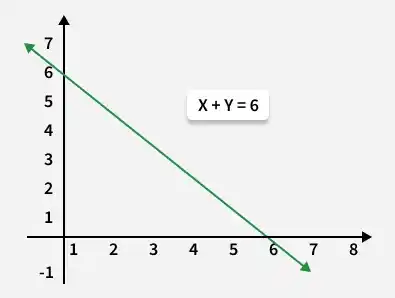
**Example: Plot the graph for a linear equation in two variables, x + y - 6 = 0.
Use the following steps to plot the graphs
**Step 1: Arrange the given equation of the line in the standard form as, x + y = 6
**Step 2: Now change the equation in the intercept form by dividing 6 on both sides to make the RHS 1.
x/6 + y/6 = 1
**Step 3: The denominator of **x and **y represents the intercept on the x and y axis respectively. The intercept on the x-axis is 6 and the intercept on the y-axis is 6.
**Step 4: Find the point on the x-axis and the y-axis, i.e. the point on the x-axis is (6, 0) and the point on the y-axis is (0, 6). Join these points to get the line.
Solved Examples
**Example 1: Solve 2x = 3(x + 4)
**Solution:
Given equation,
2x = 3(x + 4)
⇒ 2x = 3x + 3(4)
⇒ 2x = 3x + 12
⇒ 2x - 3x = 12
⇒ -x = 12
⇒ x = -12
**Example 2: Solve 2x – y = 4 and x + y = 5
**Solution:
Given Equation,
- 2x – y = 4...(i)
- x + y = 5...(ii)
From eq. (ii) y = 5 - x
Putting the value of y from eq (ii) in eq (i) we get
2x + (5 - x) = 4
⇒ 2x + 5 - x = 4
⇒ 2x - x = 4 - 5
⇒ x = -1Putting value of x in eq (i)
2(-1) - y = 4
⇒ -2 - y = 4
⇒ y = -2 - 4
⇒ y = -6Thus,
- x = -1
- y = -6
**Example 3: Solve 2x + 3y = 6 and x - y = 3.
**Solution:
Given Equation,
- 2x + 3y = 6 . . .(i)
- x - y = 3 . . .(ii)
take equation (ii),
x = y + 3 . . .(iii)
putting the value of x from eq (iii) in eq (i) we get
2(y + 3) + 3y = 6
⇒ 2y + 6 + 3y = 6
⇒ 5y = 6 - 6
⇒ 5y = 0
⇒ y = 0Putting the value of y in eq (iii)
x = y + 3 = 0 + 3 = 3
- x = 3
- y = 0
Practice Questions
**Question 1: Solve the linear equation: 3x + 7 = 19.
**Question 2: Find the value of y in the equation: 2y - 5 = 3y + 8.
**Question 3: If the sum of two numbers is 15, and one of the numbers is 7, form a linear equation and find the other number.
**Question 4: Solve for x in the equation: \frac{2x}{3} + 4 = 10
**Question 5: A mobile phone plan costs a fixed monthly charge of 30plus30 plus 30plus0.10 per minute of usage. If a user has a bill of $50, how many minutes did they use? Form and solve the linear equation.