Intercept Form of Linear Equations (original) (raw)
Last Updated : 28 Jan, 2026
Intercept From of Line is,
**x/a + y/b = 1
Where,
- **a is the x-intercept of the line which means if we put x = 0, in the above line, we get the solution for y as b
- **b is the y-intercept of the line means if we put y = 0, we get the solution as x = b
Some examples of the linear equation in intercept form for two variables are,
- x/2 + y/3 = 1
- x/3 - y/2 = 1
What are x and y intercepts?
Intercepts are the points on the x and y-axis respectively where any linear equation intersects. The following diagram shows a line with x and y-intercepts.
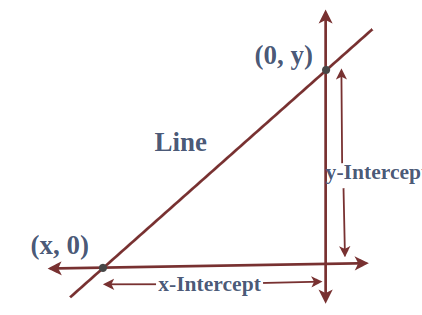
**X-Intercept : Point A(a, 0) represents the x-intercepts of the line where the y-coordinate is always 0. Thus, the general form of x-intercept is (x, 0)
**Y-intercept : Point B(0, b) represents the y-intercepts of the line where x coordinate is 0. Thus, the general form of y-intercept is (0, y)
How to Find X-Intercepts and Y-Intercepts?
For any general equation of a straight line equation i.e., Ax + By = C.
Divide the equation by C,
(Ax/C) + (By/C) = C/C
\Rightarrow \frac{x}{C/A} + \frac{y}{C/B} = 1
Now, putting y = 0, for the x-intercept we get
\Rightarrow \frac{x}{C/A} + \frac{0}{C/B} = 1 \\ \Rightarrow x = C/A
Thus, the x-intercept is ****(C/A, 0)**.
Now, putting x = 0, for the y-intercept we get
\Rightarrow \frac{0}{C/A} + \frac{y}{C/B} = 1 \\ \Rightarrow y = C/B
Thus, the y-intercept is ****(0, C/B)**
Finding Intercept Form Slope-Intercept Form of Line
The slope-Intercept Form of a straight line is,
**y = mx + c
Where,
- ****(0, c)** is the y-intercept,
- **m is the slope of the given line.
For, this form of the line
- x-intercept is given by ****(-c/m, 0)**
- y-intercept is given by ****(0, c)**
**Finding Intercept Form Point-Slope Form of Lines
The point-slope form of a line is given as follows:
**y - y 1 = m(x - x 1 )
where:
- ****(x** 1 , y 1 ) is a point on the line
- **m is the slope of the line.
To find, the x and y-intercepts of the given line,
Here, rearranging the equation, we get
y = mx - mx1 + y1
⇒ y = mx + (-mx1 + y1)
Comparing it with y = mx + c, we get
c = -mx1 + y1, which is the y-intercept of the given line.
and x-intercept is -c/m = (mx1 - y1)/m = x1 - y1/m
Thus, x and y-intercept of the given **y - y 1 = m(x - x 1 ) are
- x-Intercept is given by x 1 **- y 1 /m
- y-Intercept is given by -mx 1 **+ y 1
Finding Intercept Form Two Point Form of Line
If in the Point-slope Form of a line, we substitute the formula for slope, m = (y2 - y1)/(x2 - x1) we get the two-point Form of a Line, i.e.,
**y - y 1 = (y 2 **- y 1 )/(x 2 **- x 1 )(x - x 1 )
where,
- ****(x** 1 , y 1 ) and ****(x** 2 , y 2 ) are the two points from which line passes through.
Thus, x and y-intercept of the given **y - y 1 = (y 2 **- y 1 )/(x 2 **- x 1 )(x - x 1 ) are
- y-Intercept is given by **x 1 **- y 1 (x 2 **- x 1 )/(y 2 **- y 1 )
- y-Intercept is given by -x 1 (y 2 **- y 1 )/(x 2 **- x 1 ) + y 1
Uses of X and Y Intercept
X and Y Intercepts have various uses and some of them are,
- In curve tracing, for example, we have an unknown curve, so intercepts are one of the first parameters in the analysis of the curve.
- Both intercepts in whichever quadrant forms a triangle, whose area can calculate by 1/2 times the product of intercepts.
- By plotting both intercepts on the coordinated axes, we can plot the graph of the linear equation.
**Read More,
Examples on X and Y Intercept
**Example 1: **Find the x and y-intercepts of the line having equation: y = x + 10
**Solution:
Converting the equation of the given line in intercept form:
y - x = 10
⇒ (y/10) - (x/10) = 1, ---------dividing both sides by 10
⇒ (y/10) + (-x/10) = 1
⇒ (x/(-10)) + (y/10) = 1,
**Thus, x-intercept is -10 and y intercept is 10.
**Another solution:
x-intercept is of the form (s, 0).
Let us put y = 0 in the equation of the given line:
0 = x + 10
⇒ x = -10
**Thus, x-intercept of given line is -10.
y-intercept is of the form (0, t).
Let us put x = 0 in the equation of the given line:
y = 0 + 10
⇒ y = 10
**Thus, y-intercept of given line is 10.
**Example 2: Find the x and y-intercepts of the line having equation: 20y = 10 - 40x
**Solution:
Converting the equation of the given line in intercept form :
20y + 40x = 10
⇒ (20y/10) + (40x/10) = 1, ---------dividing both sides by 10
⇒ (2y/1) + (4x/1) = 1
⇒ (x/(1/4)) + (y/(1/2)) = 1,
**Thus, x-intercept is (1/4) and y intercept is (1/2).
**Another solution:
x-intercept is of the form (s, 0).
Let us put y = 0 in the equation of the given line:
20×(0) = 10 - 40x,
⇒ 0 + 40x = 10,
⇒ x = 1/4
**Thus, x-intercept of given line is 1/4 or 0.25
y-intercept is of the form (0, t).
Let us put x = 0 in the equation of the given line:
20y = 10 - 40×(0)
⇒ 20y = 10,
⇒ y = 1/2
**Thus, y-intercept of given line is 1/2 or 0.5
**Example 3: **Find the x and y-intercepts of the line having equation: 4x + 5y = -3
**Solution:
Converting the equation of the given line in intercept form :
4x + 5y = -3 -------given
⇒ 4x/(-3) + 5y/(-3) = -3/(-3), -----dividing both sides by -3
⇒ x/(-3/4) + y/(-3/5) = 1,
**Thus, x-intercept is (-3/4) and y intercept is (-3/5)
**Another solution:
x-intercept is of the form (s, 0).
Let us put y = 0 in the equation of the given line:
4x + 5×(0) = -3,
⇒ 4x + 0 = -3,
⇒ x = -3/4
**Thus, x-intercept of given line is -3/4
y-intercept is of the form (0, t).
Let us put x = 0 in the equation of the given line:
4×(0) + 5y = -3,
⇒ 0 + 5y = -3,
⇒ y = -3/5
**Thus, y-intercept of given line is -3/5
**Example 4: A line AB has x-intercept = 0. Find its y-intercept.
**Solution:
x-intercept of given line is 0.
This means that the point of intersection of the given line and X-axis is (0, 0).
In other words, the given line passes through the origin.
Thus, y-intercept of the given line is 0 (as the point of intersection of the given line and Y-axis is also (0, 0)).
**Example 5: **A line passes through the point (3, 4), (p, q), and (c, d), where p and d are x and y-intercepts respectively. Find the value of p, q, c, and d given that the slope of the **line is -1/2.
**Solution:
p is the x-intercept of the given line, so (p, q) lies on X-axis.
**This means that q = 0 --------(i)
d is the y-intercept of the given line, so (c, d) lies on Y-axis.
**This means that c = 0 --------(ii)
**Slope of any line = (y2 - y1)/(x2 - x1), where (x1, y1) and (x2, y2) are two points that lie on it.
Slope of given line = (4-q)/(3-p), or
-1/2 = (4-0)/(3-p), ------**from (i)
⇒ (-1)×(3-p) = 4×2,
p - 3 = 8, or
**Thus, p = 11 --------(iii)
Slope of given line = (4-d)/(3-c), or
-1/2 = (4-d)/(3-0), ------**-from (ii)
⇒ (-1/2)×3 = 4 - d,
⇒ d - 3/2 = 4,
⇒ d = 4 + 3/2
**Thus d = 11/2 or 5.5 --------(iv)
**Thus, the values are : p = 11, q = 0, c = 0, d = 11/2
Practice Questions on X and Y Intercept
**Question 1: Find the x-intercept and y-intercept of the equation 2x + 3y = 6.
**Question 2: Determine the x-intercept and y-intercept of the equation 4x - y = 8.
**Question 3: What are the x-intercept and y-intercept of the equation 5x + 2y = 10?
**Question 4: Find the x-intercept and y-intercept of the equation y = -3x + 7.
**Question 5: Determine the x-intercept and y-intercept of the equation x+y = 5.