Inverse Proportions (original) (raw)
Last Updated : 23 Jul, 2025
**Inverse proportions, also known as inverse variation, is a fundamental concept in mathematics that defines how two objects relate to each other i.e. **when one goes up and the other goes down, or vice versa.
In inverse proportions relationship between two variables the product of the variables always constant. If one variable increases, the other decreases so that their product remains the same.
**If X and Y are in inverse proportions then,
X \times Y = k.

Inverse Proportion
Inverse Proportions Examples
A factory has a certain number of toys to be packed. If the factory engages 36 persons, it takes 12 days. If there are only 18 people, it will take 24 days to finish the task. You see as the number of persons is the halved time taken is doubled if the company engages 72 people, the time taken to complete the task is in inverse proportion with number of persons.
| Number of Persons | 36 | 18 | 9 | 72 | 108 |
|---|---|---|---|---|---|
| Time Taken (in days) | 12 | 24 | 48 | 6 | 4 |
Representation of Inverse Proportion
The inverse proportions between two quantities a and b is represented as:
a ∝ 1 / b
It shows that a is inversely proportion to b.
Inverse Proportion Formula
The Inverse Proportions Formula of two quantities x and y is given by:
x = k/y \\x1 / x2 = y2 / y1 = k
where,
- **k is constant of proportionality
Note: If two variables a and b are in inverse proportion then a × b is always constant.
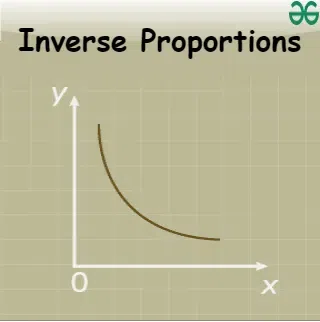
Inverse Proportions Graph
The graph of inverse proportions is in the form of a curve that shows how two values change in opposite ways. When one value gets bigger, the other gets smaller. The curve looks like a stretched-out "U" shape and never touches the x or y axes.
Direct proportions and Inverse Proportions
Direct proportions is the proportion in which one quantity is proportional to other ( when one increases the other also increases) whereas inverse proportions is the proportion in which one quantity is proportional to the reciprocal of other quantity (when one increases the other decreases).

Direct and Inverse Proportions
Applications of Inverse Proportions
There are many application of inverse proportion in different fields. Some of these applications are listed below.
- In physics, inverse proportion is used in Ohm's law to represent the relation between current and resistance, frequency and time period of oscillations in simple harmonic motion, gravitational force and distance between object etc.
- In mathematics, the inverse proportion is used to represent relation between speed and time.
- It is used in chemistry in ideal gas law to represent the relation between pressure and volume.
- It is used in economics to represent the relation between the demand and supply.
**Read More:
Inverse Proportions - Example Questions
**Question 1: If a speed of car is 10 km/hr and time is 4hrs. What is the speed to cover same distance in time 2hrs.
**Solution:
By Inverse Proportion Formula
S ∝ 1/T
S = D / T
D = S × T
D = 10 × 4 = 40 kmNow, we have to find the speed with time 2hr with same distance.
S = D / T
S = 40 / 2
S = 20 km/hr
**Question 2: If p and q are inverse proportion, such that p = 15 and q = 3 then, find p for q = 9
**Solution:
By Inverse Proportion Formula
p∝1/q
p = k / q
k = p × qD = 15 × 3 = 45
Now, we have to find p with q = 9
p = k / q
p = 45 / 9 = 5
**Question 3: If a wall can be constructed by 5 men in 18 days, then in how many days 15 men can construct the same wall
**Solution:
By Inverse Proportion Formula
M1 / M2 = D2 / D1
5 / 15 = D2 / 18
D2 = 18 / 3 = 6The 12 men can construct wall in 6 days