Inverse Relation (original) (raw)
Last Updated : 13 Aug, 2025
**Inverse Relation: An inverse relation is the opposite of a given relation obtained by interchanging or swapping the elements of each ordered pair. In simple terms, if (x, y) is a point in a relation R, then (y, x) is an element in the inverse relation.
In this article, we will learn about Inverse Relation including their domain, range, and other properties as well.

Table of Content
- What is an Inverse Relation?
- Examples of Inverse Relation
- Properties of Inverse Relations
- Domain and Range of Inverse Relation
- Inverse Relation Theorem
- Inverse Relation Graph
- Graphical Representation of Inverse Relation
- Inverse Relation Solved Examples
- Inverse Relation: Practice Problems
What is an Inverse Relation?
Inverse relation refers to pairs of elements from two sets where the roles of the elements are reversed in each pair. In other words, if there is a relation between two elements in one set, the inverse relation involves switching the positions of those elements to form a new pair.
**For example, consider a relation that maps each person to their age: = {(John, 30), (Alice, 25), (Bob, 35)}.
**The inverse relation would map each age to the corresponding person: R −1 = {(30, John), (25, Alice), (35, Bob)}.
Inverse Relation Meaning
Formally, if we have a relation _R between elements of set _A and set _B, denoted as R: _A → _B, then the inverse relation __R_−1 between elements of set _B and set _A is defined as follows:
**R**−1 : **B **→ **A
In simpler terms, if (_a, _b) is an ordered pair in the relation _R, then (_b, _a) is an ordered pair in the inverse relation __R_−1.
Examples of Inverse Relation
**Some of the examples of inverse relations are:
- _If R = {(2, 8), (3, 12), (4, 16)}, then the inverse relation __R_−1 would be {(8, 2), (12, 3), (16, 4)}
- if R = {(2, 4),(3, 9),(4, 16)}, then the inverse relation __R_−1 would be {(4, 2), (9, 3), (16, 4)}.
Properties of Inverse Relations
- Inverse relations reverse the roles of the input and output values.
- The domain of a relation transforms into the range of its inverse, and vice versa.
- The composition of a relation with its inverse results in the identity relation i.e., R o (R-1) = Identity
- The inverse of an inverse relation is the original relation itself i.e., (R-1)-1 = R
- If a relation is injective (one-to-one), then its inverse is also injective.
- If a relation is surjective (onto), then its inverse is also surjective.
Domain and Range of Inverse Relation
In an ordered pair, the first element represents the "domain," while the second element represents the "range" of a relation. Let me illustrate this using an example:
**Consider the sets A = {p, q, r, s, t} and B = {1, 2, 3, 4, 5}, with the relation R = {(p, 1), (q, 2), (r, 3), (s, 4), (t, 5)}.
- Domain of R: {p, q, r, s, t}
- Range of R: {1, 2, 3, 4, 5}.
Inverse Relation i.e., R⁻¹ = {(1,p), (2,q), (3,r), (4,s), (5,t)}.
- Domain of R⁻¹: {1, 2, 3, 4, 5}.
- Range of R⁻¹: {p, q, r, s, t}.
Based on this, we can observe, the domain of R matches the range of R⁻¹. R⁻¹'s range is the same as its domain.
**Also Check: Introduction to Domain and Range
Inverse Relation Theorem
**Statement: The inverse relation theorem claims that for each relation R, (R⁻¹)⁻¹ = R.
**Proof: Let, (x,y) ∈ R.
If (x, y) belongs to relation R, then the inverse relation R-1 contains the pair (y, x).
As a result, (x, y) belongs to the inverse of the inverse relation (R-1)-1.
Since (x, y) belongs to (R-1)-1, and (R-1)-1 equals R, we can conclude that (x, y) ∈ R.
The theory states that for any relation R, (R-1)-1 = R.
Inverse Relation Graph
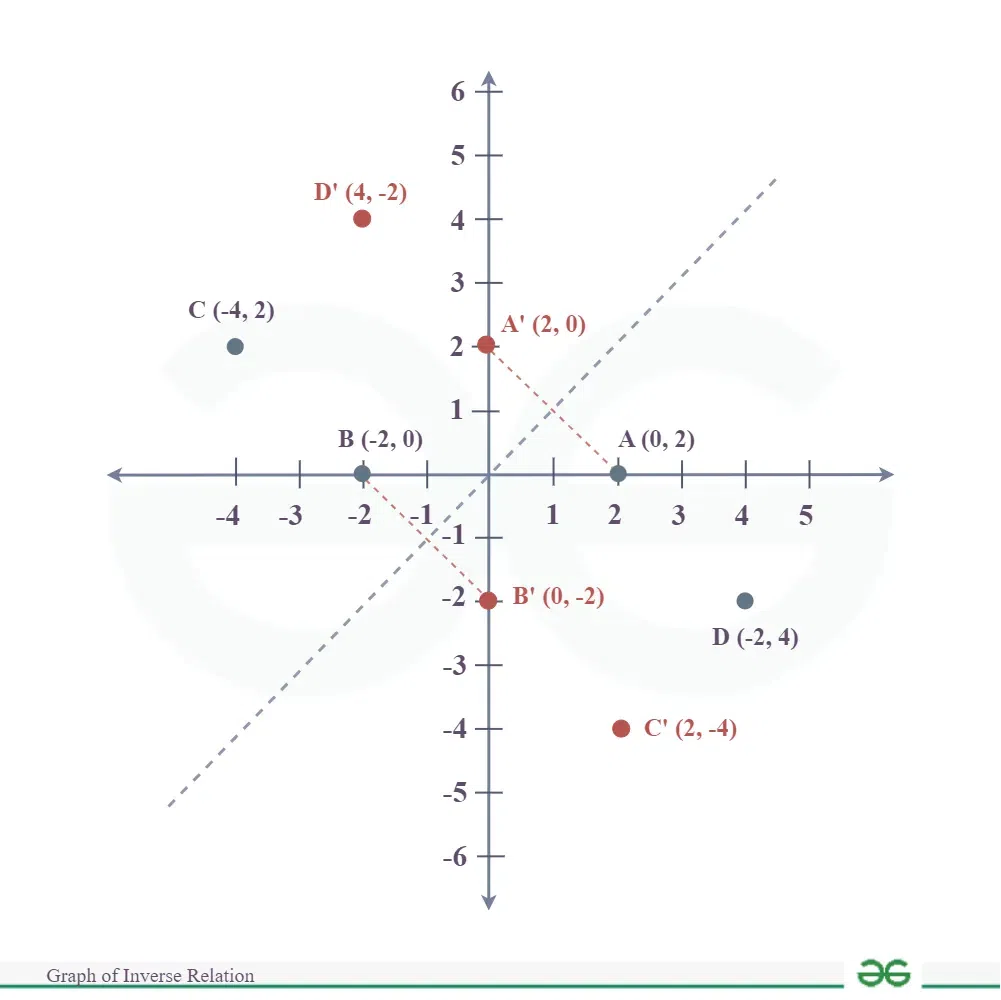
Inverse relations are represented graphically by drawing points and then reflecting them across the line y = x. Here are the steps:
**Step 1: Select any point from the original graph.
**Step 2: Swap the x and y values to create new coordinates that indicate the inverse connection.
**Step 3: Draw these additional points on the graph to show the inverse relationship.
**Example:
- Original Relation: Points (0, 2), (-2, 0), (-4, 2), (-2, 4).
- Inverse Relation: (2, 0), (0, -2), (2, -4), (4, -2).
Simply reflect the original points across the line y = x to get the inverse relation graph.
Graphical Representation of Inverse Relation
Inverse Relation Solved Examples
**Example 1: Determine the inverse of the following relation. R = {(8, 9) (3, 5), (4, 6)}
**Solution:
Given: R = {(8,9) (3,5), (4,6)}
The inverse of set R will be,
R⁻¹ = {(9,8), (5,3), (6,4)}
**Example 2: Determine the inverse of the function R = (x, x 2 )where x is a prime number smaller than 15.
**Solution:
The list of prime numbers less than 15 includes 2, 3, 5, 7, 11 and 13.
R = {(2,4), (3,9), (5,25), (7,49), (11, 121), (13, 169)}
The inverse of set R should be,
R⁻¹ = {(4,2), (9,3), (25,5), (49,7), (121, 11), (169, 13)}
**Example 3: Determine the domain and the range of the relation R = (x, x 2 )where x is a even number smaller than 9.
**Solution:
The list of even numbers less than 9 includes 2, 4, 6 and 8.
R = {(2,4), (4,16), (6,36), (8,64)}
- Domain of R = {2, 4, 6, 8}
- Range of R = {4, 16, 36, 64}
Inverse Relation: Practice Problems
**Q1: Determine the domain and the range of the relation R = (x, x2), where x is a prime number smaller than 10.
**Q2: Determine the inverse of the function R = (x, x3), where x is a odd number smaller than 20.
**Q3: Determine the inverse of the following relation. R = {(15, 12), (18, 26), (24, 16)}
People Also Read:
Conclusion - Inverse Relation
In Conclusion, inverse relations are important in mathematics because they reveal reverse links between sets of elements. Their significance extends to a wide range of applications, including equation solving and function composition, cryptography, and data encryption.
Understanding inverse relations helps to appreciate the symmetric nature of relationships and their reversal, which improves knowledge of mathematical concepts and real-world events. Inverse linkages continue to play an important role in unraveling complicated interactions and operations, helping problem solving and analysis in a wide range of industries.