Limit Formulas (original) (raw)
Last Updated : 1 Jun, 2026
Formulas make it easier and faster to evaluate limits without having to use lengthy calculations every time. For example, instead of deriving the result every time, we can directly use the standard formula:
\lim_{x \to 0} \frac{x}{\sin x} = 1
There are various formulas involving the limit, such as:
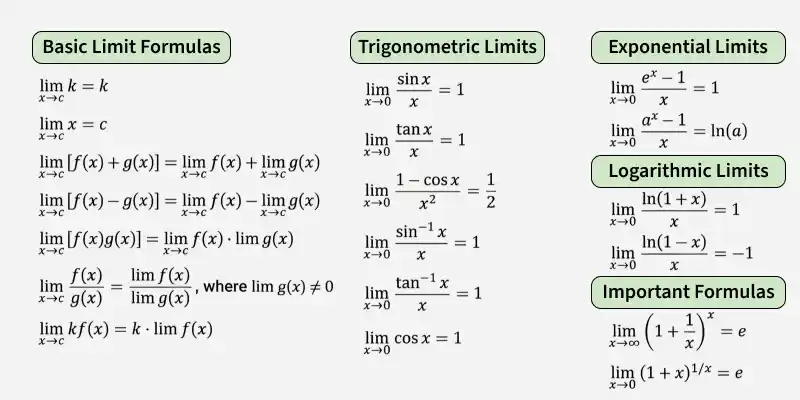
Basic Limit Formulas
| Formula | Description |
|---|---|
| limx→ck = k | The limit of a constant is the constant itself. |
| limx→cx = c | The limit of x as x approaches c is c. |
| limx→c[f(x) + g(x)] = limx→cf(x) + limx→cg(x) | The limit of a sum is the sum of the limits. |
| limx→c[f(x) − g(x)] = limx→cf(x) − limx→cg(x) | The limit of a difference is the difference of the limits. |
| limx→c[f(x) ⋅ g(x)] = limx→cf(x) ⋅ limx→cg(x) | The limit of a product is the product of the limits. |
| limx→c[f(x)/g(x)] = [limx→cf(x)]/[limx→cg(x)], provided limx→cg(x) ≠ 0 | The limit of a quotient is the quotient of the limits, provided the denominator limit is not zero. |
| limx→ck⋅f(x) = k⋅limx→cf(x) | The limit of a constant multiplied by a function is the constant multiplied by the limit of the function. |
**Trigonometric Limits
To evaluate trigonometric limits, we have to reduce the terms of the function into simpler terms or into terms of sinθ and cosθ.
\begin{aligned}&\lim_{x \to 0} \frac{\sin x}{x} = 1, \quad\lim_{x \to 0} \frac{x}{\sin x} = 1 \\[6pt]&\lim_{x \to 0} \frac{\tan x}{x} = 1, \quad\lim_{x \to 0} \frac{x}{\tan x} = 1 \\[6pt]&\lim_{x \to 0} \frac{1 - \cos x}{x^2} = \frac{1}{2}, \quad\lim_{x \to 0} \frac{\cos x - 1}{x^2} = -\frac{1}{2} \\[6pt]&\lim_{x \to a} \frac{\sin x - \sin a}{x - a} = \cos a, \quad\lim_{x \to a} \frac{\cos x - \cos a}{x - a} = -\sin a \\[6pt]\end{aligned}
If the function gives an indeterminate form by putting limits, Then use the L'hospital rule.
**L'hospital Rule
If we get the indeterminate form, then we differentiate the numerator and denominator separately until we get a finite value. Remember we would differentiate the numerator and denominator the same number of times. Similarly for all trigonometric function,
- limx ⇢ 0 sin-1x/x = limx ⇢ 0 x/sin-1x = 1
- limx⇢0 tan-1x/x=1
- limx ⇢ a sin xo/x = π/180
- limx⇢0 cosx = 1
- limx ⇢ a sin(x-a) / (x-a) =1
- limx⇢∞ sinx/x = 0
- limx⇢∞ cosx/x = 0
- limx⇢∞ sin(1/x) / (1/x) =0
**Exponential Limits
Some of the common formula related to exponents are:
- limx ⇢ 0 ex - 1 /x = 1
- limx ⇢ 0 ax - 1 /x = logea
- limx ⇢ 0 eλx - 1 /x = λ
**Logarithmic Limits
Some of the common formula related to logarithm limits are:
- limx ⇢ 0 log(1 + x) /x = 1
- limx ⇢ e logex = 1
- limx ⇢ 0 loge(1 - x) /x = -1
- limx ⇢ 0 loga(1 + x) /x = logae
Important Limit Results
Some of the important results involving limits are:
- limx⇢0 (1+x)^{\frac{1}{x}} = e
- limx⇢0 \left( 1+\frac{1}{x} \right)^x = e
- limx⇢0 \frac{e^x-1}{x} =1
- limx⇢0\frac{a^x-1}{x} = logea
- limx⇢0 \frac{1-cosmx}{x^2} = m2/2
- limx⇢0 \frac{1-cosmx}{1-cosnx} = \frac{m^2}{n^2}
Some Shortcut Formulas
- limx⇢0 \left( 1+ \frac{a}{b}x \right)^\frac{c}{dx} = e^\frac{ac}{bd}
- limx⇢0 \left( 1+ \frac{a}{bx} \right)^\frac{cx}{d} = e^\frac{ac}{bd}
**Related Articles
Sample Problem
**Question 1: Solve, limx⇢0 (x - sinx ) /(1 - cosx).
Using L-hospital,
limx ⇢ 0 (1 - cosx) / (sinx)
limx ⇢ 0 sinx / cosx = sin(0) / cos(0) = 0/1 = 0
**Question 2: Solve, limx ⇢ 0 (e2x -1) / sin4x.
Using L-hospital
limx ⇢ 0 (2)(e2x) / cos4x
limx ⇢ 0 2(e0) / cos4(0) = 2/1= 2
**Question 3: Solve, limx ⇢ 0 (1 - cosx) / x2
Using L-hospital
limx ⇢ 0 sinx /2x = 1/2 {sinx/x = 1}
**Question 4: Solve, limx ⇢ ∞ \frac{x+sinx}{x}
limx ⇢ ∞ (1 + \frac{sinx}{x} )
1 + limx ⇢ ∞ \frac{sinx}{x}
As we know, x = ∞
So 1/x = 0
1 + lim\frac{1}{x}⇢∞ \frac{sin\frac{1}{x}}{x}
1 + 0 = 1
**Question 5: limx ⇢ 0 \frac {e^x -(1+x+ \frac {x^2}{2})}{ x^3}
limx⇢0 \frac{1+\frac{x}{1!} + \frac{x2}{2!} + \frac{x3}{3!} - ( 1+ x+ \frac{x2}{2!} ) }{x3}
limx⇢0 \frac{\frac{x3}{3!}}{x3} = 1/3! =1/6
**Question 6: Solve, lima ⇢ 0 \frac{x^a-1}{a}
Using L-hospital (Differentiating numerator and denominator w.r.t a)
lima ⇢ 0 xalogx = logx
Practice Problems
Simplify:
- limx→2(3x + 4)
- limx→-1(x2 + 2x + 1)
- limx→0(sin2x/2x)
- limx→3[(x2 - 9)/(x - 3)]
- limx→∞[(5x + 7)/(2x - 3)]
- limx→0[(1 - cos x)/x]
- limx→-∞(2x3 − x2 + x)
- limx→∞(e-x)
- limx→0[(ex - 1)/x]
- limx→∞[(2x2 − 5x + 3)/(x - 3)]