Mathematical Symbols (original) (raw)
Last Updated : 24 Sep, 2025
Maths symbols are special notations used to represent numbers, operations, relations, sets, functions, and other mathematical ideas. Instead of writing everything in words, mathematicians use symbols to make expressions shorter, clearer, and more universal.
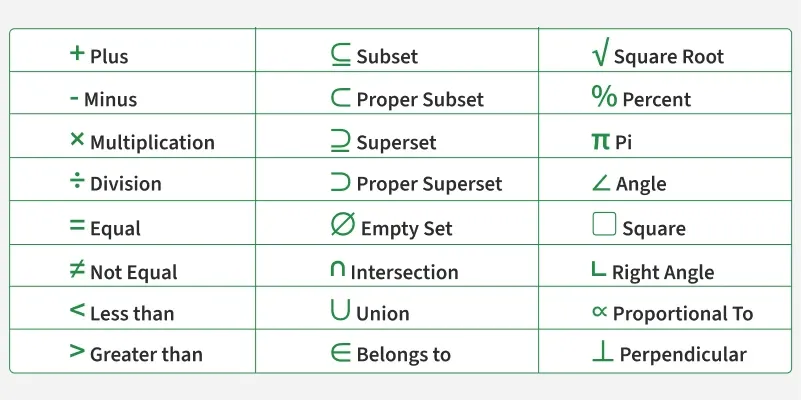
Some Common Maths Symbols
List of mathematics symbols along with their names, uses, and examples.
Basic Symbols of Maths
| Symbol | Name | Description | Example |
|---|---|---|---|
| **➕ | Addition | plus | 2 + 7 = 9 |
| **➖ | Subtraction | minus | 14 - 6 = 8 |
| ⨉ | Multiplication | times | 2 **× 5 = 10 |
| **· | 7 ∙ 2 = 14 | ||
| * | Asterisk | 4 * 5 = 20 | |
| **÷ | Division | divided by | 5 ÷ 5 = 1 |
| ****/** | 16 ⁄ 8 = 2 | ||
| = | Equality | is equal to | 2 + 6 = 8 |
| < | Comparison | is less than | 17 < 45 |
| **> | is greater than | 19 > 6 | |
| **∓ | minus – plus | minus or plus | 5 ∓ 9 = -4 and 14 |
| **± | plus – minus | plus or minus | 5 ± 9 = 14 and -4 |
| ****.** | decimal point | period | 12.05 = 12 +(5/100) |
| **mod | modulo | mod of | 16 mod 5 = 1 |
| **a b | exponent | power | 73 = 343 |
| **√a | square root | √a · √a = a | √16 = 4 |
| **3 √a | cube root | 3√a ·3√a · 3√a = a | 3√27 = 3 |
| **4 √a | fourth root | 4√a ·4√a · 4√a · 4√a = a | 4√625 = 5 |
| **n √a | n-th root (radical) | n√a · n√a · · · n times = a | for n = 5, n√32 = 2 |
| ****%** | percent | 1 % = 1/100 | 25% × 60= 25 /100 **× 60= 15 |
| **‰ | per-mile | 1 ‰ = 1/1000 = 0.1% | 10 ‰ × 50 = 10/1000 **× 50= 0.5 |
| **ppm | per-million | 1 ppm = 1/1000000 | 10 ppm × 50 = 10/1000000 **× 50 = 0.0005 |
| **ppb | per-billion | 1 ppb = 10-9 | 10 ppb × 50 = 10 **× 10-9 × 50 = 5 × 10⁻⁷ |
| **ppt | per-trillion | 1 ppt = 10-12 | 10 ppt × 50 = 10 **× 10-12 × 50 = 5 × 10⁻¹⁰ |
Algebraic Symbols
| Symbol | Name | Description | Example | |
|---|---|---|---|---|
| x, y | Variables | unknown value | 3x = 9 ⇒ x = 3 | |
| 1, 2, 3.... | Numeral constants | numbers | x + 5 = 10, here 5 and 10 are constants | |
| **≠ | Inequation | is not equal to | 3 ≠ 5 | |
| ≈ | Approximately equal | is approximately equal to | √2≈1.41 | |
| ≡ | Definition | is defined as'or' is equal by definition | (a+b)2 ≡ a2+ 2ab + b2 | |
| := | (a-b)2 := a2-2ab + b2 | |||
| **≜ | a2-b2**≜ (a-b).(a+b) | |||
| < | Strict Inequality | is less than | 17 < 45 | |
| **> | is greater than | 19 > 6 | ||
| << | is much less than | 1 << 999999999 | ||
| >> | is much greater than | 999999999 >> 1 | ||
| **≤ | Inequality | is less than or equal to | 3 ≤ 5 and 3 ≤ 3 | |
| **≥ | is greater than or equal to | 4 ≥ 1 and 4 ≥ 4 | ||
| **[ ] | Brackets | Square brackets | [ 1 + 2 ] - [2 +4] + 4 × 5= 3 - 6 + 4 × 5= 3 - 6 + 20= 23 - 6 = 17 | |
| ****( )** | Parentheses (round brackets) | (15 / 5) × 2 + (2 + 8)= 3 × 2 + 10= 6 + 10= 16 | ||
| ∝ | Proportion | proportional to | x ∝ y⟹ x = ky, where k is a constant. | |
| f(x) | Function | f(x) = x, is used to maps values of x to f(x) | f(x) = 2x + 5 | |
| ! | Factorial | factorial | 6! = 1 × 2 × 3 × 4 × 5 × 6 = 720 | |
| ⇒ | Material implication | implies | x = 2 ⇒x2 = 4, but x2= 4 ⇒ x = 2 is false, because x could also be -2. | |
| ⇔ | Material equivalence | if and only if | x = y + 4 ⇔ x-4 = y | |
| |.... | Absolute value | Absolute value of | |5 |
Geometry Symbols
| Symbol | Name | Example | |
|---|---|---|---|
| ∠ | Angle | ∠PQR = 30° | |
| ∟ | Right angle | ∟XYZ = 90° | |
| . | Point | (a,b,c) It is represented as a coordinate in space by a point. | |
| → | Ray | \overrightarrow{\rm AB} is a ray. | |
| _ | Line Segment | \overline{\rm AB} is a line segment. | |
| ↔ | Line | \overleftrightarrow{\rm AB} It is a line. | |
| \frown | Arc | \frown\over{\rm AB} = 45° | |
| ∥ | Parallel | AB ∥ CD | |
| ∦ | Not parallel | AB ∦ CD | |
| ⟂ | Perpendicular | AB ⟂ CD | |
| \not\perp | Not perpendicular | AB\not\perp CD | |
| ≅ | Congruent | △ABC ≅ △XYZ | |
| ~ | Similarity | △ABC ~ △XYZ | |
| △ | Triangle | △ABC represents ABC as a triangle. | |
| ° | Degree | a = 30° | |
| rad or c | Radians | 360° = 2πc | |
| grad or g | Gradians | 360° = 400g | |
| |x-y | Distance | | x-y | |
| π | pi constant | 2π= 2 × 22/7 = 44/7 |
Set Theory Symbols
| Symbol | Name | Meaning | Example |
|---|---|---|---|
| { } | symbols | It is used to determine the elements in a set. | {1, 2, a, b} |
| | | such that | It is used to determine the condition of the set. | { a | a > 5} |
| : | { x : x > 0} | ||
| ∈ | belongs to | It determines that an element belongs to a set. | A = {1, 5, 7, c, a}7 ∈ A |
| ∉ | not belongs to | It indicates that an element does not belong to a set. | A = {1, 5, 7, c, a}0 ∉ A |
| = | Equality Relation | It determines that two sets are the same. | A = {1, 2, 3} B = {1, 2, 3} then A = B |
| ⊆ | Subset | It represents that all of the elements of set A are present in set B, or set A is equal to set B. | A = {1, 3, a}B = {a, b, 1, 2, 3, 4, 5}A ⊆ B |
| ⊂ | Proper Subset | It represents all of the elements of set A that are present in set B, and set A is not equal to set B. | A = {1, 2, a} B = {a, b, c, 2, 4, 5, 1} A ⊂ B |
| ⊄ | Not a Subset | It determines that A is not a subset of set B. | A = {1, 2, 3}B = {a, b, c}A ⊄ B |
| ⊇ | Superset | It represents that all of the elements of set B are present in set A, or set A is equal to set B. | A = {1, 2, a, b, c}B = {1, a} A ⊇ B |
| ⊃ | Proper Superset | It determines that A is a superset of B, but set A is not equal to set B | A = {1, 2, 3, a, b}B = {1, 2, a}A ⊃ B |
| Ø | Empty Set | It determines that there is no element in a set. | { } = Ø |
| U | Universal Set | It is a set that contains elements of all other relevant sets. | A = {a, b, c} B = {1, 2, 3}, then U = {1, 2, 3, a, b, c} |
| |A | or n{A} | Cardinality of a Set | It represents the number of items in a set. |
| P(X) | Power Set | It is the set that contains all possible subsets of a set A, including the set itself and the null set. | If A = {a, b}P(A) = {{ }, {a}, {b}, {a, b}} |
| ∪ | Union of Sets | It is a set that contains all the elements of the provided sets. | A = {a, b, c}B = {p, q}A ∪ B = {a, b, c, p, q} |
| ∩ | Intersection of Sets | It shows the common elements of both sets. | A = { a, b} B= {1, 2, a} A ∩ B = {a} |
| Xc OR X’ | Complement of a Set | t of a set includes all other elements that do not belong to that set. | A = {1, 2, 3, 4, 5} B = {1, 2, 3} thenX′ = A – BX′ = {4, 5} |
| − | Set Difference | It shows the difference in elements between the two sets. | A = {1, 2, 3, 4, a, b, c}B = {1, 2, a, b}A – B = {3, 4, c} |
| × | Cartesian Product of Sets | It is the product of the ordered components of the sets. | A = {1, 2} and B = {a} A × B = {(1, a), (2, a)} |
Calculus & Analysis Symbols
| Symbol | Symbol Name | Example |
|---|---|---|
| **ε | epsilon | ε → 0 |
| **e | e Constant/Euler’s Number | e = lim (1+1/x)x , x→∞ |
| **lim x→a | limit | limx→2(2x + 2) = 2×2 + 2 = 6 |
| **y‘ | derivative | (4x2)’ = 8x |
| **y” | Second derivative | (4x2)” = 8 |
| **y (n) | nth derivative | nth derivative of xn xn {yn(xn)} = n (n-1)(n-2)….(2)(1) = n! |
| **dy/dx | derivative | d(6x4)/dx = 24x3 |
| **dy/dx | derivative | d2(6x4)/dx2 = 72x2 |
| **d n y/dx n | nth derivative | nth derivative of xn xn {dn(xn)/dxn} = n (n-1)(n-2)….(2)(1) = n! |
| Dx | Single derivative of time | d(6x4)/dx = 24x3 |
| **D 2 x | second derivative | d(6x4)/dx = 24x3 |
| **D n x | derivative | nth derivative of xn {Dn(xn)} = n (n-1)(n-2)….(2)(1) = n! |
| **∂/∂x | partial derivative | ∂(x5 + yz)/∂x = 5x4 |
| ∫ | integral | ∫xn dx = xn + 1/n + 1 + C |
| **∬ | double integral | ∬(x+ y) dx. dy |
| **∭ | triple integral | ∫∫∫(x+ y + z) dx.dy.dz |
| **∮ | closed contour/line integral | ∮C 2p dp |
| **∯ | closed surface integral | ∭V (⛛.F)dV = ∯S (F.n̂) dS |
| **∰ | closed volume integral | ∰ (x2 + y2 + z2) dx dy dz |
| **[a,b] | closed interval | cos x ∈ [ – 1, 1] |
| ****(a,b)** | open interval | f is continuous within (-1, 1) |
| **z* | complex conjugate | If z = a + bi then z* = a – bi |
| **i | imaginary unit | z = a + bi |
| **∇ | nabla/del | ∇f (x,y,z) |
| **x * y | convolution | y(t) = x(t) * h(t) |
| **∞ | lemniscate | x ≥ 0; x ∈ (0, ∞) |
Combinatorics Symbols
| **Symbol | **Symbol Name | **Meaning or Definition | **Example |
|---|---|---|---|
| n! | Factorial | n! = 1×2×3×…×n | 4! = 1×2×3×4 = 24 |
| nPk | Permutation | nPk = n!/(n - k)! | 4P2 = 4!/(4 - 2)! = 12 |
| nCk | Combination | nCk = n!/(n - k)!.k! | 4C2 = 4!/2!(4 - 2)! = 6 |
Numeral Symbols
| Name | European | Roman |
|---|---|---|
| **zero | 0 | n/a |
| **one | 1 | I |
| **two | 2 | II |
| **three | 3 | III |
| **four | 4 | IV |
| **five | 5 | V |
| **six | 6 | VI |
| **seven | 7 | VII |
| **eight | 8 | VIII |
| **nine | 9 | IX |
| **ten | 10 | X |
| **eleven | 11 | XI |
| **twelve | 12 | XII |
| **thirteen | 13 | XIII |
| **fourteen | 14 | XIV |
| **fifteen | 15 | XV |
| **sixteen | 16 | XVI |
| **seventeen | 17 | XVII |
| **eighteen | 18 | XVIII |
| **nineteen | 19 | XIX |
| **twenty | 20 | XX |
| **thirty | 30 | XXX |
| **forty | 40 | XL |
| **fifty | 50 | L |
| **sixty | 60 | LX |
| **seventy | 70 | LXX |
| **eighty | 80 | LXXX |
| **ninety | 90 | XC |
| **one hundred | 100 | C |
Greek Symbols
| Greek Symbol | Greek Letter Name | English Equivalent | |
|---|---|---|---|
| Lower Case | Upper Case | ||
| Α | α | Alpha | a |
| Β | β | Beta | b |
| Δ | δ | Delta | d |
| Γ | γ | Gamma | g |
| Ζ | ζ | Zeta | z |
| Ε | ε | Epsilon | e |
| Θ | θ | Theta | th |
| Η | η | Eta | h |
| Κ | κ | Kappa | k |
| Ι | ι | Iota | i |
| Μ | μ | Mu | m |
| Λ | λ | Lambda | l |
| Ξ | ξ | Xi | x |
| Ν | ν | Nu | n |
| Ο | ο | Omicron | o |
| Π | π | Pi | p |
| Σ | σ | Sigma | s |
| Ρ | ρ | Rho | r |
| Υ | υ | Upsilon | u |
| Τ | τ | Tau | t |
| Χ | χ | Chi | ch |
| Φ | φ | Phi | ph |
| Ψ | ψ | Psi | ps |
| Ω | ω | Omega | o |
Logic Symbols
| Symbol | Name | Meaning | Example |
|---|---|---|---|
| ¬ | Negation (NOT) | It is not the case that | ¬P (Not P) |
| ∧ | Conjunction (AND) | Both are true | P ∧ Q (P and Q) |
| ∨ | Disjunction (OR) | At least one is true | P ∨ Q (P or Q) |
| → | Implication (IF...THEN) | If the first is true, then the second is true | P → Q (If P, then Q) |
| ↔ | Bi-implication (IF AND ONLY IF) | Both are true, or both are false | P ↔ Q (P if and only if Q) |
| ∀ | Universal quantifier (for all) | Everything in the specified set | ∀x P(x) (For all x, P(x)) |
| ∃ | Existential quantifier (there exists) | There is at least one in the specified set | ∃x P(x) (There exists an x such that P(x)) |
Discrete Mathematics Symbols
| Symbol | Name | Meaning | Example |
|---|---|---|---|
| ℕ | Set of natural numbers | Positive integers (including zero) | 0, 1, 2, 3, ... |
| ℤ | Set of integers | Whole numbers (positive, negative, and zero) | -3, -2, -1, 0, 1, 2, 3, ... |
| ℚ | Set of rational numbers | Numbers expressible as a fraction | 1/2, 3/4, 5, -2, 0.75, ... |
| ℝ | Set of real numbers | All rational and irrational numbers | π, e, √2, 3/2, ... |
| ℂ | Set of complex numbers | Numbers with real and imaginary parts | 3 + 4i, -2 - 5i, ... |
| n! | Factorial of n | Product of all positive integers up to n | 5! = 5 × 4 × 3 × 2 × 1 |
| nCk or C(n, k) | Binomial coefficient | Number of ways to choose k elements from n items | 5C3 = 10 |
| G, H, ... | Names for graphs | Variables representing graphs | Graph G, Graph H, ... |
| V(G) | Set of vertices of graph G | All the vertices (nodes) in graph G | If G is a triangle, V(G) = {A, B, C} |
| E(G) | Set of edges of graph G | All the edges in graph G | If G is a triangle, E(G) = {AB, BC, CA} |
| |V(G) | Number of vertices in graph G | Total count of vertices in graph G | |
| |E(G) | Number of edges in graph G | Total count of edges in graph G | |
| ∑ | Summation | Sum over a range of values | ∑_{i=1}^{n} i = 1 + 2 + ... + n |
| ∏ | Product notation | Product over a range of values | ∏_{i=1}^{n} i = 1 × 2 × ... × n |