Measures of Spread (original) (raw)
Last Updated : 31 Mar, 2026
Measures of spread (also called measures of variability or dispersion) describe how spread out or scattered a set of data values is. While measures of central tendency (like mean or median) tell you the center, measures of spread tell you how much the data varies around that center.
**Range
The range of the data is given as the difference between the maximum and the minimum values of the observations in the data. For example, let's say we have data on the number of customers walking in the store in a week.
10, 14, 8, 10, 15, 4, 7
Minimum value in data = 4
Maximum Value in the data = 15
Range = Maximum Value in the data - Minimum value in the data
= 15 – 4
= 11
Now we can say that the range of the data is 11. This gives us an idea about the spread of the data but doesn't tell how the data is distributed.
**Variance
The variance of the data is given by measuring the distance of the observed values from the mean of the distribution. Here we are not concerned with the sign of the distance of the point; we are more interested in the magnitude. So, we take squares of the distance from the mean. Let's say we have x1, x2, x3, ... xn as n observations and \bar{x} be the mean.
(x_1 - \bar{x})^2 + (x_2 - \bar{x})^2 + (x_3 - \bar{x})^2 .... (x_n - \bar{x})^2 = \sum^{n}_{0}(x_i - \bar{x})^2
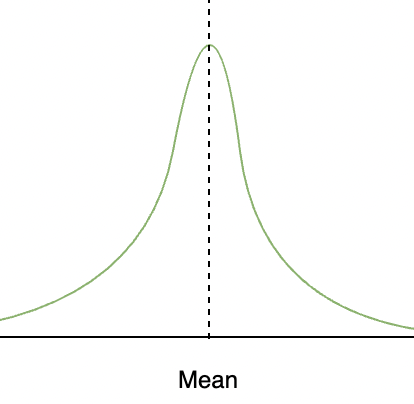
If this sum is zero, then each term has to be zero, which means that there is no scattering in the data. If it is small, then it means that the data is concentrated at the mean and vice versa for large values of the variance.
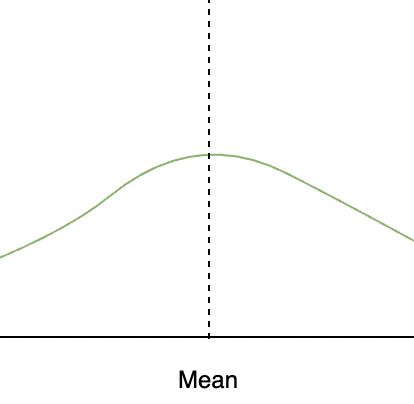
But this measure is still dependent on the number of observations in the data. That is, if there are lots of observations, this value will become large. So, we take the mean of the data,
\text{Variance} = \dfrac{\sum^{n}_{0}(x_i - \bar{x})^2}{n}
\sigma^2 = \dfrac{\sum^{n}_{0}(x_i - \bar{x})^2}{n}
**Standard Deviation
In the calculation of variance, notice that the units of the variance and the unit of the observations are not the same. So, to remove this problem, we define standard deviation. It is denoted as \sigma
\sigma = \sqrt{\dfrac{\sum^{n}_{0}(x_i - \bar{x})^2}{n}}
Let's see how to calculate these measures in some problems.
Sample Problems
**Question 1: Find out the range of the following data:
| **-4 | **5 | **-10 | **6 | **9 |
|---|
**Solution:
For calculating the range of a data, we need to find out the maximum and the minimum of the data:
Max = 9
Min = -10
Range = Max - Min
= 9 -(-10)
= 19
**Question 2: Find out the mean and the median of the same data:
| **-4 | **5 | **-10 | **6 | **9 |
|---|
**Solution:
Mean of the data: \frac{( -4 + 5 -10 + 6 + 9 )}{5}
= \frac{6}{5}
= 1.2
Median is called the middle element of the data.
Median = -10.
**Question 3: Let's say we have the following data,
| -4 | -2 | 0 | -2 | 6 | 4 | 6 | 0 | -6 | 4 |
|---|
Calculate the range, variance, and standard deviation of the data.
**Solution:
**Range
We need to find out the minimum and the maximum values of the data distribution.
Min Value = -6
Max Value = +6
Range = Max Value - Min Value
= 6 - (-6)
= 12
**Variance
To find the variance, we first need to find the mean,
Mean = \frac{( -4 + -2 + 0 + -2 + 6 + 4 + 6 + 0 - 6 + 4)}{10}
= \frac{6}{10}
= 0.6
We know the formula for Variance,
Variance = \frac{\sum^{n}_{0}(x_i - \bar{x})^2}{n}
= \frac{(x_1 - \bar{x})^2 + (x_2 - \bar{x})^2 + (x_3 - \bar{x})^2 .... (x_n - \bar{x})^2}{n}
= \frac{(-4 - 0.6)^2 + (-2 - 0.6)^2 + (0 - 0.6)^2 .... }{10}
= 17.82
**Standard Deviation
\sigma = \sqrt{\frac{\sum^{n}_{0}(x_i - \bar{x})^2}{n}}
⇒ \sigma = \sqrt{17.82}
⇒ \sigma = 4.22
**Question 4: Let's say we have the following data,
| -3 | -3 | -3 | -3 | 0 | 3 | 3 | 3 | 3 |
|---|
Calculate the range, variance, and standard deviation of the data.
**Solution:
**Range
We need to find out the minimum and the maximum values of the data distribution.
Min Value = -3
Max Value = +3
Range = Max Value - Min Value
= 3 - (-3)
= 6
**Variance
To find the variance, we first need to find the mean,
Mean = \frac{( -3 -3 -3 -3 + 0 + 3 + 3 + 3 +3 )}{10}
= 0
We know the formula for Variance,
Variance = \frac{\sum^{n}_{0}(x_i - \bar{x})^2}{n}
= \frac{(x_1 - \bar{x})^2 + (x_2 - \bar{x})^2 + (x_3 - \bar{x})^2 .... (x_n - \bar{x})^2}{n}
= \frac{(-3 - 0)^2 + (-3 - 0)^2 + (-3 - 0)^2 + .... }{9}
= 9
**Standard Deviation
\sigma = \sqrt{\frac{\sum^{n}_{0}(x_i - \bar{x})^2}{n}}
⇒ \sigma = \sqrt{9}
⇒ \sigma = 3
**Question 5: Let's say we have the following data of the number of TVs sold by a consumer electronics shop over the week.
| Monday | 4 |
|---|---|
| Tuesday | 5 |
| Wednesday | 3 |
| Thursday | 4 |
| Friday | 5 |
| Saturday | 5 |
| Sunday | 3 |
Calculate the range, variance, and standard deviation of the data.
**Solution:
Given Data:
4, 5, 3, 4, 5, 5, 3
n = 7**Range:
Min Value = 3
Max Value = 5Range = 5 − 3 = 2
**Mean:
x̄ = (4 + 5 + 3 + 4 + 5 + 5 + 3) / 7
x̄ = 29 / 7
x̄ ≈ 4.143**Variance:
Variance = Σ(xᵢ − x̄)² / n= [(4 − 4.143)² + (5 − 4.143)² + (3 − 4.143)² + (4 − 4.143)² + (5 − 4.143)² + (5 − 4.143)² + (3 − 4.143)²] / 7
= (0.020 + 0.735 + 1.306 + 0.020 + 0.735 + 0.735 + 1.306) / 7
= 4.857 / 7
Variance ≈ 0.694
**Standard Deviation:
σ = √(Variance)
σ = √0.694
σ ≈ 0.833