Perpendicular Bisector (original) (raw)
Last Updated : 21 Apr, 2026
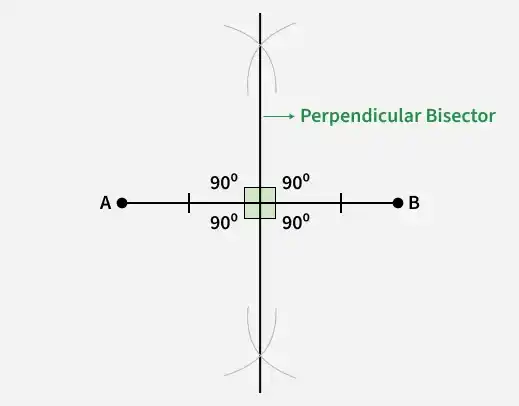
A perpendicular bisector is a line that intersects a line segment at its midpoint, divides it into two equal parts, and forms a right angle (90°) with it at the point of intersection.
In the figure shown below, the perpendicular bisector divides the line segment AB into two halves at its midpoint.
Properties
- A perpendicular bisector divides a line segment into two equal parts at its midpoint.
- It intersects the line segment at a right angle (90°).
- Every point on the perpendicular bisector is equidistant from the endpoints of the segment.
- It passes precisely through the midpoint of the line segment.
- For a given line segment, there exists a unique perpendicular bisector.
Construction of a Perpendicular Bisector
A perpendicular bisector of a line segment can be constructed using a ruler and a compass. It divides the given line segment into two equal parts at its midpoint and forms a right angle (90°) with it.
**Steps to Construct a Perpendicular Bisector
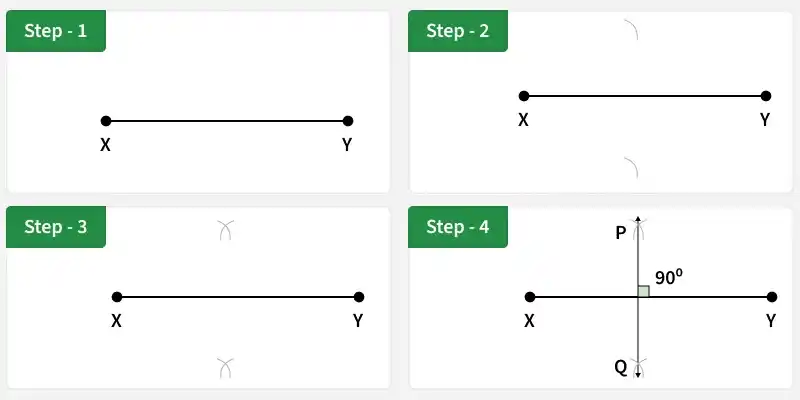
- Draw a line segment XY of any suitable length.
- With X as the centre and a radius more than half of XY, draw arcs above and below the line segment.
- With Y as the centre and the same radius, draw arcs to intersect the previous arcs.
- Mark the points of intersection as P and Q.
- Join P and Q. This line PQ is the perpendicular bisector of XY. It intersects XY at point O, which is the midpoint.
Equation for a Perpendicular Bisector
To find the equation of a perpendicular bisector of a line segment:
- Find the midpoint of the given line segment.
- Determine the slope of the line segment.
- Find the negative reciprocal of this slope (this is the slope of the perpendicular bisector).
- Use the point-slope form: y - y1 = m(x - x1) to write the equation using the midpoint.
**Learn More: **Equation of a Straight Line
Perpendicular Bisector in a Triangle
A perpendicular bisector of a triangle is a line that divides a side into two equal parts at its midpoint and is perpendicular (90°) to it. Each triangle has three such bisectors, one for each side. These bisectors intersect at a single point called the circumcenter, which is equidistant from all three vertices and acts as the centre of the circumcircle.
**Steps of Construction
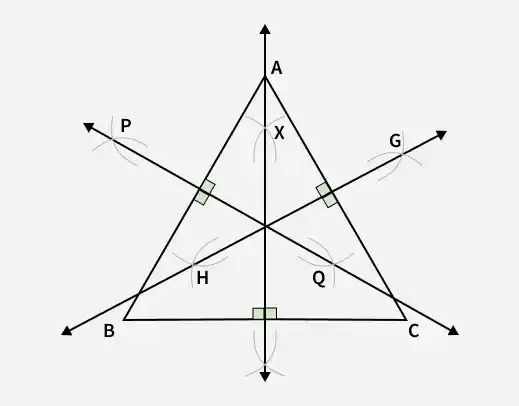
- Draw a triangle and label the vertices as A, B, and C.
- With B as the centre and a radius greater than half of BC, draw arcs above and below the side BC.
- With C as the centre and the same radius, draw arcs intersecting the previous arcs.
- Mark the points of intersection as X and Y, and join them to form the perpendicular bisector of BC.
- Repeat the same process for sides AB and AC.
- The three perpendicular bisectors intersect at a point called the circumcenter.
Perpendicular Bisector Theorem
The perpendicular bisector theorem states that any point lying on the perpendicular bisector of a line segment is equidistant from its endpoints.
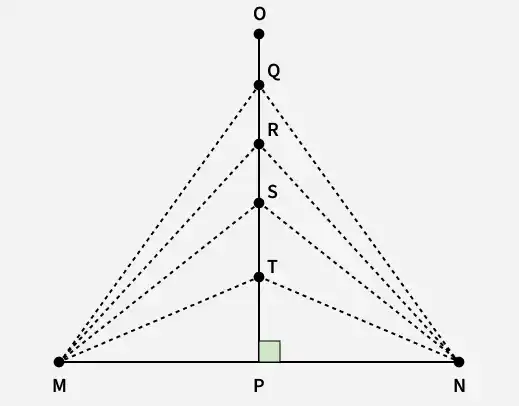
In the above figure, points Q, R, S, and T lie on the perpendicular bisector of line segment MN. Therefore:
- MQ = NQ
- MR = NR
- MS = NS
- MT = NT
This shows that every point on the perpendicular bisector is at an equal distance from both endpoints.
**Related Articles
Solved Examples
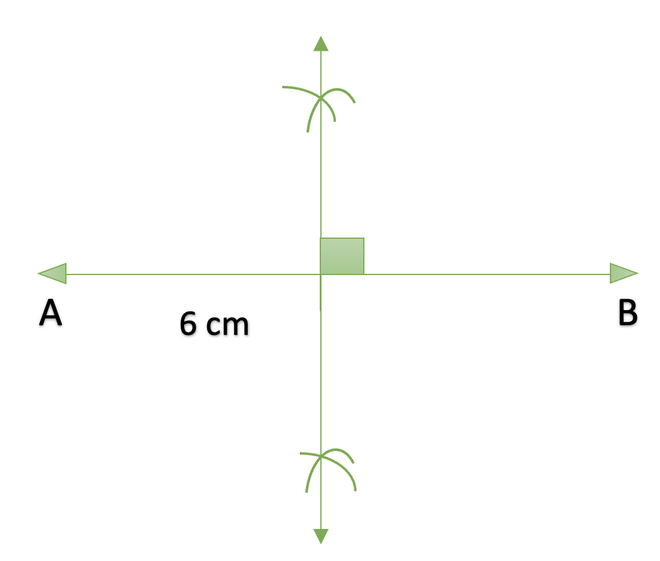
**Example 1. Draw a 6 cm line and construct a perpendicular bisector on it.
**Solution:
Below is the line of 6 cm with perpendicular bisector:
**Example 2. Draw a 10 cm line and construct a perpendicular bisector on it.
**Solution:
Below is the line of 10 cm with perpendicular bisector:

**Example 3. Draw an equilateral triangle and draw a perpendicular bisector for the sides of the triangle.
**Answer:
Below is the equilateral triangle with perpendicular bisector:

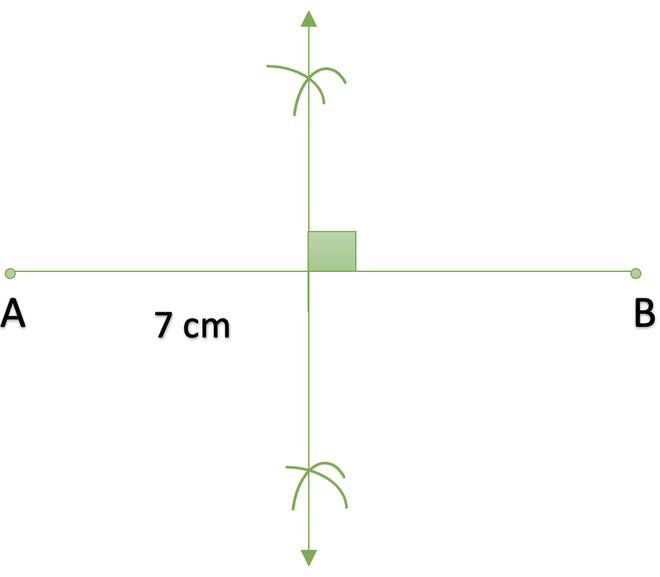
**Example 4. Draw a line segment of AB of 7cm and construct a perpendicular bisector on it.
**Solution:
Below is the line segment of 7 cm with perpendicular bisector:
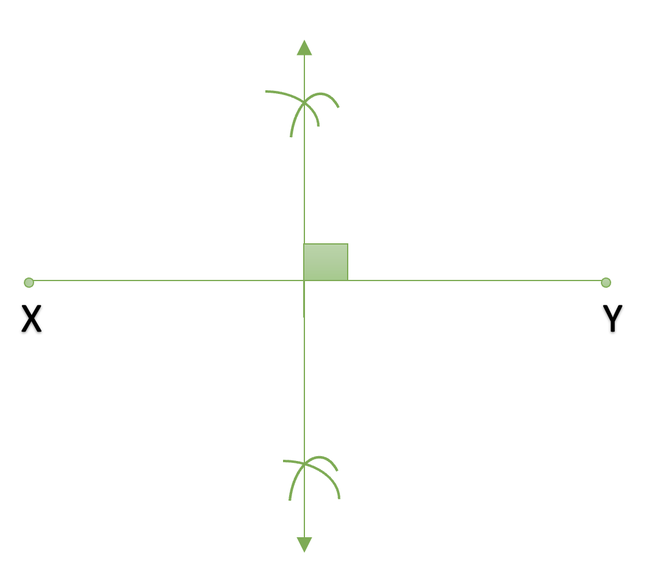
**Example 5. Draw a line segment and construct a perpendicular bisector on it.
**Solution:
Below is the line segment with perpendicular bisector:
**Example 6: Find the equation of the perpendicular bisector of a line segment with endpoints at (-3, 1) and (5, 7).
**Solution:
Step 1: Calculate the midpoint:
Midpoint = ((-3 + 5) / 2, (1 + 7) / 2) = (1, 4).
Step 2: Determine the slope of the line segment:
Slope (m) = (7 - 1) / (5 - (-3)) = 6/8 = 3/4.
Step 3: Find the negative reciprocal of the slope for the perpendicular bisector:
Perpendicular Bisector Slope = -4/3
Step 4: Use the midpoint (1, 4) and the calculated slope to write the equation of the perpendicular bisector:
y - (4) = -4/3x + 4/3
y = −4/3x + 4/3 + 4
y = −4/3x + 16/3
The equation of the perpendicular bisector is y = −4/3x + 16/3
Practice Problems
**Q1. Draw a 5 cm line and construct a perpendicular bisector on it.
**Q2. Draw a 9 cm line and construct a perpendicular bisector on it.
**Q3. Draw an equilateral triangle and draw a perpendicular bisector for the sides of the triangle.
**Q4. Draw a line segment of 10 cm and construct a perpendicular bisector on it.
**Q5. Draw a line segment of 6 cm and construct a perpendicular bisector on it.