Pie Chart (original) (raw)
Last Updated : 24 Oct, 2025
Apie chart is a popular and visually intuitive tool used in data representation, making complex information easier to understand at a glance.
This circular graph divides data into slices, each representing a proportion of the whole, allowing for a clear comparison of different categories, making it easier to digest complex information through a straightforward, intuitive format.
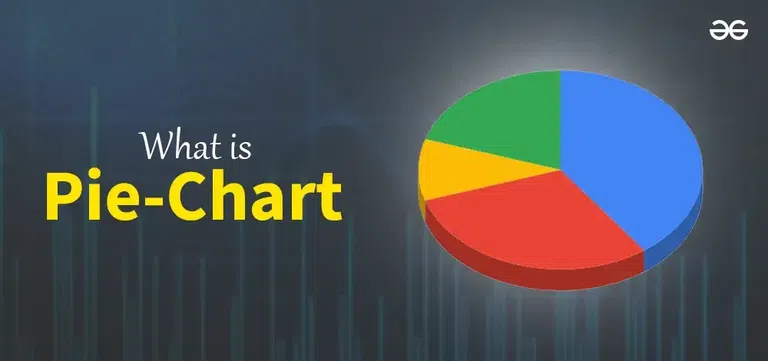
**For example, _if you want to see how much money you spend on different things like food, rent, and entertainment, a pie chart can show you this in an easy-to-understand way.
**Pie Chart Examples
In a class of 200 students, a survey was conducted to collect each student's favorite sport. The pie chart of the data is given below:
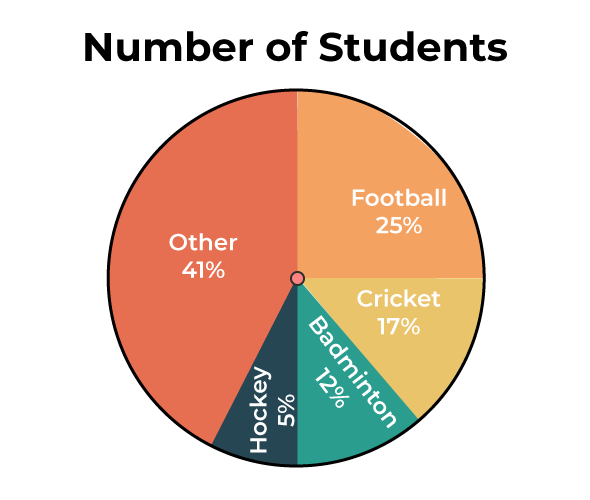
Since the pie chart is provided and the total number of students is given, we can easily take the original data out for each sport.
- **Cricket = 17/100 × 200 = 34 students
- **Football = 25/100 × 200 = 50 students
- **Badminton = 12/100 × 200 = 24 students
- **Hockey = 5/100 × 200 = 10 students
- **Other = 41/100 × 200 = 82 students
The original data for the pie chart shown above is given below:
| Sport | Number of Students |
|---|---|
| **Cricket | **34 |
| **Football | **50 |
| **Badminton | **24 |
| **Hockey | **10 |
| **Other | **82 |
Pie Chart Formula
The total value or percentage of the pie is always 100%. Here, it contains different sectors and segments in which each sector or segment of the chart corresponds to a certain portion of the net or total percentage (or data). The total or sum of all the data can be summed up to 360 degrees.
- Convert the data into degrees on a pie chart. The formula for a pie chart can be summed up as:
****(Given Data / Total Value of Data) × 360°**
- Calculate the percentage of each sector from the degrees in a pie chart.
**To work out with degrees in a pie chart, we need to follow the following steps:
- First, we need to measure every slice of the chart.
- Then, we need to divide it by 360°.
- Finally, multiply the obtained result by 100.
**The pie chart formula is given below:
(Frequency)/(Total Frequency) × 100
**Calculating the Number of Sectors on a Pie Chart
To calculate the total number of slices or sectors on a pie chart, we need to multiply the sector's percentage by the total value of the data and, finally, divide the result by 100.
Types of Pie Charts
There are various variations or types of pie charts. Some Common Types of Pie Chart Include-
- **3D Pie Chart: A 3D pie chart adds depth to the traditional two-dimensional pie chart by rendering it in three dimensions.
- **Doughnut Chart: A doughnut chart is similar to a pie chart but with a hole in the center.
- **Exploded Pie Chart: In an exploded pie chart, one or more slices are separated from the rest of the pie to emphasize their importance or to make them stand out.
- **Nested Pie Chart: Also known as a multi-level pie chart or hierarchical pie chart, this type of chart consists of multiple rings of pie charts, with each ring representing a different level of data hierarchy.
- **Ring Chart: Similar to a doughnut chart, but with multiple concentric rings representing different data categories. Each ring illustrates a separate dataset, allowing for layered comparison.
How to Create a Pie Chart?
We will learn how to create a pie chart step by step with the help of an example. A teacher surveyed a group of students to see what their favorite hobby of each student is. Let's take a look at the pie chart example with an explanation. The data collected is listed as follows:
| Hobbies | Number of students |
|---|---|
| Singing | 16 |
| Reading books | 20 |
| Dancing | 10 |
| Painting | 30 |
| Others | 24 |
Now, we will see how to construct a pie chart step by step.
**Step 1: The first step requires us to write down the available data in tabular form as follows:
| Singing | Reading Books | Dancing | Painting | Others |
|---|---|---|---|---|
| 16 | 20 | 10 | 30 | 24 |
**Step 2: Now, thesum of all the given data. Here, the Sum of All Data = (16 + 20 + 10 + 30 + 24) = 100
**Step 3: Now, calculate the percentage of each sector. We need to divide each sector value by the sum or total and then multiply it by 100.
| Singing | Reading Books | Dancing | Painting | Others |
|---|---|---|---|---|
| (16/100) × 100= 16% | (20/100) × 100= 20% | (10/100) × 100= 10% | (30/100) × 100= 30% | (24/100) × 100= 24% |
**Step 4: The Next step is to calculate the degrees corresponding to each slice of the Pie Chart. The values can be calculated as:
**Central Angle of Each Component = (Given Data / Total Value of Data) × 360
Hence,the values are as follows:
| Singing | Reading Books | Dancing | Painting | Others |
|---|---|---|---|---|
| (16/100) × 360= 57.6 | (20/100) × 360= 72 | (10/100) × 360= 36 | (30/100) × 360= 108 | (24/100) × 360= 86.4 |
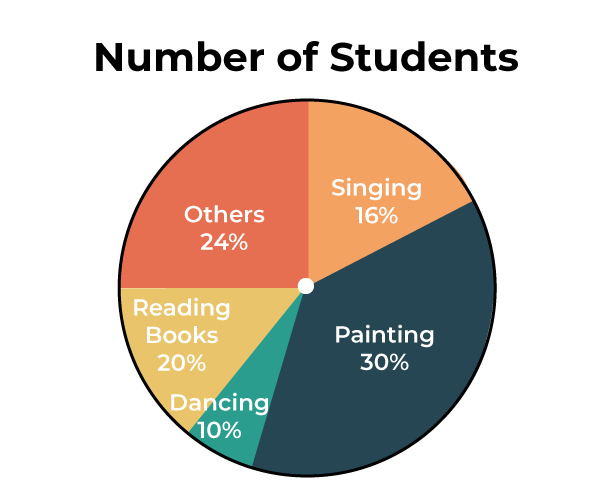
**Step 5: Now, with the help of a protractor, we will measure each angle from a single point or central point and draw the circle's sectors. The resultant pie chart will be:
How to Read a Pie Chart
In order to read a pie chart, the first thing to notice is the data presented in the pie chart. If the data is given in percentages, it should be converted accordingly in order to analyze and interpret the data. Let's take a look at an example to learn how to interpret pie charts.
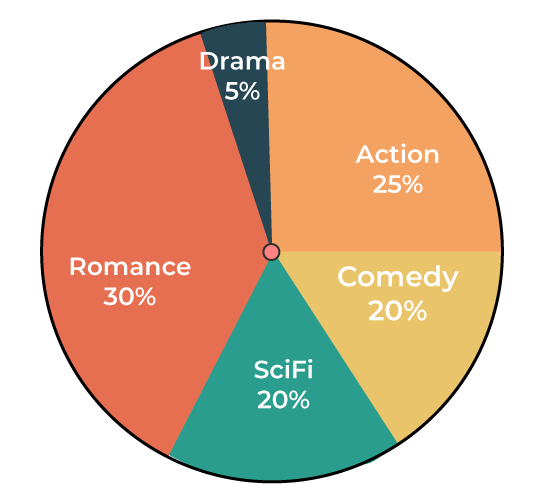
**Example: In a survey done among 300 people, it was observed which type of genre each person prefers. The pie chart of the same is mentioned below. Analyze and interpret the pie chart accordingly to find the original data.
**Solution:
While observing the pie chart, it came to notice that the data is present in percentage. Let's convert the data to obtain the original value.
- Number of people who like comedy = 20/100 × 300 = 60 people.
- Number of people who like action = 25/100 × 300 = 75 people.
- Number of people who like romance = 30/100 × 300 = 90 people.
- Number of people who like drama = 5/100 × 300 = 15 people.
- Number of people who like sci-fi = 20/100 × 300 = 60 people.
Pie Chart vs Bar Graph
The key differences between a pie chart and a bar graph are listed in the following table:
| Pie Chart | Bar Graph |
|---|---|
| Circular display of data | rectangular display of data |
| Shows parts of a whole | Compares discrete categories |
| Depicts percentages or proportions | Shows exact values or quantities. |
| Typically one variable | Can represent multiple variables. |
| Easily shows relative proportions | Effective for comparing quantities. |
| It might be difficult to compare precise values | Allows for easy comparison between categories. |
| Works well with simple datasets | Suitable for complex datasets |
| Provides a holistic view | Allows for detailed analysis. |
| Not efficient with large datasets | Efficient for displaying large datasets |
**Also Check:
Uses of Pie Chart
Whenever a fraction or fractions are represented as a part of the whole, pie charts are used. Pie charts are used to compare the data and to analyze which data is bigger or smaller. Hence, when dealing with discrete data, pie charts are preferred. Let's take a look at the uses of the pie chart:
- Pie charts are used to compare the profit and loss in businesses.
- In schools, the grades can be easily compared using a pie chart.
- The relative sizes of data can be compared using a pie chart.
- The marketing and sales data can be compared using a pie chart.
Solved Examples of Pie Chart
**Example 1: The given pie chart shows the subject of interest of each student in a class.
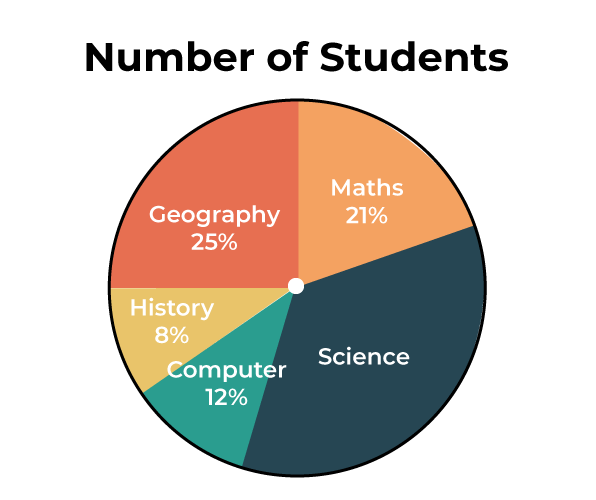
Answer the following question concerning the given pie diagram.
- If 30 students' subjects of interest are history, how many total students were surveyed?
- Which subject is liked the most?
- Which subject is disliked the most?
**Solution:
**1. According to the given question, 8% of the total number of students is 30. i.e. (8/100) x Total = 30
Therefore, Total = 30 x (100/8) = 375
Hence 375 students were surveyed.**2. According to the given pie chart, science is liked the most.
**3. According to the given pie chart, history is disliked the most.
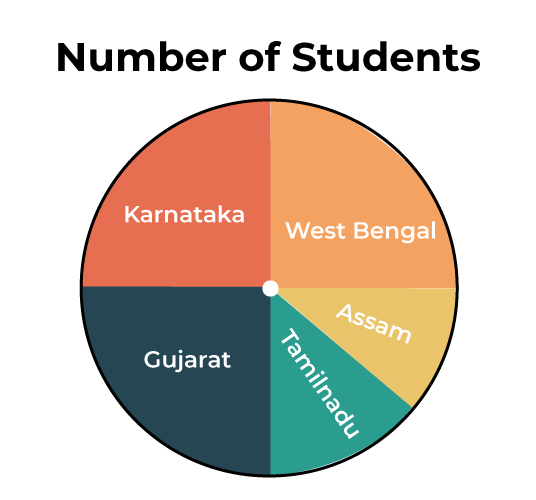
**Example 2: For a science camp, students from different states have enrolled. Construct a pie chart for the given table:
| States | Number of students |
|---|---|
| West Bengal | 10 |
| Assam | 5 |
| Tamil Nadu | 5 |
| Gujarat | 10 |
| Karnataka | 10 |
**Solution:
**Step 1: The first step requires us to jot down the available data into tabular form as follows:
West Bengal Assam Tamil Nadu Gujarat Karnataka 10 5 5 10 10 **Step 2: The next task is to calculate the sum of all the given data.
Here, the Sum of All Data = (10 + 5 + 5 + 10 + 10) = 40
**Step 3: Now, the next task is to calculate the percentage of each sector. We need to divide each sector value by the sum or total and then multiply it by 100.
West Bengal Assam Tamil Nadu Gujarat Karnataka (10/40) × 100= 25% (5/40) × 100= 12.5% (5/40) × 100= 12.5% (10/40) × 100= 25% (10/40) × 100= 25% **Step 4: Next step is to calculate the degrees corresponding to each slice. The values can be calculated as:
West Bengal Assam Tamil Nadu Gujarat Karnataka (10/40) × 360= 90 (5/40) × 360= 45 (5/40) × 360= 45 (10/40) × 360= 90 (10/40) × 360= 90 **Step 5: Now, with a protractor's help, we will measure each angle from a single point or central point and draw the circle's sectors. The resultant pie chart will be:
**Example 3: A pie chart is divided into four parts, and the values are given as x, 3x, 4x, and 4x. Find the value of x in degrees.
**Solution:
As it is known that a pie chart has 360°. Therefore, if all the angles are added, it will give 360°.
x + 3x + 4x + 4x = 360°
12x = 360°
x = 30°
A**rea Chart
A population pie chart represents the population distribution of a region or the world, as shown in the image below.

**Related Articles:
- Plot a pie chart in Python using Matplotlib
- Pie Diagrams | Meaning, Example and Steps to Construct
- How to create a Pie Chart using HTML & CSS
- How to Make a Pie Chart in Excel
- R – Pie Charts
- Real Life Applications of Pie Chart
- Chart.js Doughnut and Pie Charts
- How to add a Pie Chart into an Android Application
Practice Questions For Pie Chart
**Problem 1: A pie chart shows the distribution of students in a class based on their favorite subjects. The following percentages represent the number of students who prefer each subject:
- Math: 30%
- Science: 25%
- English: 20%
- History: 15%
- Art: 10%
**Question: If there are 200 students in the class, how many students prefer Science?
**Problem 2: A pie chart represents the market share of four companies in a specific industry. The percentages are:
- Company A: 45%
- Company B: 30%
- Company C: 15%
- Company D: 10%
**Question: What is the total market share of Company B and Company D combined?